
Why in news?
A new study measured carbon released from the exposed Aral Sea bed. Drying changed the lake from a carbon store into a major source. Its sediments released about 748 million tonnes of carbon dioxide since 1960. Researchers examined whether partial reflooding could prevent further emissions.
Background
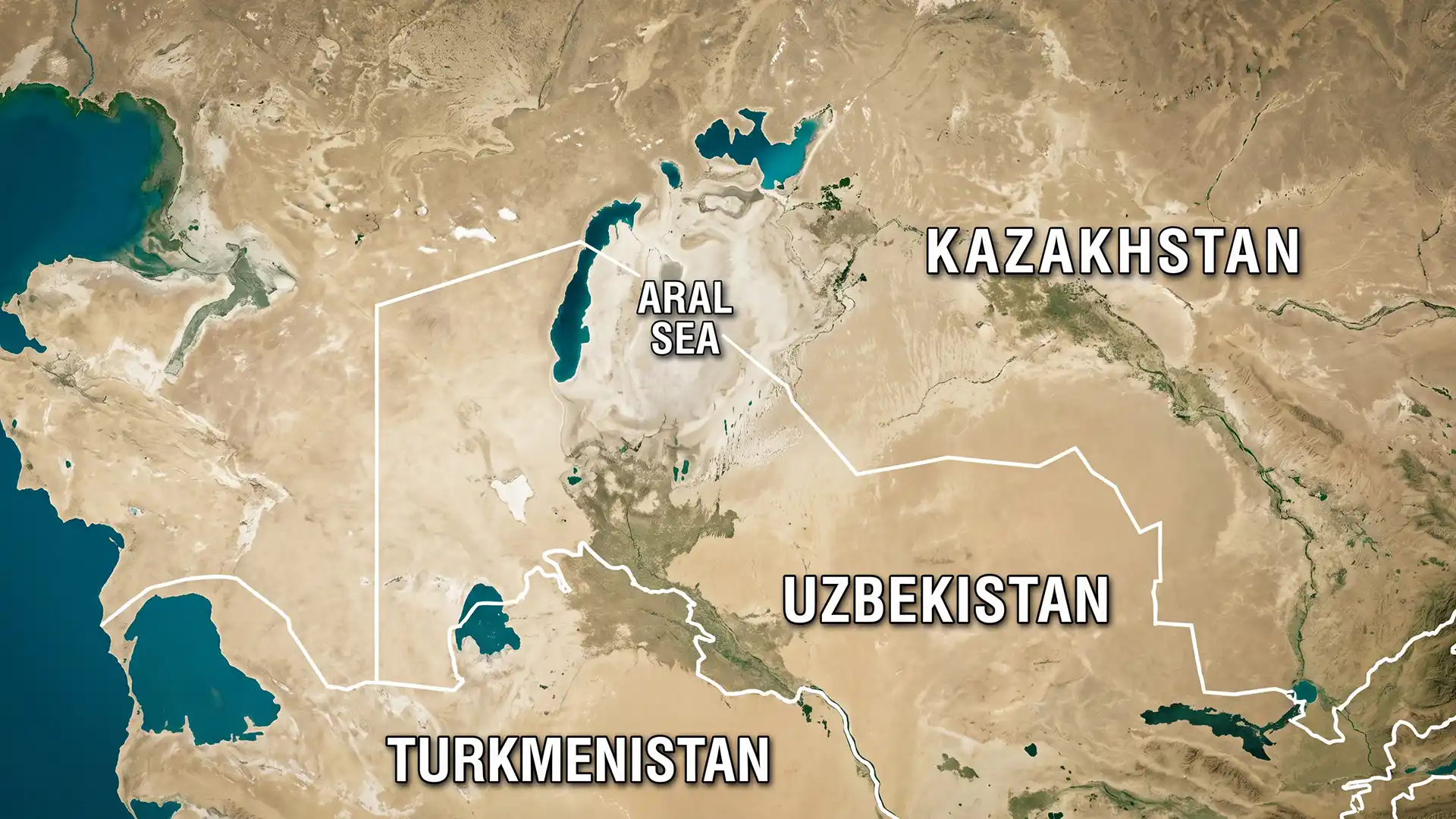
The Aral Sea was a large Central Asian inland lake between present-day Kazakhstan and Uzbekistan.
The name “sea” reflected its size, although this terminal lake had no ocean outlet.
The Syr Darya fed it from the northeast, while the Amu Darya entered from the south.
Evaporation balanced most incoming water under natural conditions.
Around 1960, its 68,000-square-kilometre area made it the world’s fourth-largest lake.
How did the Aral Sea shrink?
- Soviet planners greatly expanded irrigated farming in Central Asia.
- Canals diverted water from both main rivers towards agricultural fields.
- Cotton cultivation became a major user of the diverted water.
- River inflow fell far below the lake’s evaporation losses.
- The shoreline retreated and the remaining water became saltier.
- The lake divided into northern and southern water bodies.
- The southern part later separated into eastern and western basins.
The South Aral’s eastern lobe dried during 2014, although water sometimes returned after favourable flows.
The entire sea has not vanished, because small water bodies remain within the managed northern basin.
What environmental damage followed?
- Rising salinity destroyed much of the former commercial fishery.
- Ports became stranded many kilometres from the new shoreline.
- The exposed bed developed into the Aralkum Desert.
- Winds carried salt and contaminated dust across surrounding farmland.
- Dust exposure created serious risks for nearby communities.
- Loss of water produced harsher local seasons while damaging wetlands and delta ecosystems.
Drying allowed long-accumulated agricultural chemicals to travel again through windblown dust.
How can a lake store carbon?
Plants and organisms absorb carbon while growing, before their dead material settles into bottom mud.
Waterlogged sediments contain little oxygen, which slows microbes that normally decompose organic matter.
Carbon can consequently remain buried for long periods, making the sediment a carbon sink.
Drying exposes mud to oxygen and warmth, allowing microbes to release carbon dioxide from old organic matter.
The former sink consequently becomes a source of greenhouse gases.
What did the new study find?
For 1960–2022, scientists combined sediment cores and gas measurements with field observations and remote-sensing data.
They used surfaces exposed at different dates as stages within one long drying process.
This approach reconstructs change when continuous measurements from earlier decades do not exist.
However, compared sites may also differ because of local conditions unrelated to exposure age.
Sediment cores reveal buried carbon, while chamber measurements estimate present gas movement between soil and air.
Remote sensing maps the shoreline and scales local observations across the vast exposed bed.
They also compared surfaces exposed at different times.
The exposed sediments released about 748 million tonnes of carbon dioxide.
New vegetation offset under one percent, while exposed sediments could release another 605 million tonnes.
That projection depends on future moisture, temperature and restoration conditions.
Unit clarification: The study estimated about 204 teragrams of carbon already lost. One teragram equals one million tonnes, so this is not 204 tonnes. That carbon corresponds to roughly 748 million tonnes of carbon dioxide. These figures measure different chemical quantities and units.
Could reflooding reduce emissions?
Reflooding could cover exposed sediments, limit oxygen contact and slow further microbial decomposition.
Researchers valued possible avoided-emission benefits between 3.6 and 18 billion dollars.
This research estimate assumes suitable voluntary-market prices and does not guarantee restoration funding.
Any project requires basin-wide cooperation to secure water without harming existing Central Asian river users.
Has any part recovered?
Kazakhstan completed the World Bank-supported Kok-Aral Dam in 2005, retaining Syr Darya water in the northern basin.
Water levels rose and fisheries returned, but this success concerns only the northern basin.
The southern basins continue to face severe water and ecological problems.
Prelims link: The case joins irrigation policy, desertification, transboundary rivers and climate feedbacks. It also shows that ecosystem damage can release previously buried carbon.
Conclusion
The Aral disaster now carries a carbon cost alongside its older human and ecological losses.