
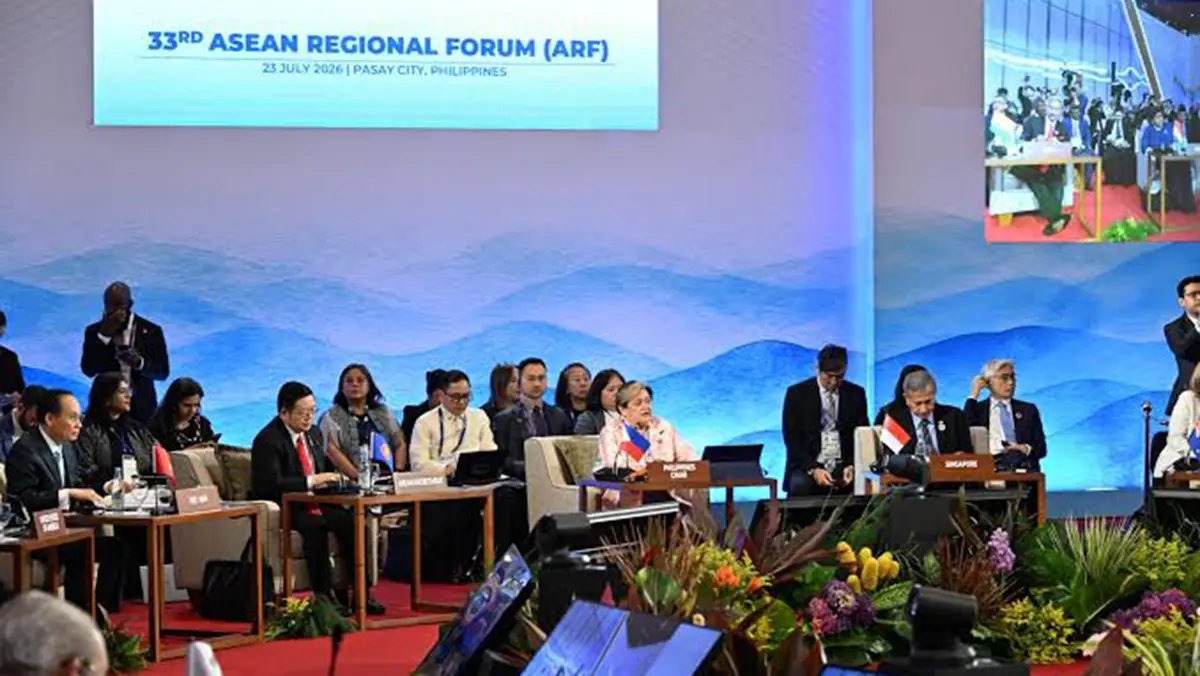
Why in news?
The 33rd ASEAN Regional Forum met in Manila on 23 July 2026. India’s External Affairs Minister represented the country at the ministerial meeting. He called for zero tolerance towards terrorism and its financing. He also stressed safe and open international shipping lanes.
Background
The Association of Southeast Asian Nations (ASEAN) leads several regional bodies, including its political-security dialogue platform.
This platform is the ASEAN Regional Forum (ARF).
ASEAN ministers agreed upon the Forum in July 1993, before its first Bangkok meeting on 25 July 1994.
Its participants include Southeast Asian states and important external powers.
Why was the Forum created?
After the Cold War changed Asia-Pacific relations, countries needed an inclusive place for regular political-security discussions.
Participants held different alliances and interests, but gradual dialogue could reduce misunderstanding and build cooperation.
Two official objectives
- Foster constructive dialogue on shared political and security concerns.
- Support confidence-building and preventive diplomacy across the region.
Confidence-building increases transparency and regular contact between governments.
Preventive diplomacy uses early consultation, mediation support and practical cooperation to stop disputes becoming violent.
Three-stage evolutionary approach
| Stage | Purpose |
|---|---|
| Stage I | Promote confidence-building measures among participants. |
| Stage II | Develop mechanisms for preventive diplomacy. |
| Stage III | Develop approaches for addressing conflicts. |
The Forum follows a gradual, non-confrontational pace, building trust before attempting more demanding cooperation.
How does ARF work?
- The ASEAN chair leads the Forum during that calendar year.
- Foreign ministers meet annually, while senior officials prepare discussions and follow-up work.
- Decisions generally require consensus, but cooperative activities continue between ministerial meetings.
- The ASEAN Secretariat supports this work through a dedicated ARF Unit.
Established during June 2004, the ARF Unit maintains records and supports the chair administratively.
Consensus brings both value and limits
| Benefit | Limitation |
|---|---|
| Every participant remains included. | One serious objection can block stronger language. |
| Dialogue can continue during political disagreement. | Decisions may become cautious or general. |
| Voluntary cooperation can build trust gradually. | The Forum lacks binding enforcement powers. |
Track I and Track II
Track I diplomacy involves government representatives, while Track II diplomacy involves scholars and policy experts.
Track II discussions test ideas freely, which governments may later consider through official channels.
Participants: an important 2026 change
The official page listed 27 participants before ministers admitted the United Kingdom as the 28th on 23 July.
The admission was an exception to the existing expansion moratorium.
Who are the 28 participants?
| Group | Participants |
|---|---|
| Eleven ASEAN members | Brunei, Cambodia, Indonesia, Laos, Malaysia, Myanmar, Philippines, Singapore, Thailand, Timor-Leste and Vietnam |
| Eleven dialogue partners | Australia, Canada, China, European Union, India, Japan, New Zealand, Republic of Korea, Russia, United Kingdom and United States |
| Six other participants | Bangladesh, North Korea, Mongolia, Pakistan, Papua New Guinea and Sri Lanka |
Timor-Leste became ASEAN’s eleventh member during October 2025, after already participating in ARF.
Therefore, its ASEAN entry did not increase the Forum’s total count.
India’s association
India became a sectoral dialogue partner during 1992, then a full dialogue partner and ARF participant during 1996.
India regularly joins Forum activities, supporting its Act East policy and wider Indo-Pacific engagement.
Main areas of cooperation
- Counter-terrorism work also addresses wider transnational crime.
- Maritime cooperation protects shipping, while disaster exercises improve emergency responses.
- Other work covers non-proliferation, disarmament and cybersecurity threats.
- Peacekeeping, defence confidence-building and preventive diplomacy reduce regional risks.
Work plans and inter-sessional meetings turn broad dialogue into practical activities.
Why maritime security receives attention
Major routes cross the Indian and Pacific oceans, making regional economies dependent upon uninterrupted maritime commerce.
Territorial disputes raise escalation risks, while piracy, smuggling and attacks threaten crews and cargo.
Dialogue can improve communication even without settling sovereignty disputes.
India’s terrorism message
India demanded zero tolerance towards terrorism, including coordinated action against financing, safe havens and cross-border support.
India also linked secure shipping lanes with economic stability, connecting continental and maritime security concerns.
Main outcomes of the 33rd meeting
- The Philippines chaired the ministerial meeting in Manila.
- Participants adopted a Manila Plan of Action guiding ARF work from 2026 to 2036.
- Ministers approved 2026–27 activities and discussed maritime security alongside emerging threats.
- The United Kingdom became the Forum’s 28th participant.
Do not confuse ASEAN-led security forums
| Mechanism | Main participants | Primary character |
|---|---|---|
| ASEAN Regional Forum | 28 broad regional participants | Inclusive political-security dialogue |
| East Asia Summit | ASEAN members and selected leaders | Leaders-led strategic cooperation |
| ASEAN Defence Ministers’ Meeting-Plus | ASEAN defence ministers and eight partners | Practical defence cooperation |
The three mechanisms overlap, but membership and functions differ.
Conclusion
ARF cannot enforce peace, but sustained dialogue can reduce mistrust and dangerous miscalculation.