
Why in news?
India and Indonesia concluded an agreement involving Astra Mk-I missiles. The agreement was announced during the Indian Prime Minister’s Indonesia visit. Indonesia became Astra’s first foreign customer, while the wider package also covered BrahMos cruise missiles.
Background
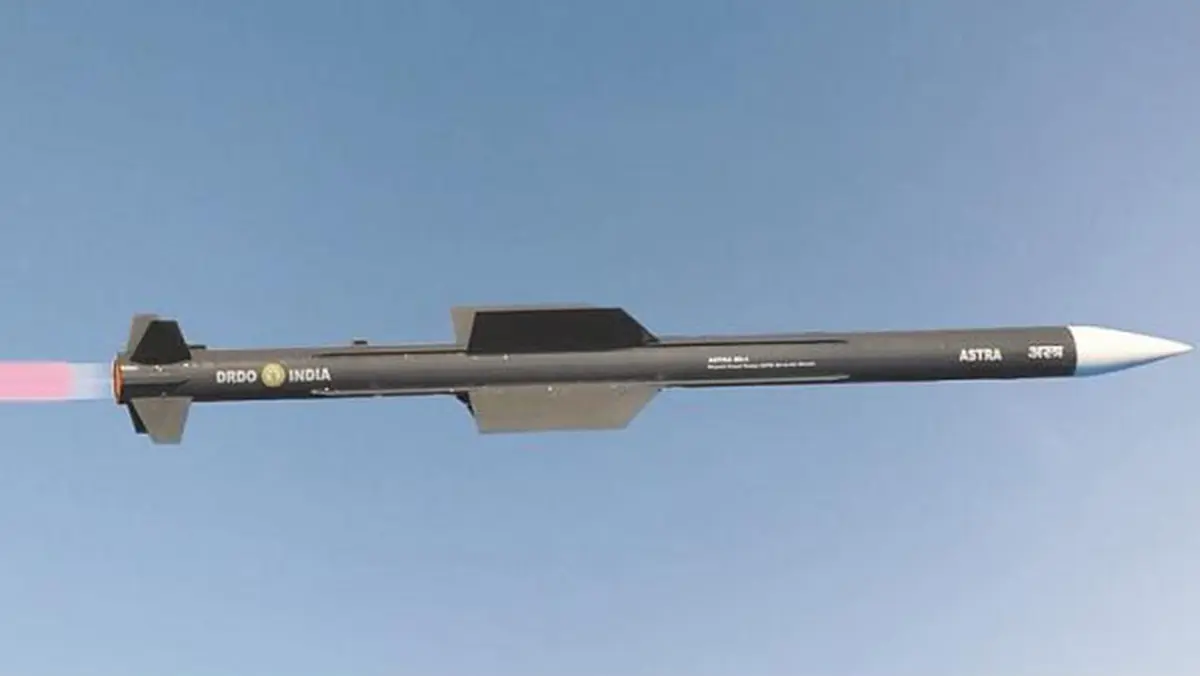
Astra Mk-I is an indigenous air-to-air missile developed by the Defence Research and Development Organisation. It serves the Indian Air Force, while Bharat Dynamics Limited is its principal production agency.
The missile belongs to the Beyond Visual Range Air-to-Air Missile category, and the common abbreviation is BVRAAM. Such a missile can engage an aircraft beyond the pilot’s direct visual range.
This capability lets the launching aircraft attack from a safer distance. It reduces the need to enter close-range aerial combat, and long-range detection and reliable target data remain essential.
Development and induction
DRDO developed Astra around requirements issued by the Indian Air Force. The programme involved several laboratories and flight-test agencies, and the Air Force supported trials and integration.
In May 2022, the Defence Ministry signed a major production contract, and Bharat Dynamics received the ₹2,971-crore order. It covered Astra Mk-I systems for the Air Force and Navy.
The contract used the Buy (Indian–IDDM) category, and IDDM means Indigenously Designed, Developed and Manufactured. DRDO had already transferred production technology to Bharat Dynamics.
Astra Mk-I is fully integrated with the Su-30MKI, and phased integration covers other aircraft, including Tejas. The Navy planned integration with the MiG-29K.
In March 2025, Astra was test-fired from a Tejas prototype, and it directly hit the flying target. The trial supported further Tejas Mk-1A integration work.
How the missile reaches its target
- Initial phase: An inertial navigation system guides the missile after launch.
- Middle phase: The aircraft can transmit updated target information during flight.
- Terminal phase: An active radar seeker detects and homes onto the target.
An active seeker carries its own radar transmitter and receiver. It reduces dependence on the launching aircraft during the final approach. Electronic counter-countermeasures help it operate amid hostile interference.
The missile uses smokeless solid propulsion, and DRDO’s export catalogue lists a launch range above 100 kilometres. Actual engagement distance changes with altitude, speed and target movement.
Why the Indonesia agreement matters
- Indonesia is the first overseas buyer of Astra missiles.
- The agreement opens an export market for an indigenous air-combat weapon.
- Astra can suit Indonesia’s Russian-origin Sukhoi fighter fleet.
- The sale supports India’s defence-export and Act East objectives.
- Training, maintenance and long-term support can deepen defence cooperation.
Astra and BrahMos are different
Astra is an air-to-air missile used against aircraft, and BrahMos is a supersonic cruise missile. It is mainly used against surface or land targets.
Astra is an Indian DRDO programme with domestic production, and BrahMos emerged from an India–Russia joint venture. The two systems should not be confused.
Conclusion
The Astra export agreement marks a major step for Indian defence manufacturing. Its first-customer status is especially important for Prelims. The missile also represents India’s shift from import dependence to system development.