
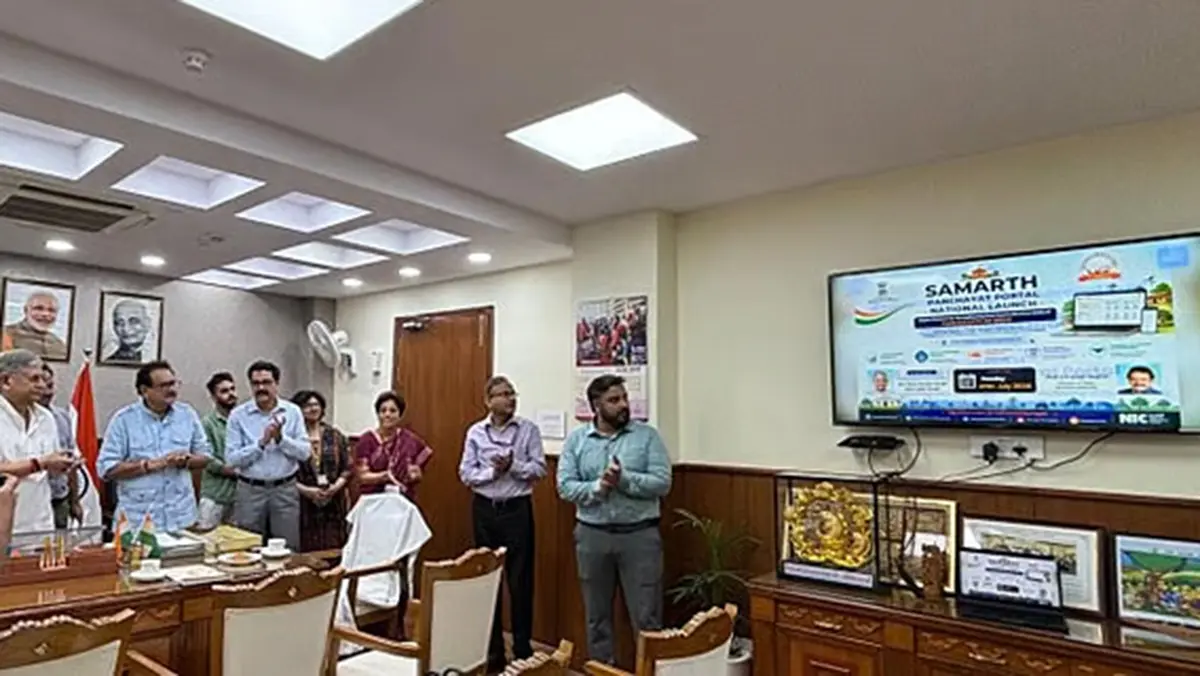
Why in news?
The Union Panchayati Raj Minister launched three linked initiatives on 27 July 2026. These included the Atmanirbhar Panchayat Programme and SAMARTH Panchayat Portal. The Ministry also released Model Own Source Revenue Rules. Together, they seek stronger and more financially independent rural local bodies.
Background
A panchayat is an elected rural local government institution, and it helps residents decide local priorities and monitor public services.
India has Gram Panchayats, intermediate Panchayats and district-level Panchayats.
States having populations not exceeding 20 lakh may omit the intermediate tier.
How constitutional panchayats developed
| Year | Development |
|---|---|
| 1957 | The Balwant Rai Mehta Committee recommended democratic decentralisation through elected local institutions. |
| 1959 | Rajasthan became the first state to inaugurate Panchayati Raj at Nagaur on 2 October. |
| 1992 | Parliament passed the Seventy-third Constitutional Amendment Act. |
| 1993 | The amendment took effect on 24 April and added Part IX. |
| 2026 | The new programme linked local assets with sustainable local revenue. |
The Eleventh Schedule lists 29 subjects connected with rural development.
Actual powers still depend on laws made by each state legislature.
Article 243H concerns panchayat taxation and related state grants.
What is Own Source Revenue?
Own Source Revenue (OSR) is money raised by a local body itself.
It differs from grants transferred by Union or state governments.
Possible sources include property tax, market fees and sanitation charges, while rent from community assets can also provide non-tax revenue.
What does the programme seek to do?
The Ministry of Panchayati Raj will help eligible panchayats prepare bankable projects.
A bankable project has a workable plan and a credible revenue model.
Projects may use local land, buildings, markets or other lawful opportunities.
The programme operates under the Rashtriya Gram Swaraj Abhiyan (RGSA).
Who can apply?
| Applicant | Minimum OSR threshold | Remaining tenure |
|---|---|---|
| Gram Panchayat | ₹50 lakh | At least three years |
| Block Panchayat | ₹1 crore | At least three years |
Special-category states receive relaxed revenue thresholds, and the remaining tenure gives enough time for planning and execution.
How will a project move forward?
- The panchayat first identifies an asset or local economic opportunity, and residents discuss the idea through the Gram Sabha process.
- The panchayat submits its proposal through the eGramSwaraj system, and state authorities screen proposals before the national challenge stage.
- Selected panchayats receive technical support for project preparation, and digital monitoring follows progress, finances and expected revenue.
The Gram Sabha includes registered voters within a village panchayat area, but it is different from the elected Gram Panchayat.
How can projects receive finance?
- Public-Private Partnerships may combine public assets with private expertise, and Corporate Social Responsibility contributions may support suitable facilities.
- Existing government schemes may converge around one project, and banks may finance projects with credible repayment capacity.
The National Bank for Agriculture and Rural Development is an institutional partner.
The Housing and Urban Development Corporation Limited is another partner.
How many projects are planned?
The programme targets 350 projects during four years.
- The first year will cover 50 projects, and each following year will cover 100 projects.
What is the SAMARTH Panchayat Portal?
SAMARTH is a unified national platform for managing panchayat revenue digitally, and the Ministry calls it a first-of-its-kind national initiative.
SAMARTH is the portal’s official name. The launch documents do not provide a longer expansion.
It covers taxpayer registration, demand notices, payments, collection and monitoring.
States can configure the platform according to their laws and revenue systems.
What had the portal recorded by launch?
- Chhattisgarh and Himachal Pradesh had already joined the portal, and more than 51 lakh taxpayers had been registered.
- Demand notices worth ₹95 crore had been generated, and collections had crossed ₹27 crore.
- Six more states were undergoing onboarding.
What are the Model OSR Rules?
The rules offer states a common framework for local revenue administration, covering assessment, collection, accounting and transparent management.
They include taxes, user charges, fees and other non-tax income.
However, these model rules are advisory, not binding central law.
States may adopt or adapt them within their existing legal systems.
Why does greater local revenue matter?
- Panchayats can maintain local assets without waiting for every grant, and reliable income can improve water, sanitation and market services.
- Local payment records can strengthen transparency and accountability, and better revenue may support longer planning horizons.
Safeguards remain necessary
- Gram Sabha approval should precede major asset decisions, and fees must remain lawful, fair and publicly explained.
- Contracts need open procurement and conflict checks, and revenue should finance genuine local public needs.
- Digital systems must protect taxpayer information.
Conclusion
The initiative can strengthen panchayats when revenue growth remains transparent and locally accountable.