Why in news?
On 28 March 2026 a massive avalanche struck the Zojila Pass near Zero Point on the Srinagar–Leh highway. The avalanche buried several vehicles and tragically killed at least seven people while injuring five. The Indian Army, Border Roads Organisation and local police launched rescue operations despite treacherous conditions.
Background
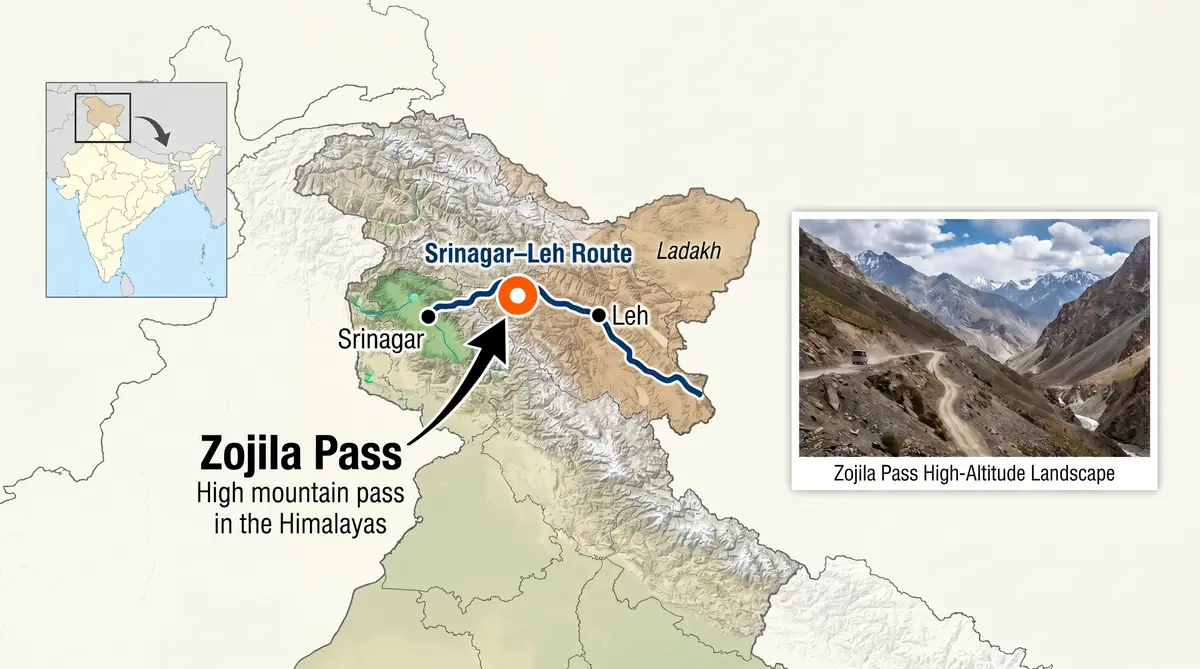
Zojila Pass, also spelled Zoji La, is a high mountain pass in the Greater Himalayas connecting the Kashmir Valley with Ladakh. At an elevation of about 3,528 m (11,575 ft) on National Highway 1, it is the lifeline linking Srinagar to Leh. The pass lies between the Kashmir Valley and Dras, acting as a gateway to the high plateau of Ladakh. Due to heavy snowfall and frequent blizzards, the pass is closed for several months each winter and reopens in spring after extensive snow clearance.
Why avalanches occur here
- High snow accumulation: Zojila receives heavy snowfall because moist westerly winds drop their load on the southern slopes of the Himalayas. Snow builds up on steep slopes above the highway.
- Unstable slopes: Warming temperatures in late winter and early spring destabilise the snowpack. Vibrations from traffic or natural triggers like rockfalls can release avalanches.
- Limited infrastructure: Despite continuous efforts by the Border Roads Organisation, the narrow pass lacks avalanche galleries or shelters, making travellers vulnerable.
- Climate variability: Climate change is altering precipitation patterns, increasing the frequency of extreme events such as avalanches and landslides across the Himalayan region.
Historical significance
The pass has strategic importance. During the 1947–48 war, Indian forces conducted Operation Bison to recapture Zojila from invaders, enabling them to drive towards Dras and Kargil. Today the road carries military supplies, civilians and tourists. Recent projects like the Zojila Tunnel aim to provide an all‑weather route and reduce the risks posed by snowfall.