Why in news?
Disruptions to shipping in the Bab al‑Mandab Strait due to armed attacks on merchant vessels in early 2026 caused crude‑oil flows through the waterway to fall by nearly half. The incident underscored the strategic importance of this narrow passage linking the Red Sea to the Indian Ocean.
Background
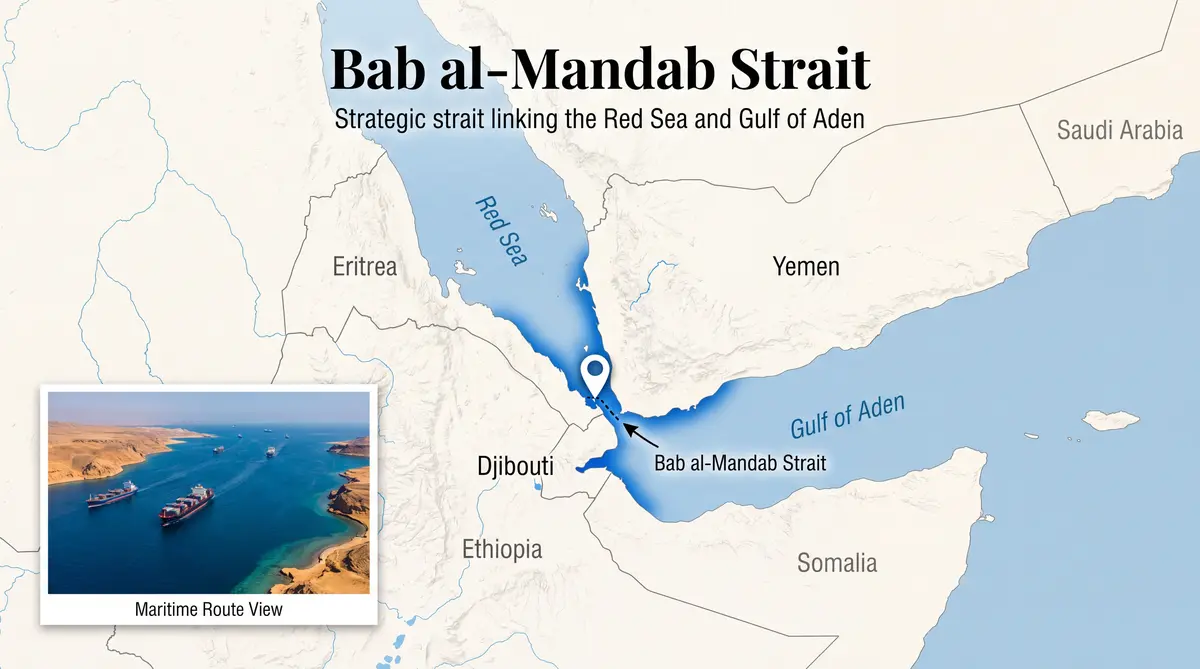
The Bab al‑Mandab Strait lies between Yemen on the Arabian Peninsula and Djibouti and Eritrea on the Horn of Africa. About 100 km long, it is one of the world’s most important maritime choke points. At its narrowest point the strait is only about 30 km wide and is split by volcanic Perim Island into two channels: a deep western channel used by most international shipping and a shallower eastern channel for smaller vessels. The strait connects the Red Sea to the Gulf of Aden and, via the Suez Canal, links Mediterranean trade routes to the Indian Ocean. Its strategic value grew after the Suez Canal opened in 1869. According to recent energy statistics, roughly 9.3 million barrels of oil and petroleum products passed through the strait each day in 2023—about 12 percent of global seaborne oil trade. Houthi attacks on shipping in 2024 and 2025 caused a sharp decline in traffic and prompted naval patrols.
Key points
- Geography: The strait separates the continents of Asia and Africa and opens onto the wider Indian Ocean. Perim Island divides it into two navigable channels.
- Strategic importance: It is a vital link for vessels transiting between Europe and Asia. Oil tankers, liquefied natural gas carriers and container ships depend on this route.
- Traffic volume: Before recent disruptions, about 6–7 percent of global trade by volume and 12 percent of seaborne oil passed through the strait. Closure or obstruction would force ships to detour around the Cape of Good Hope, increasing travel time and costs.
- Security challenges: Piracy, regional conflicts and militant attacks pose threats to shipping. International naval coalitions patrol the area to safeguard commerce.
Conclusion
The Bab al‑Mandab Strait is more than just a geographic feature—it is a linchpin of global trade and energy supply. Continued instability in the surrounding region highlights the need for collective efforts to secure this vital artery.
Source: Anadolu Agency