

Why in news?
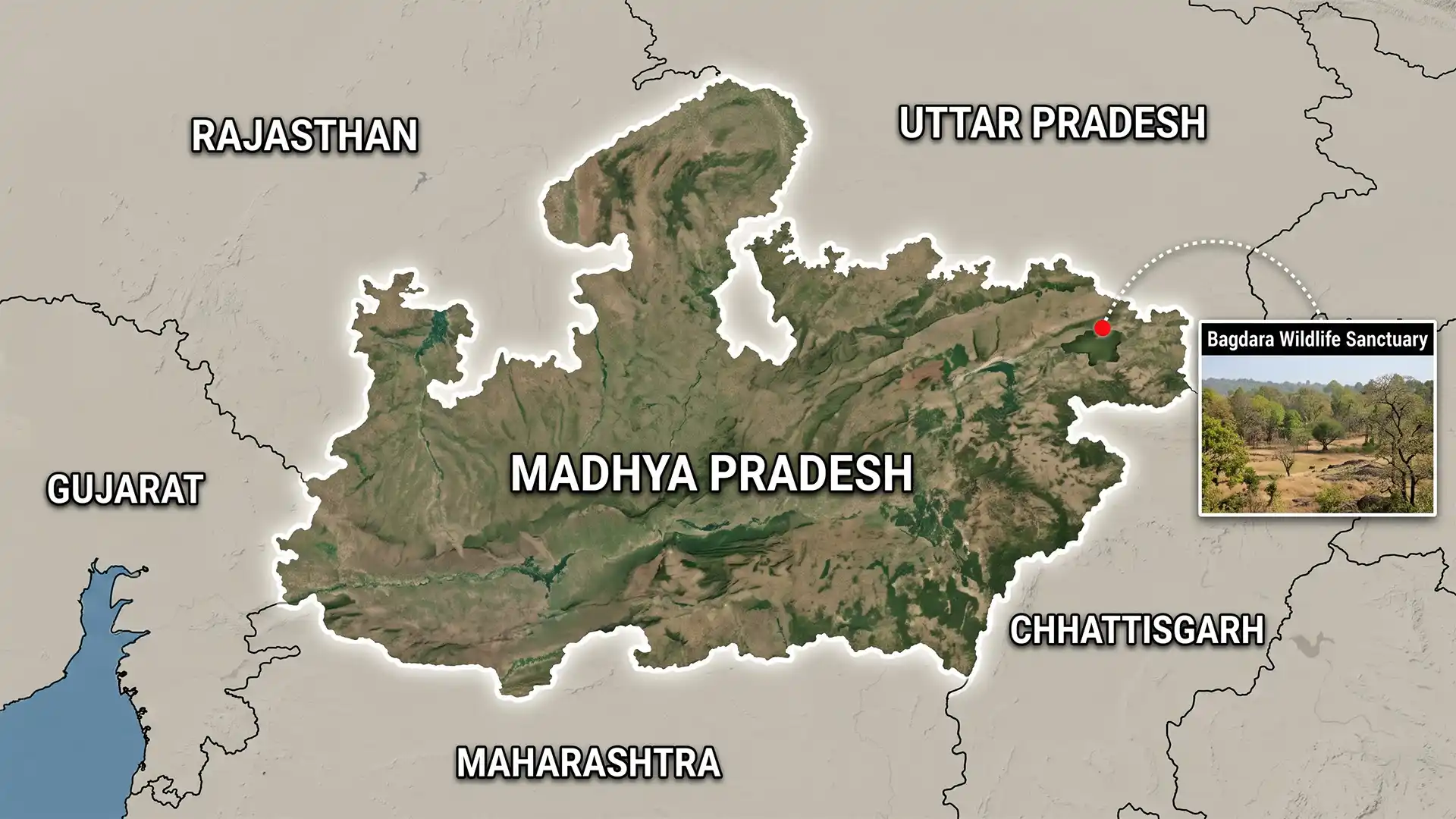
Madhya Pradesh proposed removing Bagdara Wildlife Sanctuary's protected status after citing local development difficulties.
The Standing Committee of the National Board for Wildlife considered the proposal on 9 July 2026.
It asked the state to examine landscapes that could receive a compensatory wildlife notification.
The sanctuary has not been denotified, and no compensatory site has received final approval.
Background
Bagdara Wildlife Sanctuary lies across the Sidhi and Singrauli districts of Madhya Pradesh.
It was established in 1978, mainly to conserve blackbuck and other local wildlife.
The Wildlife Institute of India records its notified area as 478 square kilometres.
The protected landscape contains forest patches, revenue land, settlements and village-use areas.
The Son River forms its southern boundary, linking Bagdara with the wider Vindhyan landscape.
Why did Madhya Pradesh seek denotification?
Wildlife-law controls apply to development and land transactions within a notified sanctuary.
The state said these approvals had caused difficulties and dissatisfaction among many residents.
Meeting records described about 64 villages and a population exceeding 32,000 within the sanctuary.
They also described roughly 230 square kilometres of forest and 246 square kilometres of revenue land.
These rounded component figures do not exactly equal the sanctuary's official 478-square-kilometre area.
The National Tiger Conservation Authority considered the forest fragmented and heavily affected by habitation.
It therefore advised identifying another landscape with stronger long-term conservation potential.
What did the Standing Committee suggest?
The committee suggested examining the Balaghat landscape east of Kanha Tiger Reserve.
This area lies within the broader landscape connecting Kanha and Pench tiger reserves.
It also mentioned land between Sanjay-Dubri and Bandhavgarh tiger reserves as another option.
These references began further examination and did not select or notify any replacement sanctuary.
Ecological and governance issues
Blackbuck generally favour open grassland and scrub rather than closed, dense forest interiors.
Bagdara also supports dry-deciduous habitats used by sambar, jackal, hyena and wild boar.
Fragmentation can restrict wildlife movement and weaken ecological links between surviving habitat patches.
However, changing protection also affects residents, land rights and future development controls.
A credible decision therefore needs ecological surveys, local consultation and clear legal safeguards.
Prelims focus
- Bagdara Wildlife Sanctuary is located in Madhya Pradesh, not neighbouring Uttar Pradesh.
- It is associated with Sidhi, Singrauli, blackbuck and the Son River landscape.
- The National Board for Wildlife is constituted under the Wild Life (Protection) Act, 1972.
- Its Standing Committee is chaired by the Union Environment Minister.
- Compensatory notification differs from plantation-based compensatory afforestation under forest-clearance rules.
Conclusion
Bagdara's case requires balancing resident concerns with transparent, science-based protection of functional wildlife landscapes.