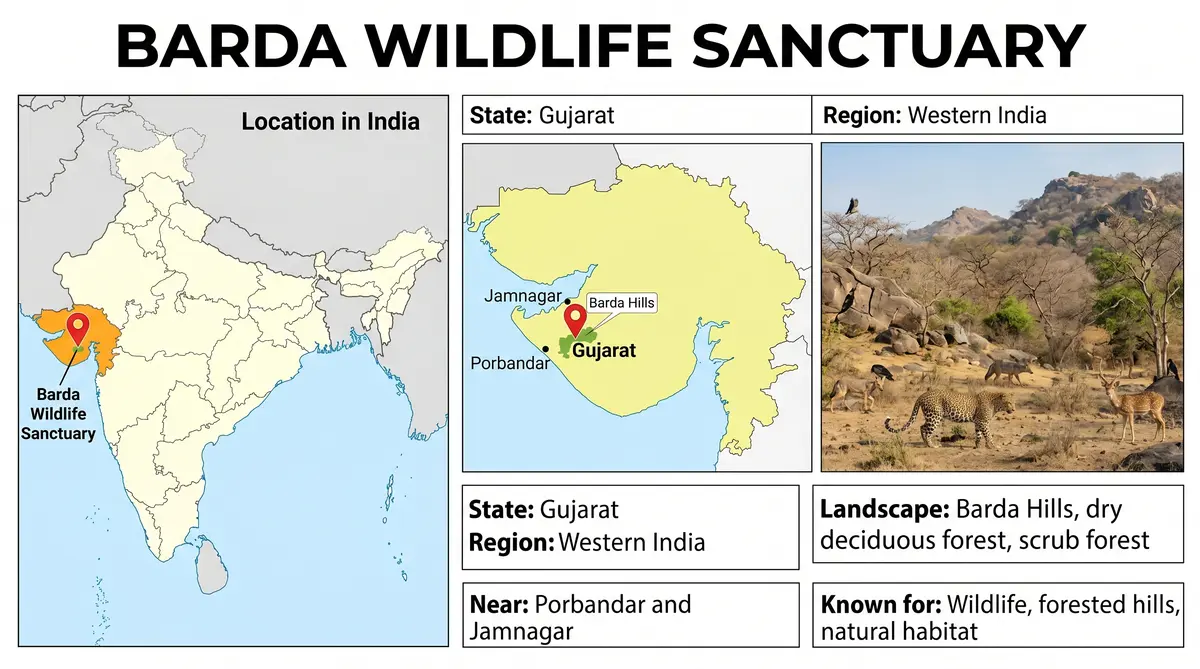
Why in News? The Gujarat government has declared Barda Wildlife Sanctuary a second habitat for Asiatic lions. Recent surveys recorded 17 lions, including several cubs, living in the sanctuary, making it a satellite population under Project Lion.
Background
Asiatic lions (Panthera leo persica) once roamed across India and West Asia, but by the early twentieth century their numbers had fallen to fewer than fifty individuals. Today all wild Asiatic lions live in and around Gir National Park in Gujarat. This concentration poses a serious risk: a disease outbreak, natural disaster or human‑wildlife conflict could wipe out the entire species. In 2018, a canine distemper virus outbreak killed 28 lions in Gir within weeks, underscoring the need for a backup habitat.
Barda Wildlife Sanctuary is located about 100 kilometres west of Gir, near Porbandar. It was a private hunting reserve until being declared a sanctuary in 1979. The landscape comprises semi‑arid hills, dry deciduous forests and thorn scrub. Historically lions lived in the area but disappeared by the late nineteenth century.
Building a Second Lion Population
- Natural recolonisation and translocation: After years of habitat restoration, a male lion wandered into Barda in 2023. Wildlife managers then translocated five lionesses from Gir under scientific supervision. The pride bred naturally, producing eleven cubs, and by 2025 there were 17 lions in Barda.
- Satellite Population 8: Barda has been designated “Satellite Population 8” under Project Lion, a ten‑year ₹2,927‑crore programme launched in 2020 to conserve Asiatic lions. It is the first fully protected satellite habitat for lions within Gujarat.
- Prey augmentation: Early surveys found only about 119 spotted deer (chital) in the sanctuary’s 192 km² area. To prevent lions from attacking livestock, the forest department relocated deer from Gir using the African Boma technique, which gently funnels animals into relocation pens. Increasing the prey base is crucial for sustaining a growing lion population.
- Genetic diversity: Decades of isolation have left Asiatic lions with low genetic diversity, making them susceptible to disease. Wildlife biologists use satellite tracking and selective relocations to maximise genetic mixing between Gir and Barda populations.
- Community engagement: The Project Lion plan includes constructing elevated platforms (machans) for farmers, building protective walls around open wells, employing rescue teams and promoting eco‑tourism. On World Lion Day 2025, Gujarat announced ₹180 crore for developing Barda, including a safari park.
Conclusion
Barda Wildlife Sanctuary offers a vital lifeline for Asiatic lions. Establishing a second, self‑sustaining population reduces the risk of catastrophic loss and allows the species to expand beyond its current range. Success will depend on enhancing the prey base, managing human‑wildlife interactions and ensuring genetic diversity. Project Lion demonstrates how careful planning and community involvement can secure the future of India’s iconic big cat.
Sources: India Today feature on Barda