
Why in News?
A study by the Wildlife Institute of India has documented a breeding population of barn swallows (Hirundo rustica) living year‑round in Manipur’s Imphal Valley. Traditionally known as long‑distance migrants, these birds appear to have settled permanently, suggesting that climate change and local conditions are altering migratory behaviour.
Background
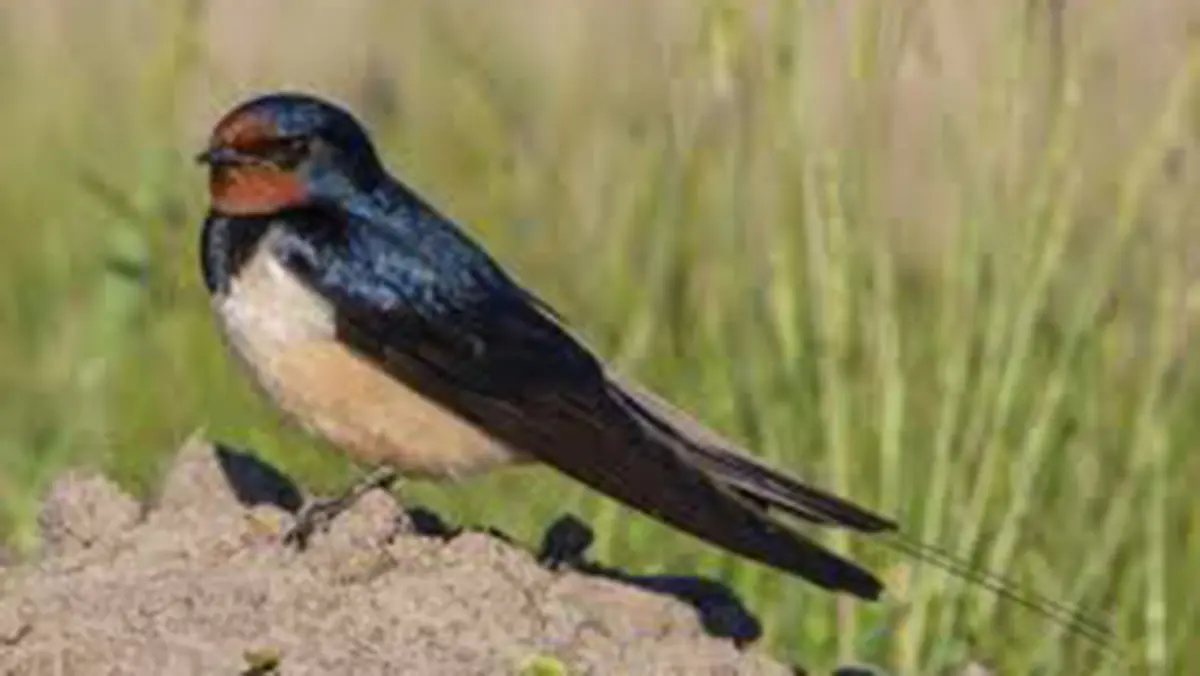
The barn swallow is one of the world’s most widespread passerine birds. Breeding across the temperate Northern Hemisphere, it migrates to the Southern Hemisphere during the non‑breeding season. The species is noted for its forked tail, glossy blue‑black upperparts and cinnamon underparts. While barn swallows occasionally breed south of their typical range, permanent residency is uncommon.
Researchers conducted surveys in 2022–23 across nearly 50 houses and other structures in Manipur’s Imphal Valley. They ringed 45 individuals and monitored nests throughout the year. Observations revealed that pairs were breeding in both spring and autumn, indicating that the population no longer migrates. This resident population may be a result of local warming, agricultural landscapes that provide abundant insects, and reduced predation.
Key Findings of the Study
- Permanent residency: Colour‑ringed birds were re‑sighted in the same locations months after banding, proving that they did not undertake long migration.
- Mixed subspecies traits: The birds exhibit morphological characteristics intermediate between subspecies, suggesting that they may be hybrids or represent an evolutionary transition.
- Breeding behaviour: Multiple broods were observed annually, with nests built on man‑made structures such as verandas and utility poles.
- Cultural significance: Locals call the bird “Sambrang” and associate it with Goddess Lakshmi, encouraging people to protect nests. This cultural reverence helps safeguard breeding sites.
About the Barn Swallow
- Distribution: The species breeds across Europe, Asia and North America and winters in Africa, South America and southern Asia. It prefers open habitats such as fields, meadows, marshes and coastal areas.
- Size and appearance: Adults measure about 15–19 cm long with a wingspan of 32–34 cm. They have iridescent blue‑black upperparts and a deeply forked tail with white spots.
- Conservation status: The International Union for Conservation of Nature (IUCN) lists the barn swallow as Least Concern, but local populations may be affected by habitat change.
Significance
- Documenting a resident population in Manipur broadens our understanding of how migratory species respond to climate change and human‑modified landscapes.
- The study underscores the value of community involvement; local respect for the “Sambrang” has helped protect nests and foster coexistence.
- Further research could clarify whether this population represents a new subspecies or a hybrid zone, contributing to avian evolutionary studies.
Conclusion
The discovery of resident barn swallows in Manipur illustrates that even well‑known migratory birds can adapt to changing conditions. It also highlights the need to monitor shifting wildlife behaviours as indicators of environmental change.
Source: TH

