
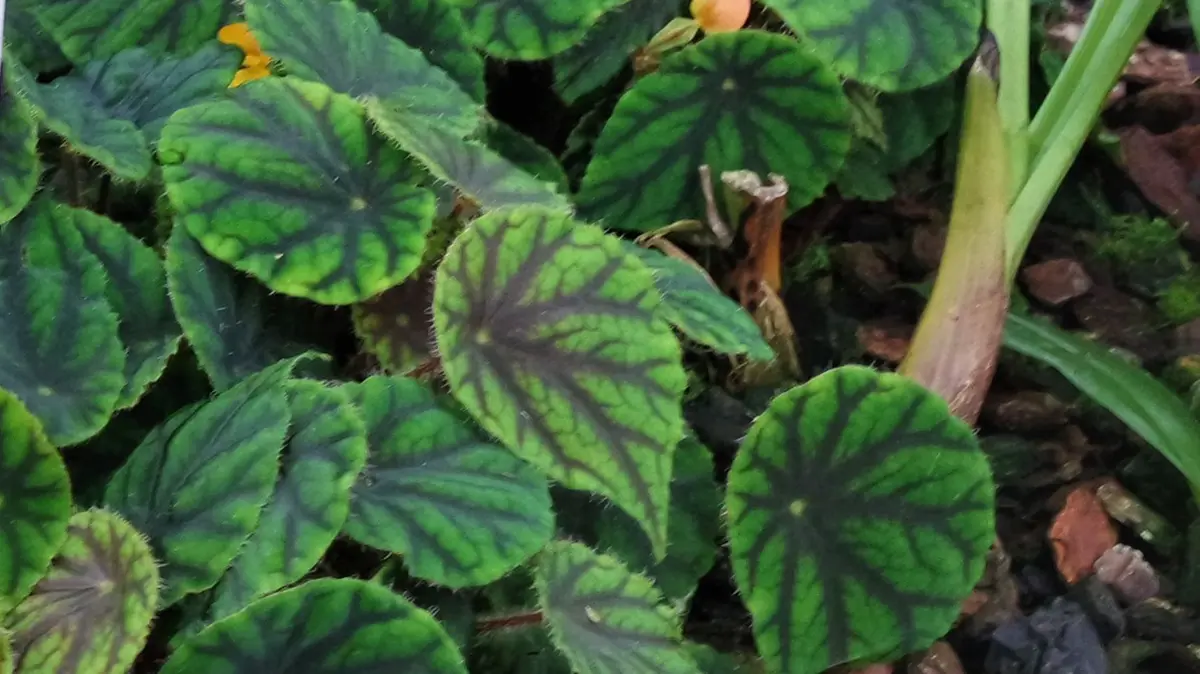
Why in news?
Botanists described a new plant species from Arunachal Pradesh. Their paper appeared on 7 July 2026. Surveys found about eleven mature plants in two small groups. The discovery highlights rich biodiversity and an extremely narrow known range.
Background
Begonia quadricornualata is a newly described flowering plant, and it belongs to the family Begoniaceae and the large genus Begonia.
Begonias commonly grow in humid, shaded places, and many species have unequal leaf halves, soft stems and colourful flowers.
A “new species” is new to scientific description, and it does not mean that the plant evolved recently.
Where was the plant found?
Botanical Survey of India researchers found it at Senki View in Papum Pare district. The site borders Itanagar Wildlife Sanctuary.
The plant grew on moist soil near forest streams, and shade, flowing water and high humidity created a suitable microhabitat.
This area lies near the meeting zone of the Himalaya and Indo-Burma biodiversity hotspots.
A biodiversity hotspot has exceptional native species and severe habitat loss, and such areas receive high global conservation priority.
How did the discovery develop?
- Researchers encountered the plant during routine botanical documentation.
- They repeatedly monitored its small population between 2019 and 2025.
- They compared its flowers, leaves, hairs and fruits with related species.
- The formal description appeared in the Nordic Journal of Botany in July 2026.
Rohan Maity, Umeshkumar Tiwari and Sudhansu Sekhar Dash authored the study. Their work raises Arunachal Pradesh’s recorded begonia count to fifty.
Why was it recognised as a separate species?
Taxonomists identify species through a complete combination of characters, and one unusual feature alone is normally insufficient.
- The upright plant bears delicate white or pinkish flowers.
- Female plants carry dense, stiff, reddish-brown hairs.
- Leaf stalks can reach about fifty centimetres.
- A female plant generally produces one flower at a time.
- Its developing fruit has four clear horn-like projections.
- The mature fruit carries four wings and reddish-brown woolly hairs.
Its long leaf stalks help separate it from close relatives, and these include Begonia handelii and Begonia tessaricarpa.
What does its name mean?
The name combines Latin words connected with four horns and wings. It refers to the plant’s unusual ovary and fruit.
The ovary first shows four horn-like structures, and these structures become four wings as the fruit matures.
Remember: The four-winged fruit gives this species its name, and its known site lies beside Itanagar Wildlife Sanctuary.
How rare is it?
Researchers found only two small subpopulations, and together, they contained about eleven mature individuals during the monitoring period.
However, the wider landscape has not received complete surveys, and more plants may survive in similar, inaccessible stream habitats.
The researchers therefore assessed the species as Data Deficient, and this indicates inadequate information for a confident extinction-risk category.
Status caution: The paper’s assessment is not proof of a published global Red List entry. Data Deficient also does not mean safe.
Which threats affect the known site?
- Road expansion can remove plants and alter stream drainage.
- Livestock grazing can damage soft stems and compact wet soil.
- Invasive weeds can occupy the plant’s narrow habitat.
- Small populations remain vulnerable to landslides and random events.
- Unplanned collection could remove a large population share.
Why does the finding matter?
Northeast India still contains many poorly documented habitats, and field taxonomy reveals species before development or disturbance removes them.
The finding also supports careful surveys around protected-area boundaries, and a species can depend upon habitat lying outside formal protection.
Researchers should map additional stream valleys and study pollination, and seed production and genetic variation also need investigation.
Conclusion
This four-winged begonia shows the value of patient fieldwork, and protecting its stream habitat should accompany wider surveys and monitoring.