
Why in news?
India and Belgium held their first Strategic Dialogue in Brussels. The meeting took place on 15 July 2026. Ministers discussed trade, technology, energy, security and global issues. Both sides agreed to build a more structured partnership.
Background
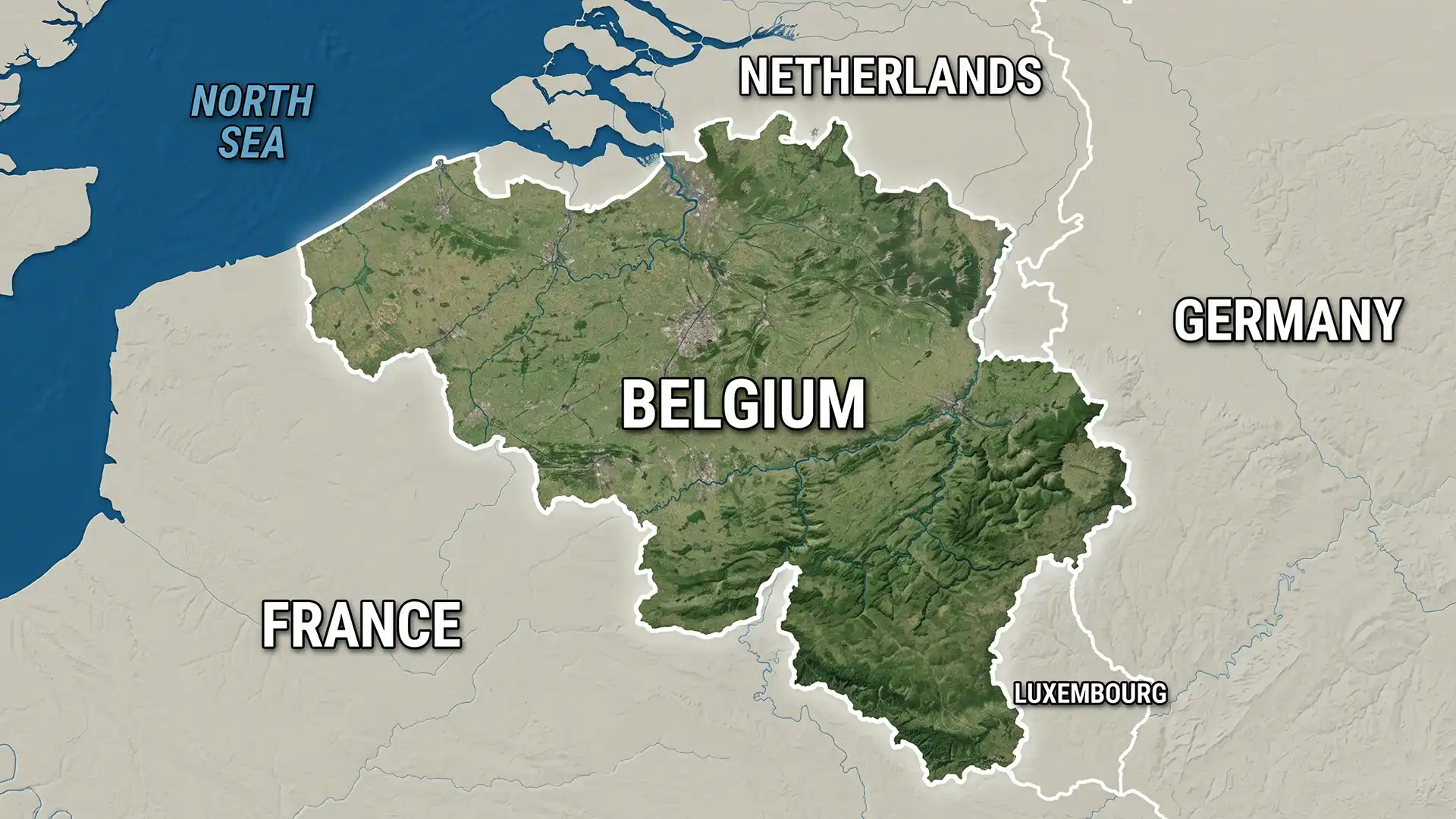
Belgium is a small western European country; its capital is Brussels and its currency is the euro.
The Netherlands lies to its north and Germany lies to its east.
Luxembourg borders the southeast and France lies south and west; Belgium has a short North Sea coastline.
Its location made it an important European centre for trade, transport and diplomacy.
What are Belgium’s main physical features?
Belgium has three broad geographical regions; its lower coastal plain contains dunes, reclaimed land and flat farmland.
The central plateau has gently rising land, fertile soils and major cities.
The Ardennes in the southeast has forested hills and thinner soils.
Signal de Botrange is Belgium’s highest natural point, at 694 metres.
The Scheldt and Meuse are its two most important river systems.
The Yser is another notable river reaching the North Sea.
How did modern Belgium emerge?
- The area formed part of several European kingdoms and empires.
- The Congress of Vienna joined it with the Netherlands in 1815.
- Religious, political and economic tensions later increased.
- The Belgian Revolution began in Brussels in 1830 and led to separation and independence.
- A liberal constitution and monarchy followed in 1831; later reforms gradually created a federation.
- The present federal structure developed through reforms between 1970 and 1993.
Belgium is now a federal constitutional monarchy with a parliamentary system.
The monarch serves as head of state, while elected institutions exercise government authority.
Why does Belgium have Regions and Communities?
Belgium contains Dutch-speaking, French-speaking and German-speaking populations; Dutch, French and German are its official languages.
Its federal system divides powers among territorial and language bodies; the three Regions are Flemish, Walloon and Brussels-Capital.
Regions handle territorial matters, including economy and planning; the three Communities are Flemish, French and German-speaking.
Communities handle language-related matters, including culture and education; Regions and Communities are not identical categories.
Prelims point: Belgium has three Regions, three Communities and three official languages.
Why is Brussels internationally important?
Brussels hosts major European Union institutions; the European Union is shortened to EU.
The European Commission and European Council conduct much of their work there.
The North Atlantic Treaty Organization, shortened to NATO, also has its headquarters in Brussels.
Accuracy note: NATO has a Brussels headquarters; the EU has no single official headquarters.
Important EU institutions work in Brussels, Strasbourg and Luxembourg; calling Brussels the EU’s sole headquarters is therefore misleading.
How did India–Belgium relations develop?
- India became independent on 15 August 1947; Belgium established diplomatic relations about one month later.
- It was among the first European countries to do so.
- Trade grew around diamonds, chemicals, machinery and pharmaceuticals, while research and technology links also expanded.
- A Belgian Economic Mission visited India in March 2025; the first Strategic Dialogue followed in July 2026.
Antwerp is an important global diamond trading centre; Indian diamond businesses have longstanding links with the city.
Economic relations now extend well beyond this traditional sector.
Who led the first Strategic Dialogue?
External Affairs Minister S. Jaishankar represented India.
Belgian Deputy Prime Minister and Foreign Minister Maxime Prévot represented Belgium.
They co-chaired the 15 July 2026 meeting, creating a high-level mechanism for regular strategic discussion.
It did not create a military alliance or legally binding treaty.
What did the two sides discuss?
- Trade and investment: Both sides considered ways to expand business links.
- Green transition: Talks covered cleaner energy and low-carbon technologies.
- Innovation: Research, digital systems and emerging technologies received attention.
- Connectivity: Better transport and commercial links can support trade.
- Defence: Ministers discussed industrial and security cooperation.
- Global issues: They exchanged views on regional and international developments.
- People links: Education, mobility and cultural exchanges can deepen relations.
Both countries supported stronger multilateral cooperation; Belgium’s EU position gives the relationship wider European importance.
What happened at the business forum?
An EU–India Business Forum was held in Brussels on the same day.
The Federation of Belgian Enterprises hosted the event, where representatives discussed trade, investment and supply chains.
The meeting followed the conclusion of EU–India free trade negotiations in 2026.
A Free Trade Agreement is shortened to FTA; such agreements can reduce trade barriers and improve market access.
Status matters: Concluded negotiations do not mean immediate application; legal review, signature and approval steps remain.
Why is Belgium useful for India?
- Belgium offers access to major European institutions and policy discussions.
- Antwerp provides strong trade, port and logistics connections.
- Belgian firms have expertise in clean technology, chemicals and advanced manufacturing.
- Universities and research centres can support innovation partnerships.
- Closer ties can strengthen India’s engagement with the wider EU.
Why is India useful for Belgium?
- India offers a large market and expanding industrial capacity.
- Indian companies can support technology, pharmaceuticals and skilled services.
- India provides an important partner for diversified supply chains.
- Its diplomatic weight matters in global and Indo-Pacific discussions.
Conclusion
The first Strategic Dialogue gives India–Belgium relations a regular high-level structure; practical projects will determine its lasting value.