
Why in news?
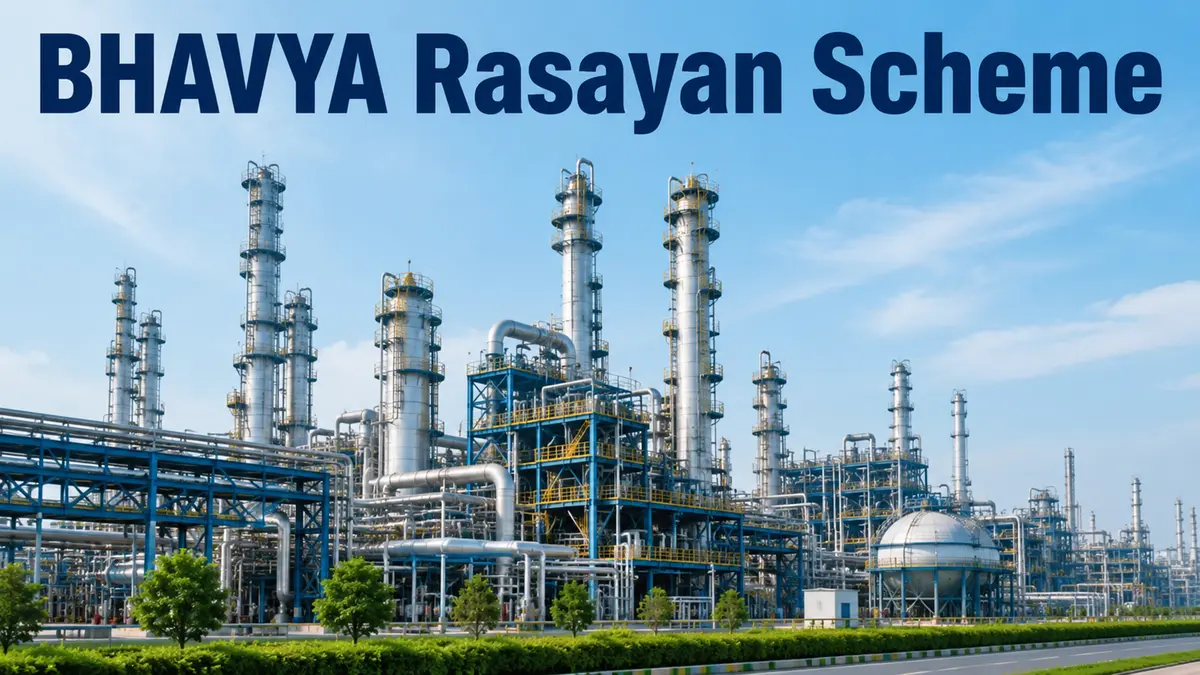
The Union Cabinet approved the BHAVYA Rasayan Scheme on 24 July 2026. It will support three large and dedicated chemical parks. The scheme has a central outlay of ₹3,030 crore. It will operate from 2026–27 through 2030–31.
Background
BHAVYA Rasayan expands to Bharat Audyogik Vikas Yojana Rasayan in the scheme’s official title.
“Rasayan” means chemical, while the remaining words describe India’s industrial development programme.
The 2026–27 Union Budget announced the parks, and Cabinet approval now provides their financial and implementation framework.
Why does the chemical industry need dedicated parks?
Chemical production involves many connected factories, specialised utilities and strict safety requirements at every operational stage.
One manufacturer’s output often becomes another manufacturer’s raw material within an integrated industrial value chain.
Scattered factories must separately build treatment, storage, transport and emergency facilities at a higher individual cost.
A planned cluster shares these facilities across many units, potentially reducing costs and improving regulatory monitoring.
Core design of the scheme
| Feature | Approved provision |
|---|---|
| Number of parks | Three dedicated chemical parks will receive central support. |
| Scheme period | Five years, from 2026–27 through 2030–31. |
| Total central outlay | ₹3,030 crore has been approved. |
| Infrastructure component | ₹3,000 crore supports common facilities and basic utilities. |
| Administrative component | ₹30 crore supports administration of the scheme. |
| Maximum central grant | Each selected park may receive up to ₹1,000 crore. |
| Minimum state contribution | The concerned state must contribute at least ₹500 crore per park. |
| Minimum land | Each park needs eight contiguous square kilometres, or 2,000 acres. |
How will states be selected?
The three parks will be developed by selected state governments through a competitive challenge route.
Under this route, interested states compete using detailed proposals, measurable readiness criteria and credible implementation commitments.
A stronger proposal may offer suitable land, connectivity, clearances and industrial demand.
Land must be contiguous and free from unresolved legal claims, meaning it must be encumbrance-free.
What does plug-and-play infrastructure mean?
Plug-and-play infrastructure provides essential shared facilities before individual factories begin full commercial operations inside the selected park.
This common foundation reduces the time and expense needed for every unit’s separate construction and commissioning.
| Shared facility | Purpose |
|---|---|
| Common Effluent Treatment Plant | It treats contaminated liquid waste from participating industrial units. |
| Treatment, Storage and Disposal Facility | It safely handles hazardous waste before final disposal. |
| Hazardous-waste infrastructure | It supports collection, tracking, treatment and secure containment. |
| Solvent recovery and distillation | It recovers useful solvents and reduces waste generation. |
| Steam network | It supplies process heat through a common distribution system. |
| Pipeline network | It moves inputs or utilities more safely between connected facilities. |
| Logistics and warehousing | It stores and moves raw materials and finished products. |
| Water supply network | It provides and distributes process water within the park. |
Understanding the chemical value chain
Upstream industries make basic feedstocks, while downstream industries convert them into specialised or consumer products.
Ancillary industries provide essential packaging, equipment, testing, maintenance and logistics for the main production units.
The scheme intends to place these closely connected activities near one another within a planned industrial ecosystem.
Expected economic benefits
- Shared facilities can reduce capital and operating expenses.
- Nearby suppliers can lower transport time and logistics costs.
- Integrated clusters may attract both domestic and foreign investment.
- Higher domestic capacity can replace selected chemical imports.
- Competitive production may support exports and global value-chain participation.
- New factories can generate direct and supporting employment.
Chemicals supply agriculture, textiles, medicines, construction, automobiles and electronics.
Therefore, improved chemical capacity can influence many downstream industries.
Environmental promise and necessary safeguards
Common treatment systems can perform better than many small and fragmented facilities.
Central monitoring can also detect abnormal discharge, treatment failure or unsafe waste handling more quickly.
Solvent recovery can reduce both pollution and demand for fresh material.
- Site selection must consider water availability and nearby communities.
- Cumulative pollution needs assessment across the whole industrial cluster.
- Emergency planning must cover fires, explosions and toxic releases.
- Waste tracking must continue until safe treatment or disposal.
- Independent monitoring should verify promised environmental performance.
Conclusion
BHAVYA Rasayan can improve chemical competitiveness if shared infrastructure is matched by strict safety and environmental enforcement.