
Why in news?
Solar Defence and Aerospace Limited demonstrated Bhargavastra to the Indian Army. The demonstration took place in Nagpur on 24 July 2026. Its sensors detected and tracked a deliberately flown drone swarm. However, the system still awaits further trials and possible induction.
Background
An unmanned aerial vehicle flies without an onboard human pilot.
It may be remotely controlled or use programmed autonomous functions.
Modern forces use drones for surveillance, targeting, communication and attack.
Small drones can be cheap, mobile and difficult to detect.
What is a drone swarm?
A drone swarm is a coordinated group of unmanned aircraft.
Its members may share information and change behaviour, while simultaneous targets can overwhelm ordinary air-defence systems.
Some autonomous swarms may continue despite communication jamming.
Related threat: loitering munitions
A loitering munition can search an area before attacking a target.
It combines some features of a drone and a guided weapon.
It is often called a “kamikaze drone”, though that term is informal.
Who developed Bhargavastra?
Solar Defence and Aerospace Limited (SDAL) developed the integrated system.
SDAL is wholly owned by Solar Industries India Limited, while Economic Explosives Limited developed associated munitions.
How did the project progress?
| Period | Development |
|---|---|
| Early development | SDAL designed a low-cost response to weaponised drone swarms. |
| May 2025 | Rocket firings occurred at the Gopalpur firing range in Odisha. |
| 24 July 2026 | The full configuration was demonstrated at Nagpur. |
| Next stage | The developer expected internal trials within two or three months. |
| Later stage | Successful user evaluation would precede any procurement or induction. |
What happened during the Nagpur demonstration?
- The developer flew several drones as a simulated swarm, and radar and other detectors found the approaching targets.
- The command system formed a common real-time air picture, and it generated an attack warning for the operators.
- Operators assigned selected targets to the launcher, and the team demonstrated the complete firing sequence.
Live rocket firing did not occur inside the company premises.
Earlier range trials had already tested rocket and missile components.
Main system components
| Component | Role |
|---|---|
| Command-and-control vehicle | Receives sensor data and manages engagements |
| Radar | Searches airspace and tracks approaching objects |
| Electro-optical and infrared sensors | Visually confirm and follow targets by day or night |
| Passive radio-frequency detector | Listens for signals without transmitting |
| Launcher vehicle | Carries tubes for rockets and guided micro-missiles |
What is the C4I architecture?
The system uses Command, Control, Communications, Computers and Intelligence (C4I).
This architecture joins sensors, operators and launchers through one network, reducing the delay before engagement.
It also helps prevent different sensors from showing conflicting pictures.
Reported sensor ranges
- The radar can detect suitable aerial targets up to ten kilometres, and the electro-optical tracker has a reported six-kilometre range.
- Actual detection depends on size, weather and background clutter, and passive detectors depend on signals emitted by the target.
A silent autonomous drone may provide little radio-frequency evidence, so Bhargavastra combines several sensor types.
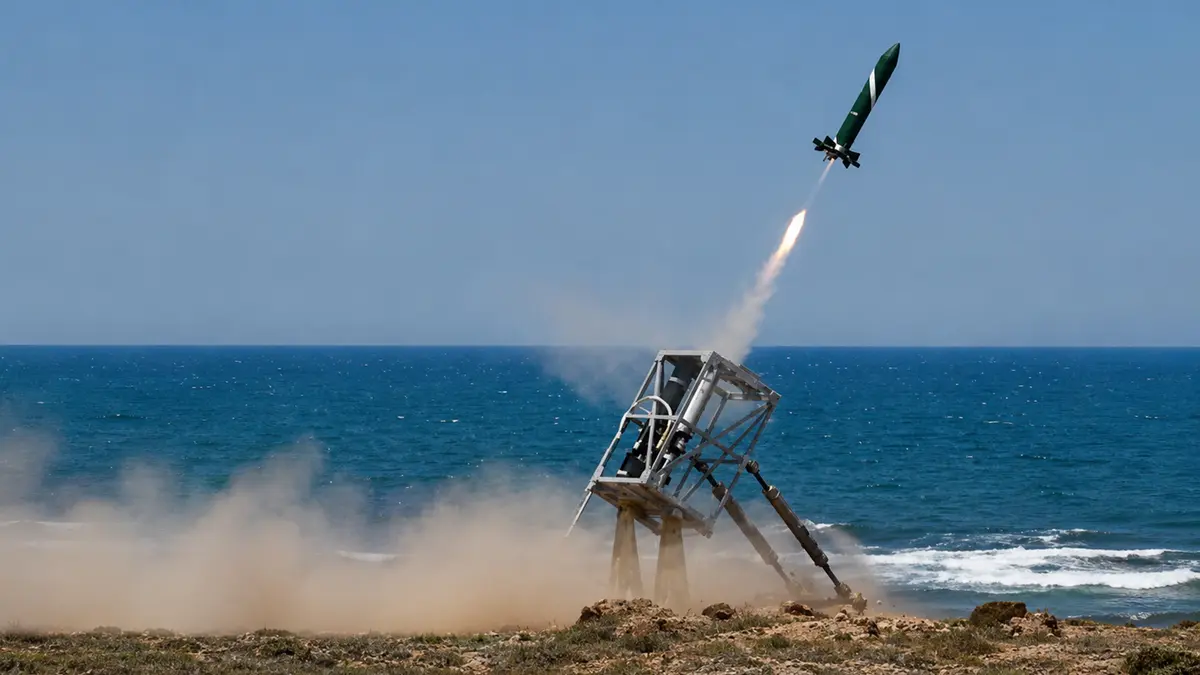
How does the dual hard-kill system work?
| Layer | Weapon | Intended use |
|---|---|---|
| First layer | Unguided micro-rockets | Creates a reported 20-metre lethal zone against clustered drones |
| Second layer | Precision-guided micro-missiles | Engages selected targets up to about 2.5 kilometres |
Hard-kill physically damages the drone, while soft-kill electronically disrupts navigation, control or communication.
The platform can integrate optional jamming, while hard-kill weapons address jam-resistant autonomous drones.
Why use rockets and micro-missiles?
A large surface-to-air missile can cost far more than a small drone.
Repeated expensive interceptions create an unfavourable cost-exchange ratio, so micro-weapons seek a cheaper short-range response.
Unguided rockets may also cover several tightly grouped targets.
Mobility and terrain
Both command and launcher elements use road-mobile vehicles designed for deserts, plains and snow-bound high-altitude areas.
The developer reports operation above 5,000 metres, although formal trials must still demonstrate actual performance there.
What does Make-II mean?
The Army reviewed Bhargavastra under Make-II, which generally supports industry-funded prototype development for military needs.
The government does not finance prototype development, while successful trials can lead to procurement competition.
Why are “first” claims treated carefully?
The developer calls Bhargavastra among the world’s first integrated systems with this vehicle-mounted, multi-layer configuration.
Several countries already operate different counter-drone weapons, so the superlative must remain attributed to the developer.
Remaining challenges
- Friendly drones require reliable identification safeguards, and dense terrain can create radar clutter and blocked views.
- Reload time matters during repeated swarm attacks, and falling debris may threaten people and infrastructure.
- Electronic links must resist cyber and jamming attacks, and formal trials must confirm accuracy across weather conditions.
Conclusion
Bhargavastra is promising indigenous technology, but successful trials must precede operational claims.