
Why in news?
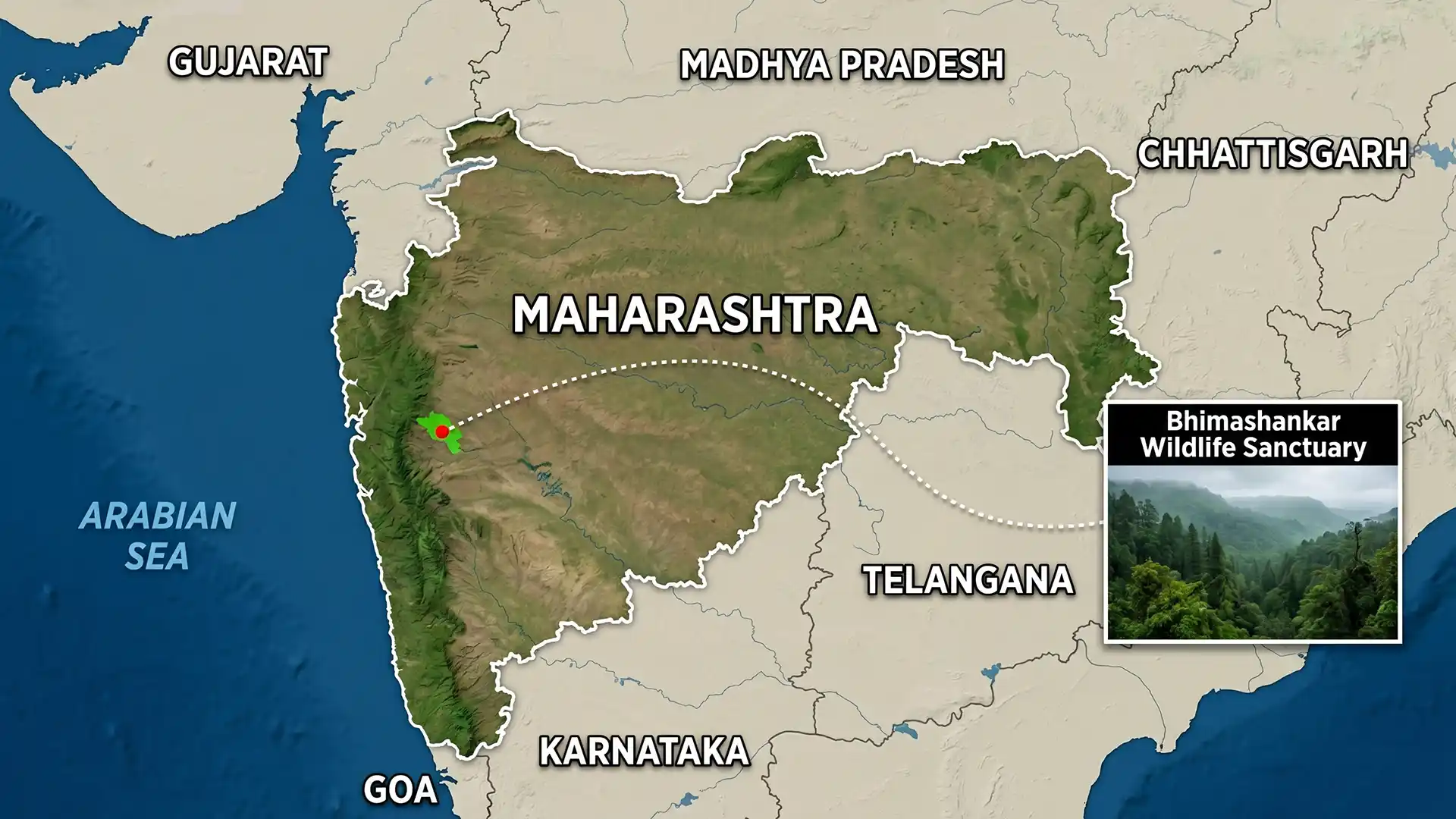
Conservation authorities in Maharashtra recently announced a detailed survey to estimate the population of the Indian giant squirrel in Bhimashankar Wildlife Sanctuary. The survey will help assess habitat health and guide future conservation actions in one of the Western Ghats’ biodiversity hotspots.
Background
Bhimashankar Wildlife Sanctuary covers about 131 square kilometres in the Western Ghats north of Pune. Notified in 1985 under the Wildlife Protection Act, it was established primarily to protect the habitat of the Indian giant squirrel (Ratufa indica elphistonii), an arboreal rodent known for its striking three‑coloured fur. The sanctuary’s landscape comprises undulating hills, dense evergreen and semi‑evergreen forests and grasslands. Nine tribal villages and several sacred groves fall within its boundaries, underscoring the region’s cultural and ecological significance.
Flora and fauna
- Indian giant squirrel: This large tree squirrel, also called the Malabar giant squirrel, is the state animal of Maharashtra. It spends most of its life in the canopy, leaping between trees. Colour patterns vary from maroon and brown to cream. Habitat loss and hunting have reduced its numbers, making population surveys important for conservation.
- Other wildlife: Bhimashankar harbours a rich assemblage of mammals, including leopards, sambar and barking deer, golden jackal, wild boar, common langur, rhesus macaque and Indian pangolin. Endemic reptiles and amphibians are also present. The sanctuary’s sacred groves host rare plant species and act as genetic reservoirs.
- Community involvement: The sanctuary incorporates the traditional practices of local tribes, who manage sacred groves and worship forest deities. Their knowledge is invaluable for sustainable resource management.
Significance of the survey
A systematic population survey will provide baseline data on the Indian giant squirrel’s numbers and distribution. It will help identify habitat corridors and threats such as deforestation, human–wildlife conflict and climate change. The findings can be used to design conservation plans and ecotourism guidelines that balance wildlife protection with livelihoods.
Conclusion
Bhimashankar’s mixed forests and sacred groves make it a treasure house of biodiversity. Protecting flagship species like the Indian giant squirrel will preserve the ecological integrity of the Western Ghats and support local communities that depend on the forest.