Why in news?
In early May 2026 the Uttarakhand forest department started a scientific census of the Binsar Wildlife Sanctuary. More than 100 camera traps are being placed across 50 grids to monitor tigers, leopards, Himalayan bears, deer and foxes. Data from this exercise will help map animal movements and improve conservation plans. So the sanctuary has been in the news for its new wildlife survey.
Background
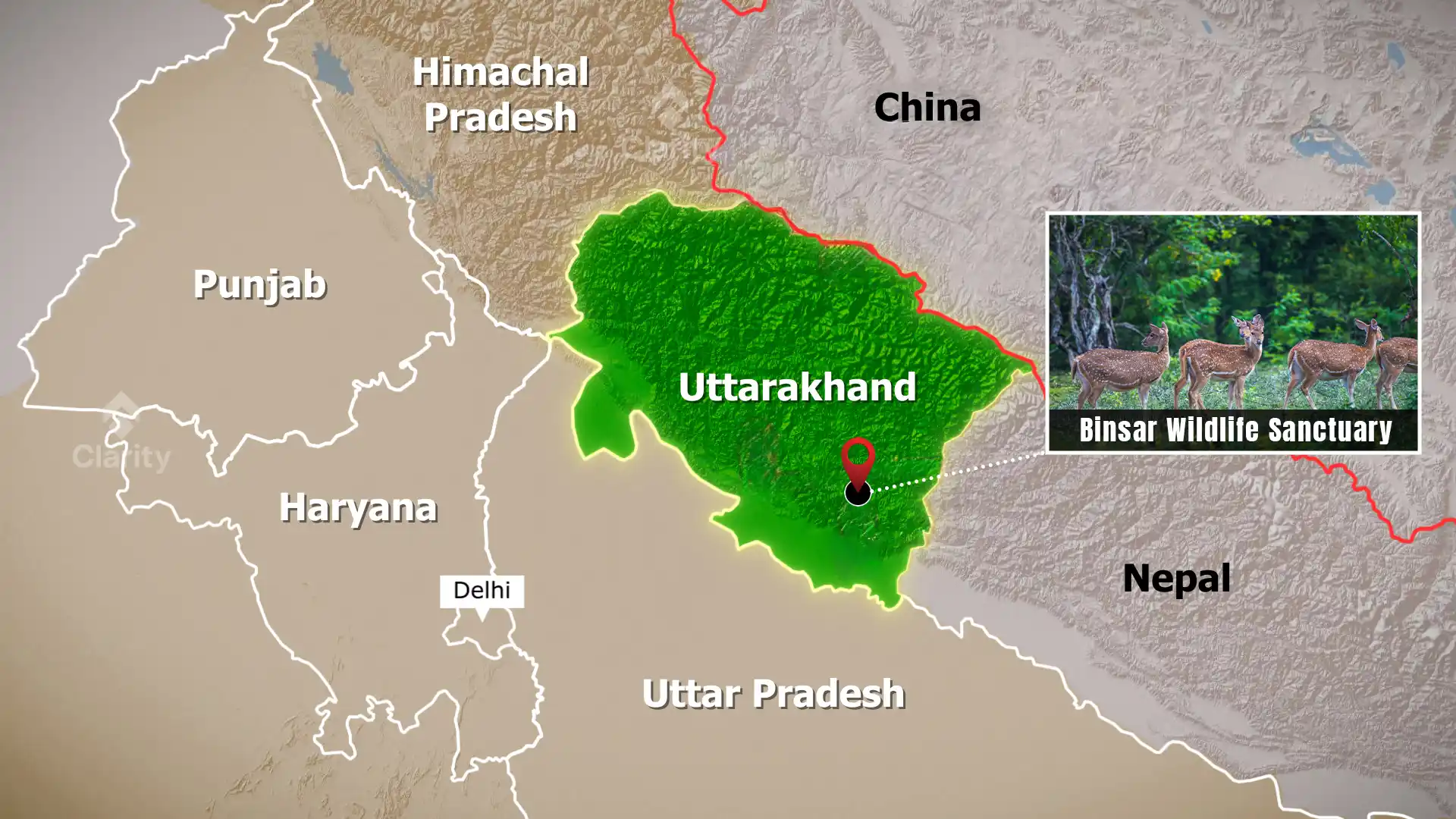
Binsar Wildlife Sanctuary is located on the Jhandi Dhar hills in the Kumaon region of Uttarakhand. It lies about 33 km from Almora town and sits at an altitude of roughly 2,420 m. The sanctuary, established in 1988, was created to protect the high‑altitude broadleaf oak, rhododendron and other Himalayan flora. In earlier times this area served as the summer capital of the Chand dynasty, and later British officers used it as a summer retreat. The name Binsar comes from the ancient Bineshwar Mahadev temple located nearby.
Key features
- The sanctuary covers about 47 sq km. Its high ridges are clothed in broadleaf oak and rhododendron forests while chir pine grows at lower elevations.
- From “Zero Point” visitors can see snow‑clad Himalayan peaks such as Nanda Devi, Trishul, Chaukhamba and Panchachuli.
- Fauna includes barking deer, ghoral (mountain goat), Himalayan black bear, leopard, fox, jackal, langur and porcupine. The area is also an Important Bird Area with over 200 recorded bird species.
- The sanctuary is a popular trekking and camping destination due to its cool climate and scenic views.
Significance
Binsar plays a vital role in conserving the remaining patches of oak and rhododendron forests in the Kumaon Himalayas. The new camera‑trap survey will generate baseline data about resident wildlife and their movement corridors. Such information is crucial for formulating management plans, reducing human–wildlife conflict and boosting eco‑tourism.
Sources: TOI