

Why in news?
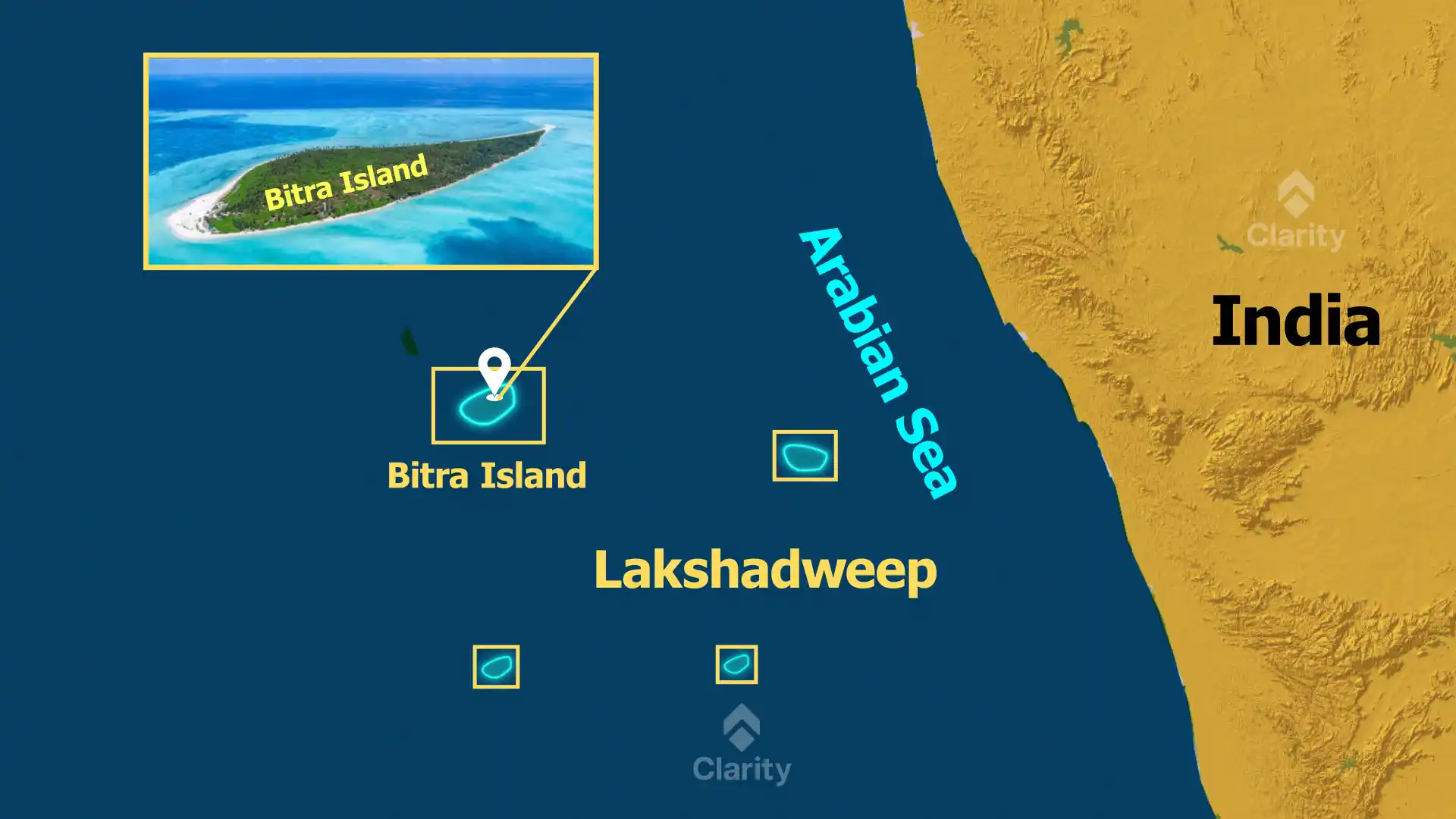
Bitra Island made headlines in mid‑2025 when reports suggested that the Lakshadweep administration was considering its takeover for defence infrastructure. Although the proposal remains under discussion, the attention drew curiosity about this little‑known island.
Background
Bitra is the smallest inhabited island in the Lakshadweep archipelago. It covers just 0.105 square kilometres, with a length of about 570 metres and a width of 280 metres. The surrounding lagoon spans approximately 45.6 square kilometres. Located at 11°36′ N latitude and 72°11′ E longitude, it lies roughly 483 kilometres west of Kochi on the Indian mainland.
The island was historically a nesting ground for sea birds visited by fishers from nearby islands such as Kiltan and Chetlat. A shrine dedicated to an Arab saint, Malik Mulla, attracted occasional visitors. Permanent settlement began around 1945 when a woman from Chetlat decided to live there. According to the 2011 Census, the population stood at about 271 people, making Bitra the least‑populated inhabited island in the union territory.
Geography and ecology
- Climate: The island experiences a tropical maritime climate with temperatures ranging between 25 °C and 35 °C. Humidity stays around 70–76 percent. The southwest monsoon brings heavy rainfall from May to September, while October to March is relatively dry.
- Lagoon and reef: Bitra is ringed by a coral reef that calms the lagoon’s waters. The reef supports a variety of fish and coral species, making the island suitable for snorkelling and small‑scale fishing.
- Economy: Residents depend mainly on fishing and coconut cultivation. A few government jobs and small shops provide additional income.
- Access: During the monsoon, boats are advised to stay within the lagoon due to rough seas. The island has a helipad, and passenger ships occasionally visit from other Lakshadweep islands and the mainland.
Significance
- Strategic location: Positioned in the Arabian Sea, Bitra offers a potential base for monitoring maritime traffic and securing India’s western seaboard. Any development must, however, consider the island’s fragile ecology and the rights of its small community.
- Cultural heritage: The shrine of Malik Mulla and the islanders’ unique way of life add cultural value. Respecting local traditions is essential if infrastructure projects proceed.
- Conservation concerns: Coral reefs and seabird breeding grounds could be disturbed by construction. Sustainable planning is necessary to balance security requirements with environmental protection.
Conclusion
Bitra Island may be tiny, but its ecological sensitivity and strategic location make it important. Any decisions about its future should involve the community and safeguard the coral reef ecosystem while addressing national security needs.
Source: NIE