
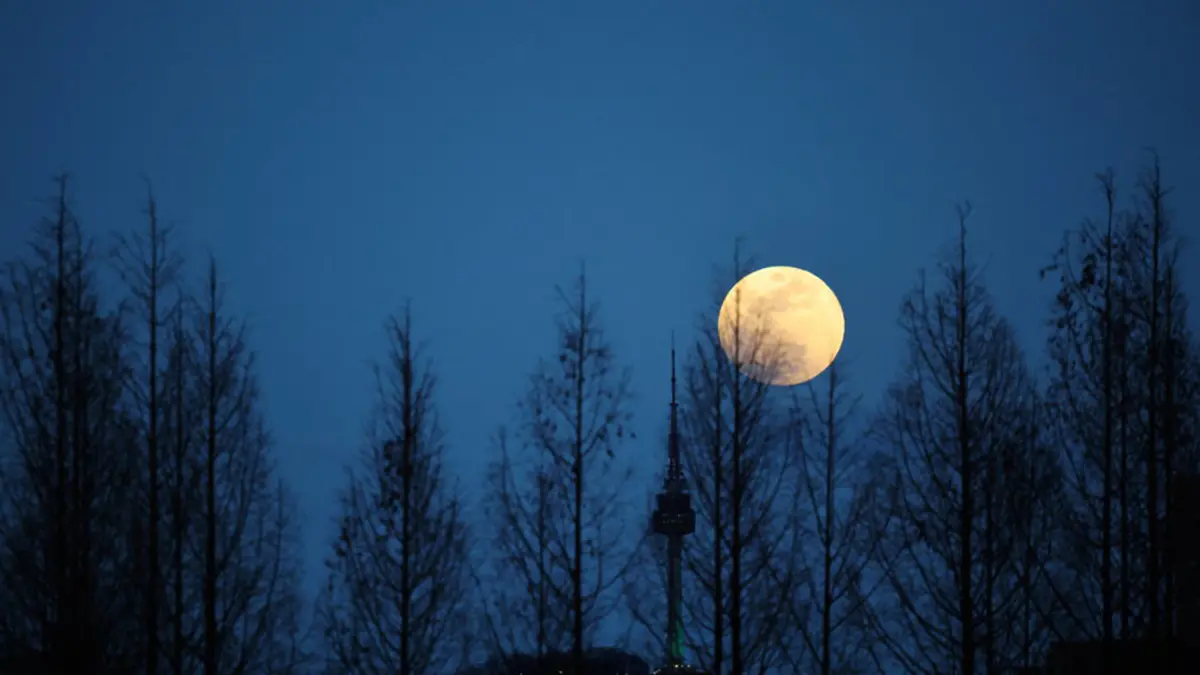
Why in news?
At the end of May 2026 sky‑watchers observed a “Blue Micromoon” – the second full moon in a calendar month coinciding with the Moon’s greatest distance from Earth. Although the Moon did not appear blue in colour, this combination of a monthly Blue Moon and a micro‑moon is uncommon and drew attention from astronomy enthusiasts.
Background
The term “Blue Moon” has come to mean the second full moon in a single calendar month. Because the lunar cycle lasts about 29.5 days, two full moons in one month occur roughly once every two to three years. The last monthly Blue Moon occurred in August 2023; the next will not happen until December 2028. A “micromoon” occurs when the Moon is at apogee – the farthest point in its elliptical orbit around Earth. At apogee the Moon appears about seven per cent smaller than when it is at perigee (closest approach) and may shine slightly dimmer.
Explanation
- Blue vs seasonal Blue Moon: Traditional folklore uses “Blue Moon” for the third full moon in a season that has four. Modern usage popularised by magazines in the 1940s defines a Blue Moon as the second full moon in a calendar month.
- Micro‑moon characteristics: When the full moon occurs near apogee, it looks smaller and takes slightly longer to cross the sky. This is the opposite of a supermoon, which occurs near perigee and appears larger and brighter.
- Colour of the Moon: The Moon can appear orange or yellow near the horizon due to Rayleigh scattering of shorter wavelengths by Earth’s atmosphere. The term “blue moon” has nothing to do with colour; only in rare circumstances, such as after volcanic eruptions or wildfires, can the Moon appear bluish because of atmospheric particles.
- Frequency: Monthly blue moons occur every two to three years, but a Blue Micromoon – where the second full moon of a month also occurs at apogee – is rarer.
Conclusion
The May 2026 Blue Micromoon offered a chance for stargazers to ponder the interplay of orbital mechanics and calendar conventions. Such events highlight the dynamic nature of the Earth–Moon system and remind us that even familiar celestial bodies can surprise us with rare alignments.