
Why in news?
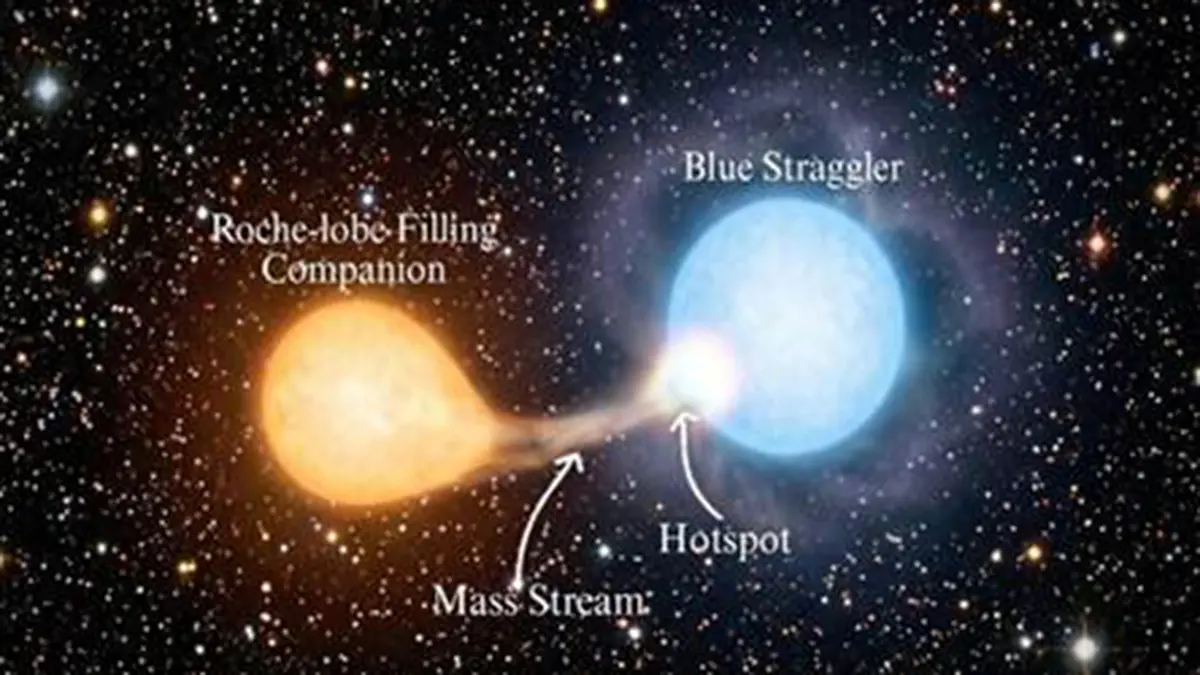
Astronomers reported a blue straggler star that is still actively forming. The star belongs to a binary system inside open cluster Collinder 261. One star is transferring matter to its brighter companion. This direct evidence helps explain an old astronomical puzzle.
Background
Stars form when gravity compresses gas and dust inside cold clouds.
A young star spends most of its life on the main sequence.
During this stage, its core fuses hydrogen into helium, while its mass controls temperature, brightness and lifetime.
What is a star cluster?
A star cluster contains stars born from broadly similar material.
Cluster stars usually have similar ages and distances, making clusters useful natural laboratories.
| Cluster type | General character |
|---|---|
| Open cluster | Loosely bound and usually located in a galactic disc |
| Globular cluster | Densely packed, old and roughly spherical |
Collinder 261 is an old open cluster within the Milky Way.
How do astronomers compare cluster stars?
They plot brightness against colour on a colour-magnitude diagram, because colour indicates surface temperature.
Hotter stars generally appear bluer, while cooler stars form the redder part of the main-sequence pattern.
What is the main-sequence turnoff?
The heaviest cluster stars use core hydrogen first, then leave the main sequence for later stages.
This departure point is the main-sequence turnoff, whose position helps astronomers estimate a cluster’s age.
What is a blue straggler star?
A blue straggler star appears bluer and brighter than the turnoff.
It therefore looks younger and more massive than neighbouring stars, creating the “straggler” puzzle.
The star did not reset its age, but instead gained fresh material or formed through a merger.
When were blue stragglers recognised?
American astronomer Allan Sandage identified unusual blue stars in the globular cluster Messier 3 during 1953.
Later studies found blue stragglers in different cluster types.
How can a blue straggler form?
| Pathway | What happens? |
|---|---|
| Binary mass transfer | One star loses matter, while its companion gains mass. |
| Stellar merger | Two stars combine into one more massive object. |
| Direct collision | Close encounters merge stars inside a dense cluster. |
| Multiple-star interaction | Complex gravitational encounters alter or merge system members. |
What system did the team study?
The Transiting Exoplanet Survey Satellite (TESS) Input Catalog (TIC) lists this system as 327546480.
It lies about 9,500 light-years from Earth.
Its host cluster is roughly seven billion years old, and the system is a semi-detached binary.
What is a semi-detached binary?
A binary system contains two stars orbiting their common centre.
Each star controls a surrounding gravitational region called a Roche lobe.
One star in this system fills its Roche lobe.
Matter then crosses toward the companion through an inner balance point.
Measured properties
| Property | Measured or modelled value |
|---|---|
| Blue straggler mass | About 1.67 times the Sun’s mass |
| Donor mass | About 0.32 times the Sun’s mass |
| Orbital period | About 2.11 days |
| Mass ratio | About 0.19 |
| Rotation speed | About 69.55 kilometres per second |
The quoted rotation value is a projected velocity, whose interpretation depends partly on the viewing angle.
How did astronomers detect the process?
The United States National Aeronautics and Space Administration (NASA) operates TESS.
- TESS measured changing brightness, and its light curve revealed repeated variations across the orbit.
- The European Southern Observatory measured changing radial velocities. Those measurements traced each star’s movement toward and away from Earth.
- Strong X-rays independently indicated active accretion.
Accretion means matter collecting onto an astronomical object.
What does the evolutionary model suggest?
Modelling indicates that mass transfer began when the system was about 5.46 billion years old.
The cluster is now about seven billion years old.
Therefore, transfer has continued for roughly 1.5 billion years.
The receiving star has become heavier and unusually luminous.
Why is the discovery important?
- It catches a blue straggler during continued formation, and it directly supports the binary mass-transfer pathway.
- It helps test models of old binary evolution, and it explains why some cluster stars appear unexpectedly young.
- It improves understanding of rotation, accretion and X-ray emission.
The study appeared in The Astrophysical Journal Letters.
Conclusion
The system offers rare direct evidence of a companion rejuvenating an ageing star.