
Why in news?
Field observations and camera traps have confirmed dholes inside Assam’s Bornadi Wildlife Sanctuary. The species had rarely appeared in recent records from this small sanctuary. Its presence suggests that prey and forest links may still support predators. However, one detection cannot prove complete ecosystem recovery.
Background
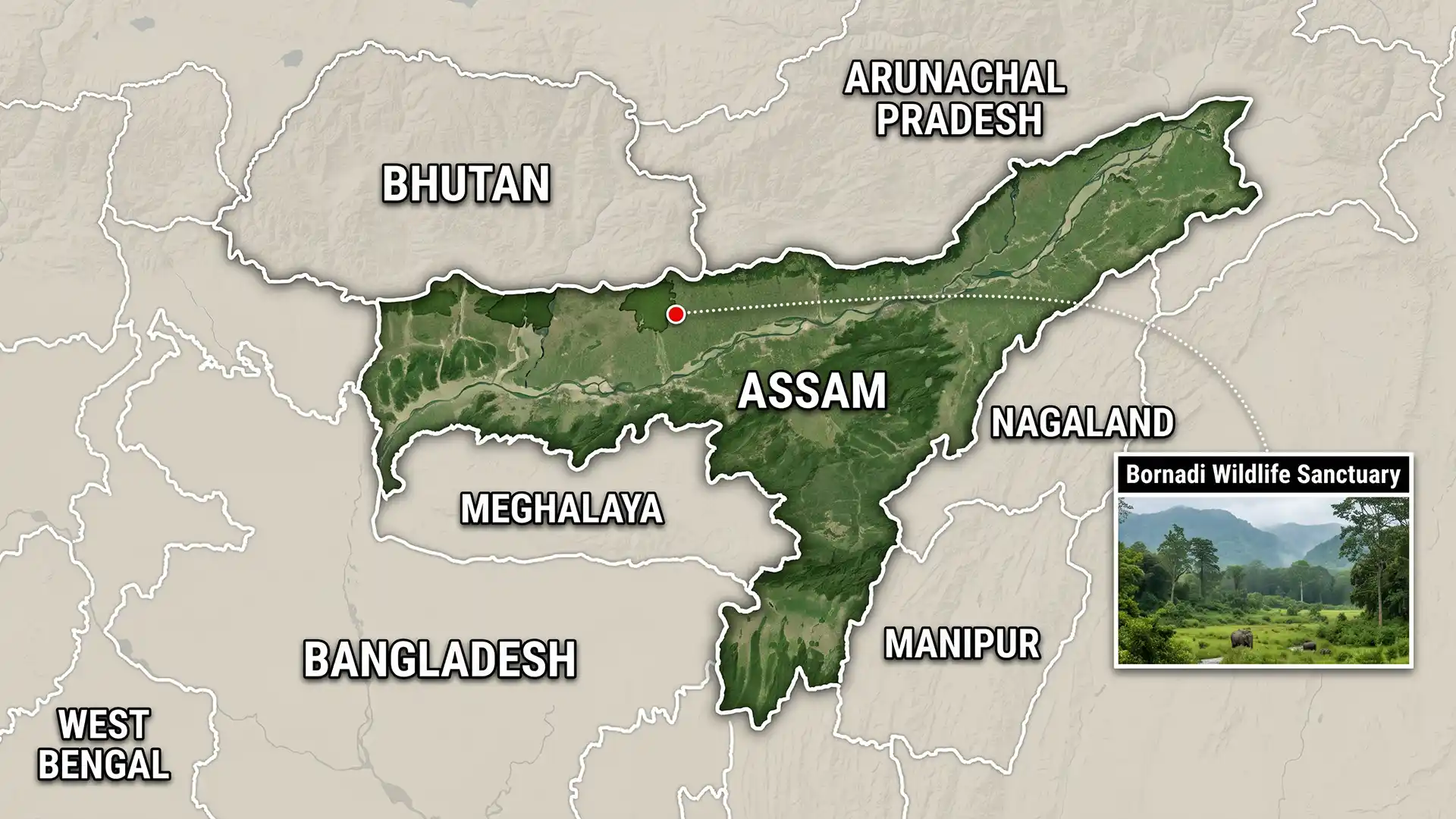
Bornadi Wildlife Sanctuary is also written as Barnadi, but both spellings refer to the same protected area.
The sanctuary lies along the Himalayan foothills in Assam, close to Bhutan.
Assam notified it on 22 August 1980, and the official protected area covers 26.22 square kilometres.
Why was the sanctuary created?
Bornadi received protection mainly for the pygmy hog and hispid hare.
Both are highly threatened grassland mammals native to the Himalayan foothills and adjoining alluvial plains.
The sanctuary also protects woodland, grassland and riverine habitats across this sensitive foothill zone near Bhutan.
Location and physical setting
- The sanctuary extends across Udalguri and Baksa districts of Assam.
- Bhutan lies directly north of the protected landscape.
- The Bornadi River forms an important western boundary.
- The area belongs to the porous Himalayan foothill belt called Bhabar.
- Mountain streams carry water and sediments into the adjoining plains.
Bhabar soils contain coarse stones and gravel, so surface water often disappears into these porous foothill deposits.
The wider Bhutan–Greater Manas landscape helps wide-ranging animals move safely between important feeding and breeding areas.
Important wildlife
| Group | Important examples |
|---|---|
| Large mammals | Asian elephant, gaur, tiger, leopard and Himalayan black bear occur here. |
| Smaller threatened mammals | Pygmy hog, hispid hare and Chinese pangolin are important examples. |
| Deer | Barking deer and other prey species use the sanctuary’s mixed habitats. |
| Birds | Bengal florican and several forest or grassland birds occur locally. |
What is a dhole?
The dhole is a wild canid whose scientific name is Cuon alpinus.
Other common names include Asiatic wild dog, Indian wild dog and red dog across different parts of its range.
Dholes live in organised social groups, often containing related individuals, and cooperate while hunting suitable prey.
They communicate within their social groups through whistles, other calls, scents and coordinated body movements.
Their rounded ears, reddish coat and bushy dark tail help field identification.
Conservation status
| Framework | Status | Meaning |
|---|---|---|
| International Union for Conservation of Nature Red List | Endangered | The species faces a very high extinction risk in the wild. |
| Global population estimate | About 4,500–10,500 individuals | Only around 949–2,215 are estimated mature individuals. |
| Historic range change | More than 75 per cent lost | Remaining populations are often small, isolated and declining. |
Why have dholes declined?
- Habitat loss divides continuous forests into small and isolated patches.
- Declining deer and wild-pig populations reduce available natural prey.
- Retaliatory killing follows occasional attacks on domestic livestock.
- Free-ranging dogs can transmit rabies or canine distemper.
- Competition with larger predators can affect small dhole populations.
What does the new record indicate?
A resident predator usually needs adequate natural prey, reliable water and safe movement routes across its territory.
Therefore, dhole presence can indicate continuing ecological function within the wider landscape.
Camera traps also provide dated and location-specific evidence without repeatedly disturbing shy or nocturnal animals.
Repeated records across several seasons remain necessary for estimating group size, breeding success and long-term survival.
Conservation priorities
- Forest links with Bhutan and neighbouring protected areas need continued legal and community protection.
- Regular camera-trap surveys should distinguish visitors from resident packs.
- Prey populations require protection from hunting and habitat degradation.
- Vaccinating nearby domestic dogs can reduce disease transmission.
- Quick livestock compensation can reduce retaliatory hostility towards predators.
Conclusion
The dhole record renews conservation hope, but lasting recovery needs connected habitat, prey and repeated monitoring.