
Why in news?
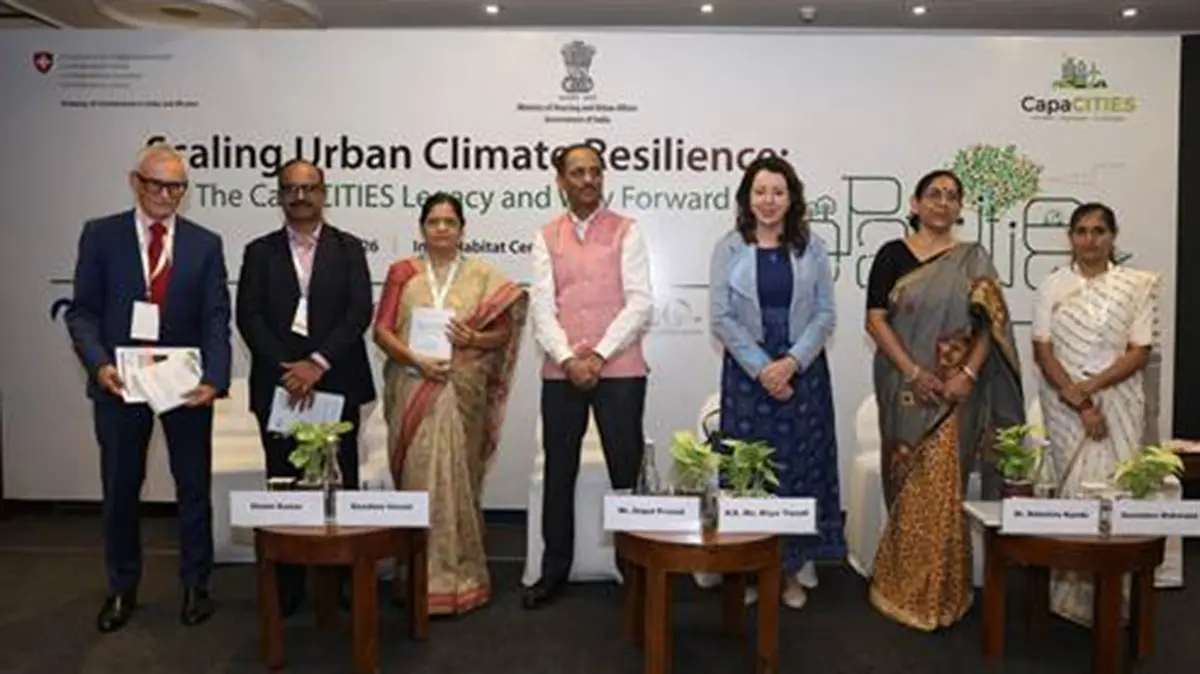
A national event marked ten years of an urban climate programme. The programme has supported eight Indian cities since 2016. Officials released three practical knowledge products during the event. The experience will now guide climate planning in more cities.
Background
Cities produce large greenhouse gas emissions through transport, buildings, waste and industry. They also face heat, floods and water shortages.
Urban climate policy must therefore perform two connected tasks. It must reduce emissions and prepare communities for unavoidable climate effects.
Mitigation reduces the causes of climate change. Adaptation reduces harm from present or expected climate effects.
Climate resilience means preparing, absorbing shocks and recovering without lasting damage. Resilience also includes learning from each event.
The Capacity Building Project on Low Carbon and Climate Resilient City Development in India began during 2016.
Its stylised short name is CapaCITIES. The capital letters help readability but should not be treated as separate words.
Who supports the programme?
The Embassy of Switzerland to India and Bhutan funds the programme. It forms part of India-Switzerland cooperation on climate action.
ICLEI – Local Governments for Sustainability, South Asia leads implementation, and South Pole and econcept also support the work.
The National Institute of Urban Affairs serves as knowledge partner, and it helps connect practical learning with national urban policy.
ICLEI is the organisation’s current official name, and its older historical acronym expansion should not replace this current title.
Which cities received direct support?
- Ahmedabad, Rajkot and Vadodara are located in Gujarat.
- Coimbatore, Tiruchirappalli and Tirunelveli are located in Tamil Nadu.
- Siliguri is located in West Bengal.
- Udaipur is located in Rajasthan.
These eight cities differ greatly in climate and economic structure, and their experience therefore offers lessons for several urban conditions.
What happened at the anniversary event?
The event took place at India Habitat Centre, New Delhi, on 14 July 2026.
Its title was “Scaling Urban Climate Resilience: The CapaCITIES Legacy and Way Forward.” Representatives attended from over thirty cities.
The participants represented six states, national institutions and technical organisations, and they reviewed achievements and discussed wider adoption.
Which knowledge products were released?
- The Net-Zero Climate Resilient Cities Methodology Toolkit explains integrated city planning.
- An energy-transition guidebook helps Urban Local Bodies plan practical energy changes.
- A white paper explains how cities can attract finance for low-carbon projects.
A video training series also became available through the National Urban Learning Platform. Officials can use it for self-paced learning.
Net zero means balancing remaining greenhouse gas emissions with verified removals. It does not mean every activity produces zero emissions.
What institutional changes were achieved?
All eight partner cities prepared net-zero and climate-resilient plans, and six established permanent climate action cells within local institutions.
A climate action cell coordinates departments, tracks data and follows project delivery. Permanent staffing helps work continue after external support ends.
The planning method now reaches over thirty-five cities, and another thirty-four cities engaged through the Climate Smart Cities Assessment Framework.
More than one thousand officials and practitioners received training, and twelve climate action plans were completed across the wider programme.
What pilot projects were tested?
- Ahmedabad tested solar-supported charging for electric buses.
- Coimbatore developed a 154 kilowatt-peak floating solar installation.
- Rajkot created a Green Mobility Zone and supported one hundred electric autorickshaws.
- Tiruchirappalli worked on restoring an urban lake system.
- Tirunelveli developed an early warning system for floods.
- Vadodara tested dense urban plantation using the Miyawaki method.
These pilots tested different parts of climate action. They covered clean energy, transport, water management, warning systems and urban greenery.
Ecology caution: A Miyawaki plantation can add urban green cover. It is not automatically equal to a mature natural forest.
What do the financial figures mean?
City plans identified possible climate investments worth ₹7,142 billion, and this equals about ₹7.142 lakh crore.
“Identified” means plans found potential investment needs, and it does not mean governments have already spent that entire amount.
Pilot projects received ₹120.52 million, or about ₹12.05 crore, and government partners co-financed about ₹4.05 crore.
Authorities also committed about ₹384 crore for project expansion. A commitment is stronger than identification but may precede final spending.
The programme prepared twenty-five quick-win projects and conceptualised twenty-four bankable projects, and sixteen received detailed bankability reports.
A bankable project has credible costs, benefits, risks and repayment arrangements. These features help attract public or private finance.
Remember the sequence: An investment may be identified, prepared, committed and finally spent. These stages are not interchangeable.
How did the work spread beyond India?
Related planning frameworks reached Bhutan, Bangladesh, Sri Lanka and Malaysia, and local authorities adapted methods to their own conditions.
This transfer does not mean every city copied identical projects. Climate plans must respond to local hazards, budgets and institutions.
Why is city-level capacity important?
Municipal bodies manage many climate-sensitive services, and these include drainage, waste, street lighting, water supply and local transport.
National targets require local implementation, yet many municipalities lack specialised staff, emissions data or investment-ready project designs.
Capacity building creates skills and routines inside institutions, and it is more durable than a single externally managed project.
Conclusion
Ten years of practical work produced methods, institutions and tested projects. Wider success now depends upon finance and permanent municipal capacity.