

Why in news?
The Union Budget 2026‑27 allocated ₹20,000 crores to develop Carbon Capture, Utilisation and Storage (CCUS) technologies in India. The funding aims to move beyond pilot projects and scale up commercial‑ready systems as part of India’s strategy to reduce industrial emissions and avoid potential carbon tariffs imposed by trading partners.
Background
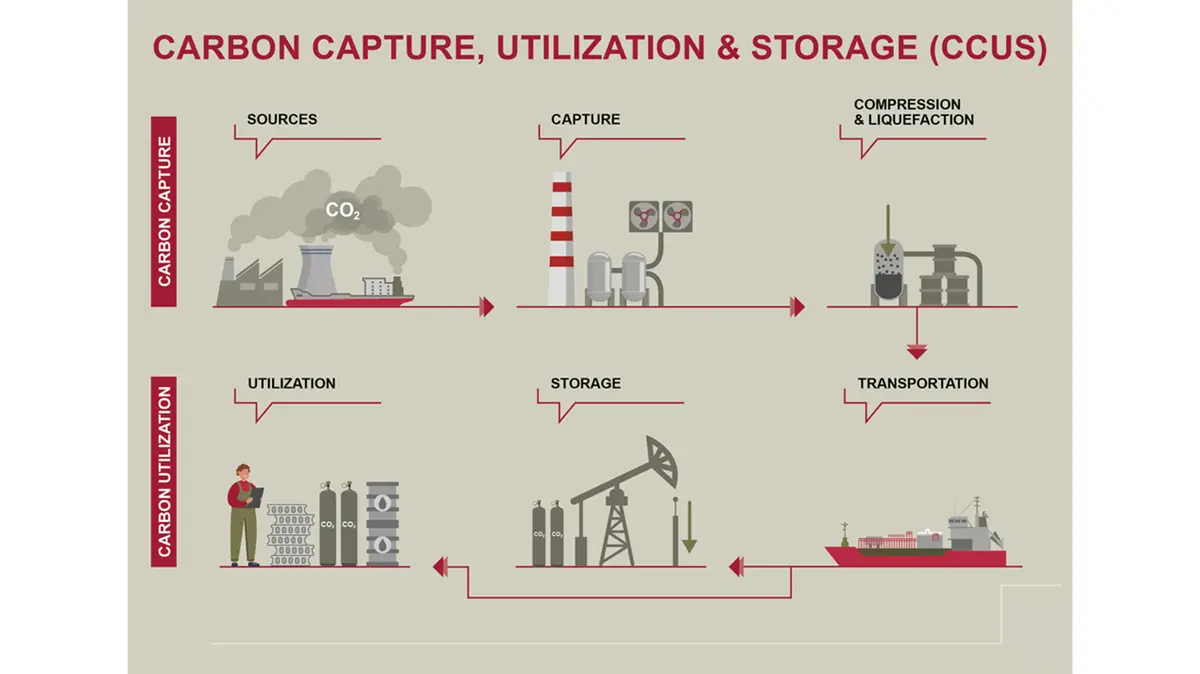
CCUS is a suite of technologies that capture carbon dioxide from industrial sources or directly from the air, transport it and either store it securely underground or convert it into useful products. Many hard‑to‑abate sectors—such as cement, steel and fertilisers—cannot easily switch to renewable energy. CCUS offers a bridge by allowing continued operation while reducing emissions.
How CCUS works
- Capture: CO2 is separated from exhaust gases at the emission source. There are three main capture methods:
- Post‑combustion: CO2 is scrubbed from flue gas using chemical solvents such as amines. This method is suitable for existing power and industrial plants but is energy intensive because CO2 concentrations are low.
- Pre‑combustion: Fuel is gasified into syngas, from which CO2 is removed before combustion. Higher CO2 concentration makes this method more efficient but requires major equipment changes.
- Oxy‑fuel combustion: Fuel is burned in pure oxygen, producing flue gas consisting mainly of CO2 and water vapour. The concentrated stream simplifies capture but needs energy‑intensive air‑separation units.
- Transport: Captured CO2 is compressed into a supercritical fluid and transported via pipelines, ships or trucks to storage or utilisation sites.
- Storage or utilisation: CO2 can be injected into deep geological formations like depleted oil and gas fields or saline aquifers for long‑term storage. Alternatively, it can be used in enhanced oil recovery, to produce chemicals (methanol, urea), building materials or synthetic fuels—transforming waste into value.
India’s plans and challenges
- India plans to fund commercial‑scale CCUS projects, shared pipelines and storage hubs, and five pilot projects in industries like cement, partnering with academic institutions and private companies.
- Challenges include high costs—especially for post‑combustion capture—energy penalties, regulatory frameworks for storage liability, and attracting private investment.
- Supporters view CCUS as indispensable for meeting global climate targets, while critics worry it may prolong fossil fuel use. For India, CCUS will complement renewable energy by cutting emissions in sectors where alternatives are limited.
Significance
- Helps India comply with climate commitments and avoid border carbon adjustments (tariffs) on carbon‑intensive exports.
- Builds domestic expertise and creates jobs in a new clean‑tech value chain, supporting economic growth alongside decarbonisation.
- Demonstrates India’s willingness to invest in emerging technologies and balance industrial development with environmental stewardship.
Source: IE