

Why in news?
Three men described by officials as alleged poachers died during firing involving forest personnel in Karnataka’s Cauvery Wildlife Sanctuary.
What can be stated
Initial reporting said forest staff encountered a group inside the sanctuary. Officials alleged that the group opened fire first.
Three men died, while one other person reportedly escaped. These are preliminary accounts, not judicial findings.
The men must therefore remain described as alleged offenders. Ballistics, post-mortems and witness evidence must establish the sequence.
Why the location matters
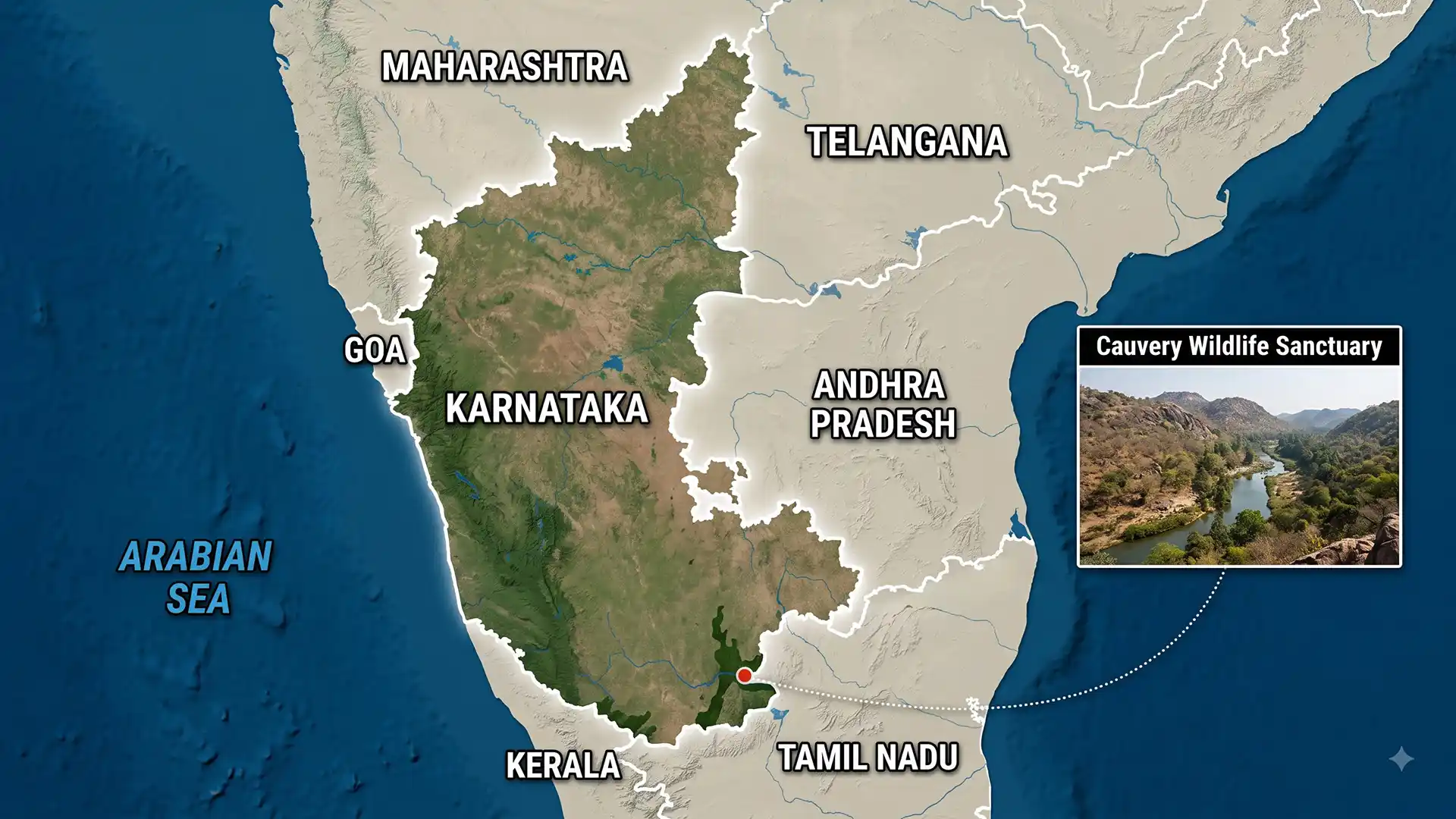
The sanctuary spans parts of Chamarajanagar, Mandya and Ramanagara districts. The Cauvery flows through its centre for about 105 kilometres.
The 2017 eco-sensitive-zone notification recorded a sanctuary area of about 1,027.5 square kilometres.
It lies at the southern end of the Eastern Ghats, near the Western Ghats transition.
Forest corridors connect it with Malai Mahadeshwara Hills, Biligiri Ranganathaswamy Temple Tiger Reserve and Bannerghatta National Park.
Its riparian forests support elephants, tigers and the grizzled giant squirrel. The river also supports fish and downstream communities.
Two duties apply together
The State must prevent illegal hunting. It must also investigate every lethal use of force independently and fairly.
Law and governance
The Wild Life (Protection) Act, 1972 prohibits hunting except narrow statutory cases. It also empowers authorised officers to detect offences.
Those powers do not settle disputed facts after a death. Ordinary criminal law and evidence standards remain relevant.
Weapons, cartridges and recovered wildlife material need documented custody. Scene mapping and medical evidence should be protected from contamination.
Forest patrols also need body-worn recording where feasible. Reliable communication can reduce confusion in remote operations.
Local relationships matter because protected areas meet villages, grazing routes and livelihoods. Intelligence-led enforcement works better with community trust.
Conservation needs legitimacy
Firm anti-poaching action and transparent accountability reinforce each other. Neither should be used to weaken the other.
Conclusion
The sanctuary’s ecological importance requires strong protection. The deaths equally require an impartial, evidence-led investigation.