
Why in news?
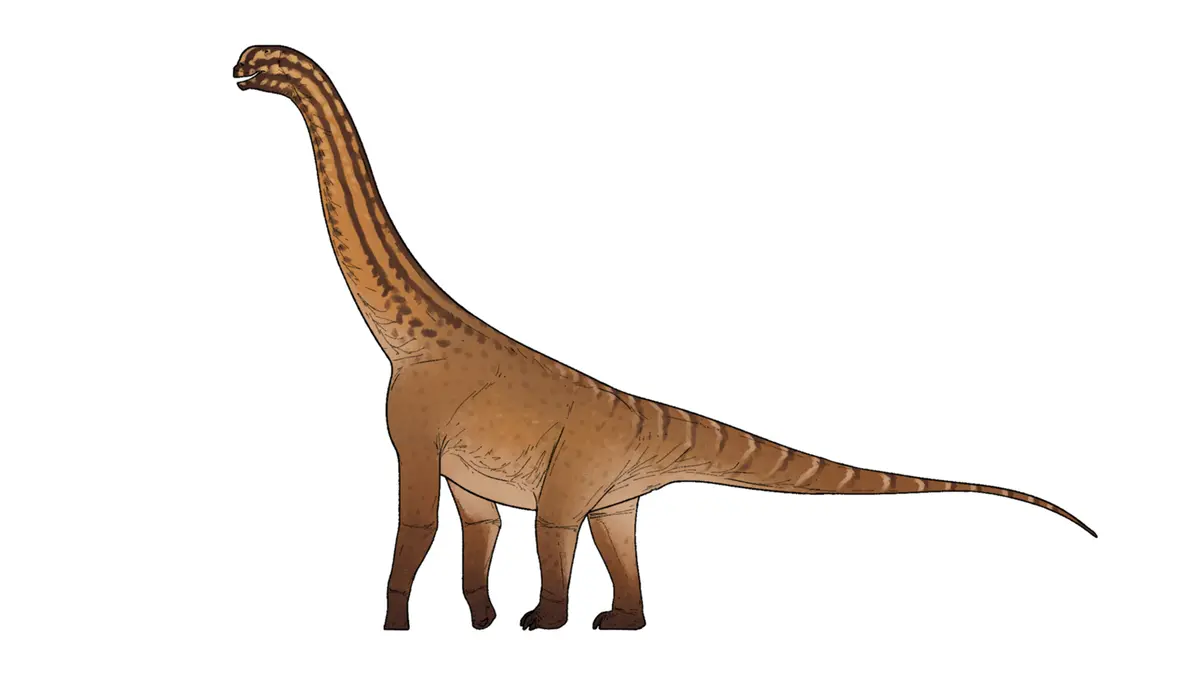
Indian researchers have described a new long-necked dinosaur from Gujarat’s Kachchh Basin. They named the species Ceratocaudia antiqua. Its front tail vertebra carried a curved, horn-like crest. The finding provides rare evidence about early neosauropod evolution in India.
Background
Dinosaurs lived during the Mesozoic Era, which contains the Triassic, Jurassic and Cretaceous periods.
Sauropods were long-necked, four-legged herbivores, and many later forms became enormous although early relatives were smaller.
Neosauropoda is a widely distributed advanced group containing two major branches: Diplodocoidea and Macronaria.
Ceratocaudia belonged to an early branch of Macronaria.
Later macronarians included brachiosaurs and titanosaurs, among many other increasingly diverse and geographically widespread forms.
Where was the fossil found?
Researchers found the bones near Amrapar in Kutch district of Gujarat.
The fossil came from the Kaladongar Formation within the Khadir Uplift.
Both features belong to the fossil-rich Kachchh sedimentary basin.
The basin preserves sedimentary rocks deposited when western India had very different coastlines and environmental conditions.
Who conducted the study?
The team included earth scientists and palaeontologists from the Indian Institute of Technology Bombay.
Researchers from the Birbal Sahni Institute of Palaeosciences also participated.
The peer-reviewed description appeared online on 16 July 2026 in the Journal of Vertebrate Paleontology.
What material did researchers recover?
The site produced around 181 fragments from one individual, including vertebrae, ribs and several limb elements.
The skeleton remained incomplete because burial, later rock pressure and prolonged surface erosion destroyed many other body parts.
Researchers estimated a total body length of roughly seven metres.
How old was it?
The surrounding formation spans a broad Early-to-Middle Jurassic interval.
This interval extends roughly between 185 and 168 million years ago.
Available evidence suggests an age near 170–180 million years.
However, the exact age remains uncertain because the host rocks cover a broad interval.
Why is the tail remarkable?
A front tail vertebra carried a prominent curved crest resembling a horn.
The tail joints also changed along the animal’s tail.
Some joints had flatter ends, while joints farther along the tail showed a ball-and-socket arrangement.
This unusual arrangement could combine firmness near the body with greater sideways flexibility farther along the tail.
Researchers suggested the tail might swing sideways against smaller predators.
This proposed defensive use remains a functional scientific inference, not directly observed behaviour from the living animal.
Other identifying features
- Its neck vertebrae contained a distinctive notch.
- Several lower-leg structures differed from related sauropods.
- The combined features created a unique anatomical diagnosis.
- Bone tissue showed extensive remodelling and age-related change.
Bone histology studies microscopic growth patterns, which showed this animal was an adult rather than a young individual.
Therefore, its small relative size was not simply caused by youth.
How did technology help?
Researchers digitally recorded fragile and irregular pieces through accurate three-dimensional laser scanning.
Computed tomography revealed internal structures without breaking the fossils.
Detailed digital models allowed separated fragments to be compared accurately and virtually reconstructed without damaging them.
Such non-destructive methods also preserve exact measurements and three-dimensional forms for future researchers worldwide.
What does the name mean?
The genus combines a Greek root for horn with Latin cauda, meaning tail and describing the unusual crest.
The species word antiqua means ancient and refers to the dinosaur’s great geological age.
Why does the discovery matter?
- It is India’s earliest diagnosable macronarian currently known.
- It is among the oldest diagnosable members of that lineage globally.
- It shows that early neosauropods already displayed unusual tail adaptations.
- It improves knowledge of Jurassic dinosaur distribution across Gondwana.
- It strengthens Kachchh’s importance for vertebrate fossil research.
Gondwana was the southern supercontinent containing India during much of the Mesozoic.
India later separated and moved north before colliding with Asia.
Conclusion
Ceratocaudia antiqua adds a distinctive Indian chapter to the early global history of long-necked dinosaurs.