

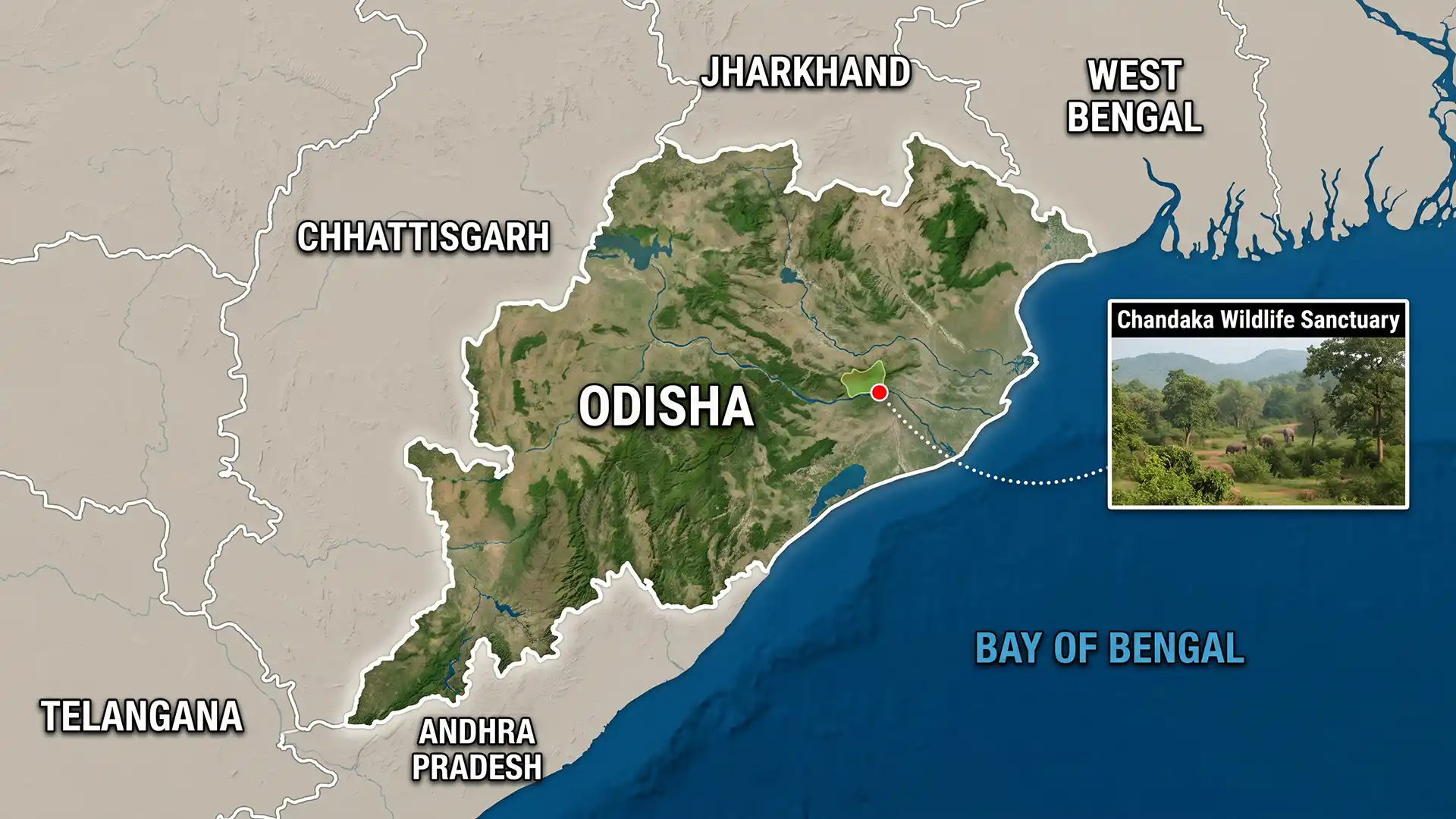
Why in news? The Odisha Forest Department has shelved a plan to introduce Indian gaurs (wild bison) into Chandaka‑Dampara Wildlife Sanctuary. Wildlife officials cited heavy human and livestock pressure around the sanctuary, which could jeopardise the animals’ survival.
Background
Chandaka‑Dampara Wildlife Sanctuary lies about 20 km from Bhubaneswar and marks the north‑eastern extent of the Eastern Ghats. Covering roughly 193 sq km of undulating hills and valleys, it was established primarily to protect Asian elephants and their habitats. The sanctuary includes small hills up to about 202 m in height, but it has no perennial streams; the 100‑ha Kumarkhunti reservoir is the only reliable water source during the dry season.
Biodiversity and threats
- Flora and fauna: The forests consist of a mosaic of evergreen and deciduous species. Main tree species include kochila, kalicha, belo, kangada, giringa, sunari, sal and teak. Chandaka supports about 70 elephants, plus chital, barking deer, wild boar, sloth bear, hyena and pangolin. Birdlife is rich, with peafowl, Asian openbill storks, purple wood‑pigeons and many raptors recorded.
- Human pressure: The sanctuary is surrounded by villages and agricultural fields. Local farmers graze an estimated 5,000 cattle within its boundaries. Encroachment, firewood collection and paddy cultivation along valley bottoms have reduced fodder for elephants and increased human–wildlife conflict.
- Suspension of gaur project: Officials planned to translocate Indian gaurs from Debrigarh to Chandaka to restore the species in the Eastern Ghats. However, veterinarians warned that cattle grazing inside Chandaka could transmit diseases to the gaurs and that the lack of secure habitat could lead to conflict. The project was therefore put on hold.
Conclusion
Chandaka Wildlife Sanctuary plays a crucial role in conserving elephants and other species near a fast‑growing city. Balancing wildlife conservation with the needs of surrounding communities remains challenging. Reducing livestock grazing, improving habitat connectivity and involving local people in conservation will be essential before any gaur reintroduction can succeed.
Sources: TOI