
Why in news?
Scientists identified a new fungal genus from Chandraprabha Wildlife Sanctuary and named it Hyalokamalomyces. The fungus was found on diseased leaves of the amaltas tree. Genetic evidence showed that its earlier classification was incorrect.
Background
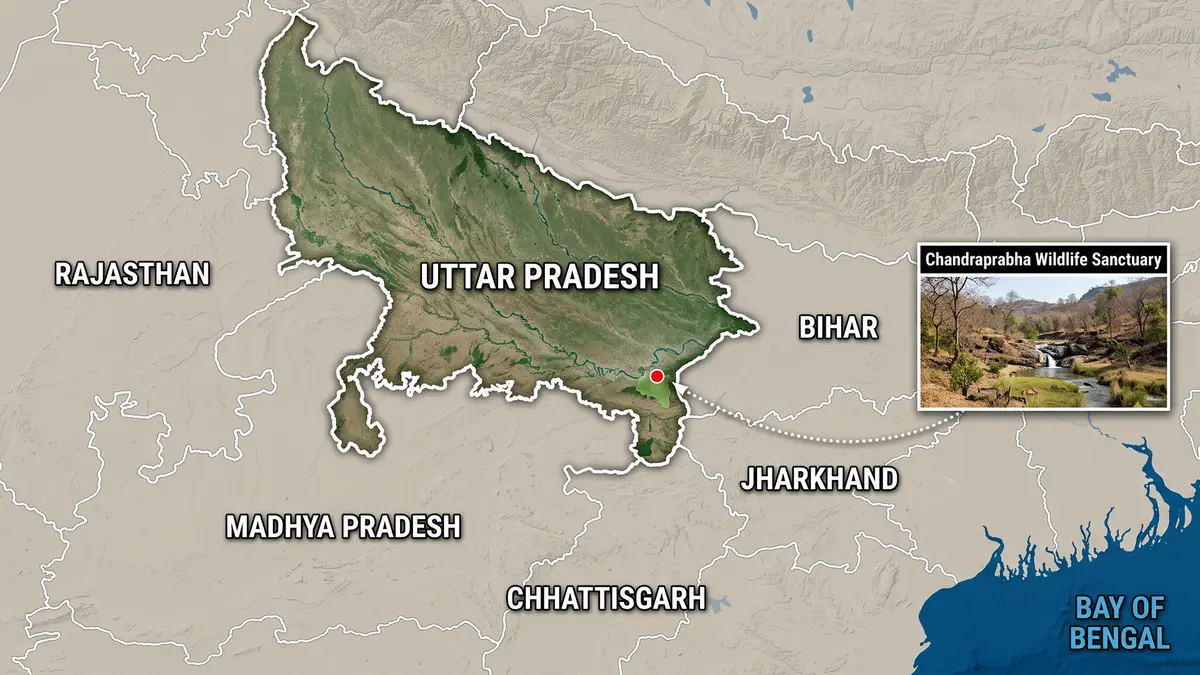
Chandraprabha Wildlife Sanctuary lies in Chandauli district of Uttar Pradesh, and it covers about 78 square kilometres.
The sanctuary occupies the Naugarh and Vijaigarh hillocks of the northern Kaimur Range. Its landscape includes forests, grasslands and waterfalls.
The Chandraprabha River flows through the area, and it joins the Karamnasha River, which later meets the Ganga.
How did the sanctuary develop?
- Varanasi’s rulers used the forest as a hunting preserve from the eighteenth century.
- Uttar Pradesh declared it a wildlife sanctuary in May 1957.
- Three Asiatic lions were introduced there during 1958.
- The introduced population increased to eleven by 1969.
- All lions had disappeared from the sanctuary by 1970.
No lions live in the sanctuary today, and the failed introduction remains part of India’s early wildlife-management history.
What was the fungal discovery?
Researchers examined diseased leaves of Cassia fistula, and this tree is commonly called amaltas or golden shower.
The fungus had previously been called Cylindrosporium cassiae, and that placement depended mainly upon visible form.
The new study combined morphology, laboratory culture, electron microscopy and genetic analysis. These methods placed it in a distinct evolutionary branch.
Scientists therefore created the genus Hyalokamalomyces, and it belongs to the fungal family Mycosphaerellaceae.
What does the name mean?
“Hyalo” refers to the fungus’s transparent or glass-like structures. “Kamalomyces” honours Professor Kamal for his contribution to fungal taxonomy.
The researchers deposited a living culture in Pune. The National Fungal Culture Collection of India will preserve it for future work.
Taxonomy point: A genus groups closely related species. Creating a new genus means the organism required a new classification above species level.
Why were several methods necessary?
- Morphology examined the fungus’s shape and reproductive structures.
- Culture studies observed its growth under controlled laboratory conditions.
- Electron microscopy revealed very small structural details.
- Multi-locus analysis compared genetic information from several genome regions.
- Phylogeny reconstructed its evolutionary relationship with other fungi.
Modern taxonomy often combines these approaches, and similar appearance alone can hide important evolutionary differences.
What lives inside the sanctuary?
Dry and mixed deciduous forests dominate the sanctuary, and common trees include teak, mahua, tendu and amaltas.
Its animals include leopards, sloth bears, chital, sambar and nilgai, and chinkara, wild boar and many birds also occur.
Rajdari and Devdari waterfalls are major attractions, and tourism must remain compatible with habitat and water protection.
Does the new fungus threaten people?
The study concerns a leaf-associated fungus and its scientific classification. It does not report a human or animal disease outbreak.
Fungal biodiversity supports decomposition, nutrient cycling and plant relationships, and disease-causing species also help scientists understand forest health.
Conclusion
The new genus shows that even familiar sanctuaries hold undocumented microscopic diversity. Protecting habitats also preserves organisms that science has barely begun to understand.