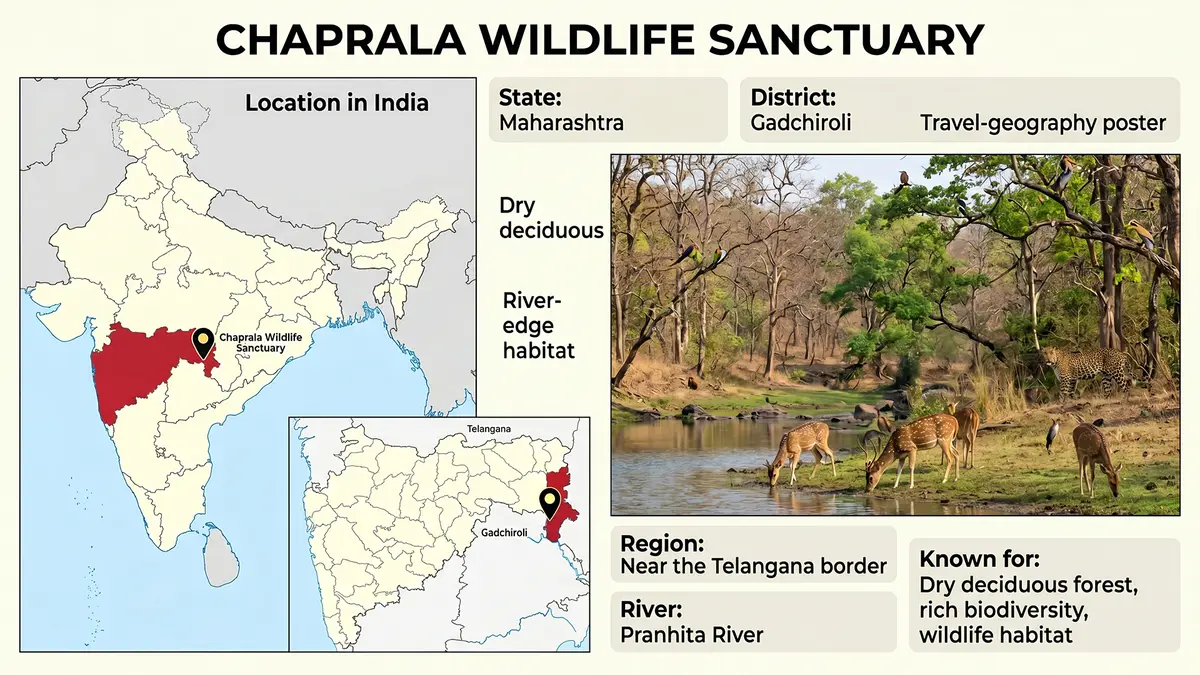
Why in News?
Chaprala Wildlife Sanctuary in Maharashtra’s Gadchiroli district has attracted attention for two reasons: plans to ensure that the proposed Pranahita–Chevella irrigation project does not submerge the sanctuary, and the sanctuary’s first citizen science bird survey that recorded a rare striated grassbird. These developments highlight the ecological value of Chaprala and the need to balance development with conservation.
Geography and Ecosystem
Established in 1986, Chaprala Wildlife Sanctuary covers about 134.78 square kilometres. It lies between the Pranhita and Wainganga rivers, which converge to form the Wardha–Wainganga system, a major tributary of the Godavari. Rolling hills such as Markhanda and Pedigundam flank the sanctuary, and seasonal streams drain into the Pranhita. The area features southern tropical dry deciduous forests interspersed with grasslands and riparian zones.
- Flora – Dominant tree species include teak, arjun, salai, mahua, bel, dhawada, tendu, sissoo and semal. Along the riverbanks, reeds and grasses provide habitat for aquatic and semi‑aquatic species.
- Fauna – The sanctuary supports tigers, leopards, sloth bears, dholes (wild dogs), civets, langurs, sambar deer, chital, nilgai, blackbuck and four‑horned antelope. Freshwater turtles, fish and prawns thrive in the Pranhita River. Recent bird surveys recorded more than 140 species, including river lapwing, oriental darter, orange‑breasted green pigeon and the rare striated grassbird.
- Management – Chaprala falls under the unified control of Tadoba–Andhari Tiger Reserve. Its proximity to human settlements and reliance on river systems make it vulnerable to ecological disturbances.
Conservation Challenges
- Hydroelectric projects – The proposed Pranahita–Chevella barrage initially threatened to submerge parts of the sanctuary. Irrigation engineers have since adjusted the alignment to minimise impact, but environmentalists stress continued vigilance.
- Habitat fragmentation – Roads, agriculture and mining in surrounding areas have fragmented wildlife corridors, increasing human–animal conflict.
- Poaching and fishing – Illegal hunting and overfishing along the Pranhita River can disrupt food chains and reduce populations of fish‑eating birds and reptiles.
- Lack of awareness – Many residents are unaware of the sanctuary’s ecological importance. Community participation is essential for monitoring and conservation.
Conclusion
Chaprala Wildlife Sanctuary harbours a unique blend of riverine and forest ecosystems. Its species richness, including apex predators and rare birds, underscores its conservation value. While infrastructure projects can bring economic benefits, they must be designed to avoid submerging or fragmenting critical habitats. Ongoing citizen science surveys and community engagement will help map biodiversity and guide sustainable management of the sanctuary’s natural resources.