

Why in News?
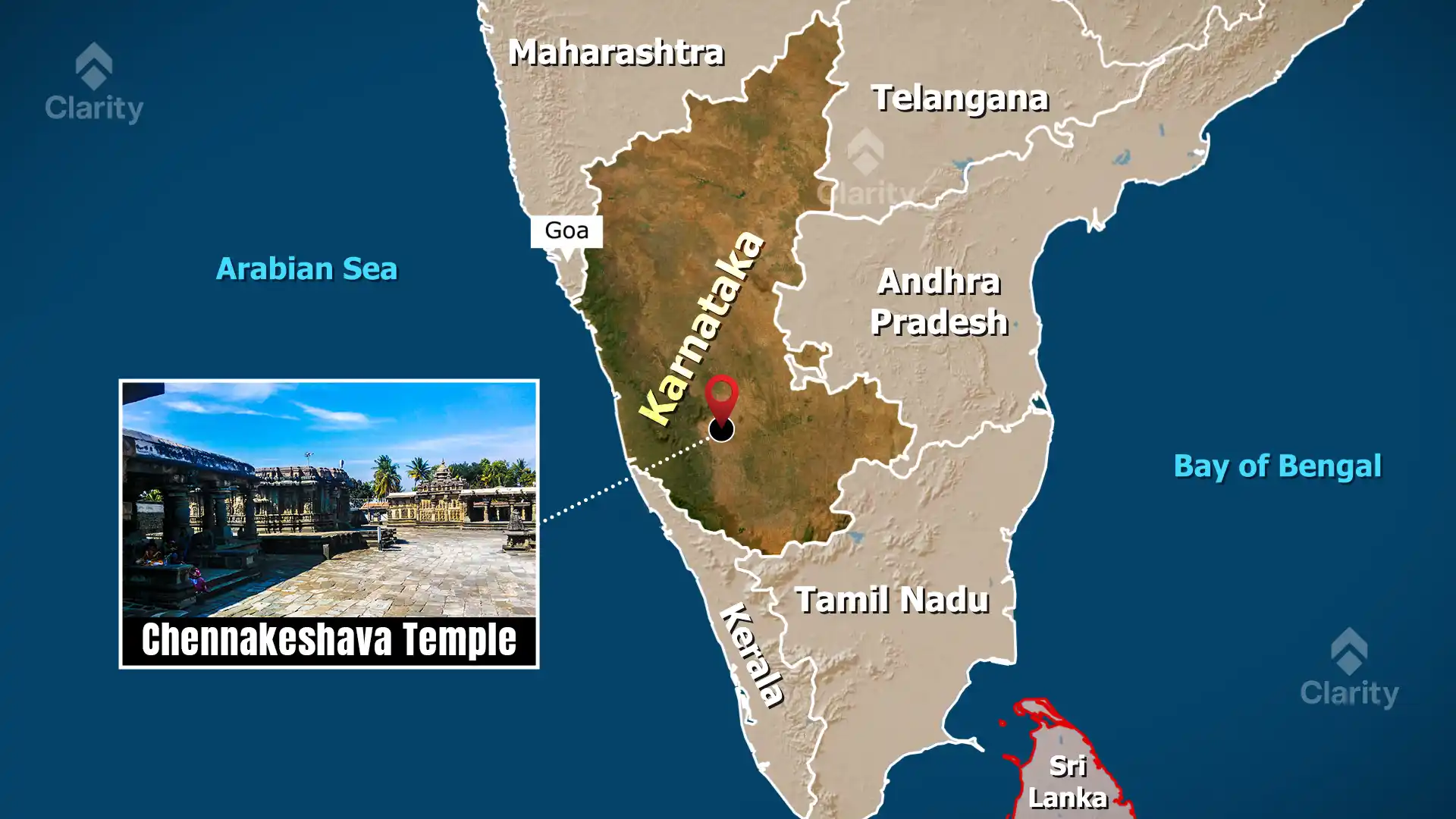
The Prime Minister’s new office complex, Seva Teerth, inaugurated in February 2026, takes inspiration from ancient Indian architecture. Its stone plinth band was modelled on the base mouldings of the 12th‑century Chennakeshava Temple in Belur, Karnataka, highlighting the temple’s enduring artistic influence.
Background
The Chennakeshava Temple (also called the Keshava or Vijayanarayana Temple) is a masterpiece of Hoysala architecture. King Vishnuvardhana commissioned it in 1117 CE after defeating the Cholas at Talakad. Construction continued for over a century, making it one of the finest examples of Hoysala craftsmanship.
- Location and Deity: The temple stands on the banks of the Yagachi River in Belur (Velapura), Karnataka. It is dedicated to Lord Vishnu in the form of Chennakeshava (“handsome Kesava”).
- Architecture: Hoysala temples emphasise horizontal plans rather than tall towers. The Chennakeshava Temple sits on a star‑shaped platform (jagati) and is built of soapstone, allowing intricate carvings. The outer walls bear friezes depicting elephants, lions, horses, battle scenes and episodes from epics. More than 80 bracket figures (madanikas) portray women in various graceful poses.
- Religious and Political Context: The temple symbolised the Hoysala shift from Jainism to Vaishnavism and served as a statement of the kingdom’s power. It remains a UNESCO World Heritage site and an active place of worship.
- Influence on Modern Design: Seva Teerth’s architects drew upon the temple’s continuous carved band at the base to create a contemporary plinth with repetitive floral and geometric motifs. The complex also integrates elements from Buddhist stupas and Chalukyan temples, reflecting India’s architectural legacy.