
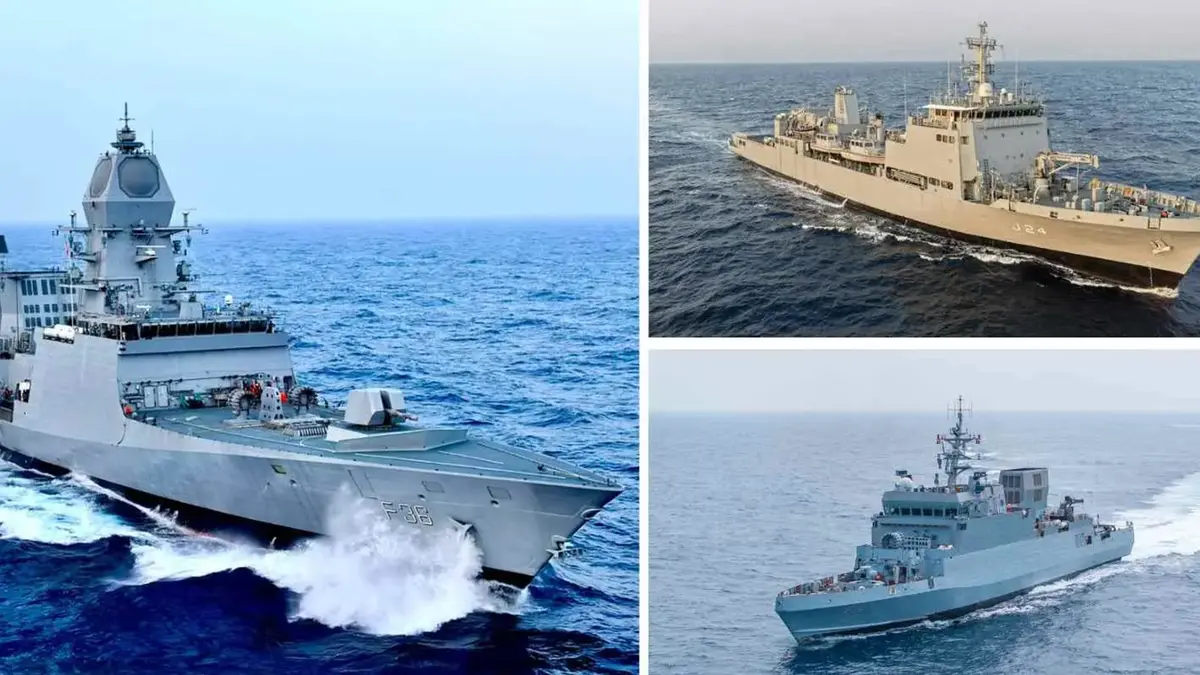
Why in news?
The Indian Navy is preparing to commission three indigenously built frontline platforms in Kolkata on 21 June 2026. They are the frigate Dunagiri, the survey vessel Sanshodhak and the anti‑submarine craft Agray. These vessels showcase India’s growing shipbuilding capability and are part of the drive for self‑reliance in defence.
Background
The frigate Dunagiri is the fifth of the Project 17A stealth frigates built by Garden Reach Shipbuilders & Engineers. It carries a mix of indigenous weapons such as the BrahMos supersonic missile and a medium‑range surface‑to‑air missile system. The design emphasises reduced radar, acoustic and infrared signatures. The survey vessel Sanshodhak is the fourth and final ship in the Survey Vessel (Large) series constructed by Larsen & Toubro. It will conduct hydrographic surveys, chart coastal waters and support search‑and‑rescue missions. The shallow water craft Agray belongs to the Arnala class. Built by Garden Reach, it is designed for anti‑submarine warfare and protection of coastal installations. All three platforms have more than 75 percent indigenous content and involve hundreds of micro, small and medium enterprises.
Key features and significance
- Dunagiri – advanced frigate: The 149‑metre ship uses combined diesel and gas propulsion for efficiency. It is armed with BrahMos cruise missiles, a medium‑range surface‑to‑air missile system, torpedo launchers and a close‑in weapon system. Modern sensors and a combat management system give it stealth and situational awareness.
- Sanshodhak – survey workhorse: Equipped with state‑of‑the‑art hydrographic equipment, including autonomous underwater vehicles and unmanned surface craft, it can map seabeds and waterways. Its integrated platform management system reduces crew workload and improves safety.
- Agray – anti‑submarine craft: This 77‑metre vessel carries lightweight torpedoes, rocket launchers and a hull‑mounted sonar to detect and neutralise underwater threats. Its shallow draught allows operations close to the coast and around offshore installations.
- Indigenous ecosystem: More than two hundred Indian companies supplied components and systems. The platforms demonstrate maturity in ship design and production, reflecting the government’s Aatmanirbhar Bharat and Make in India policies.
- Strategic impact: The new vessels will enhance the Navy’s surface warfare, hydrographic survey and coastal defence capabilities. They also free India from dependence on foreign suppliers for critical naval assets.
Conclusion
The commissioning of Dunagiri, Sanshodhak and Agray marks a milestone for indigenous shipbuilding. These ships will strengthen maritime security, support economic activities along the coast and inspire confidence in India’s defence industry.