
Why in news?
Indian Institute of Technology Guwahati researchers developed a biological material for removing lead from water. The material comes from commonly available cyanobacteria. It removed 66.2 per cent of lead under experimental conditions. Researchers now plan tests with mixed industrial wastewater.
Background
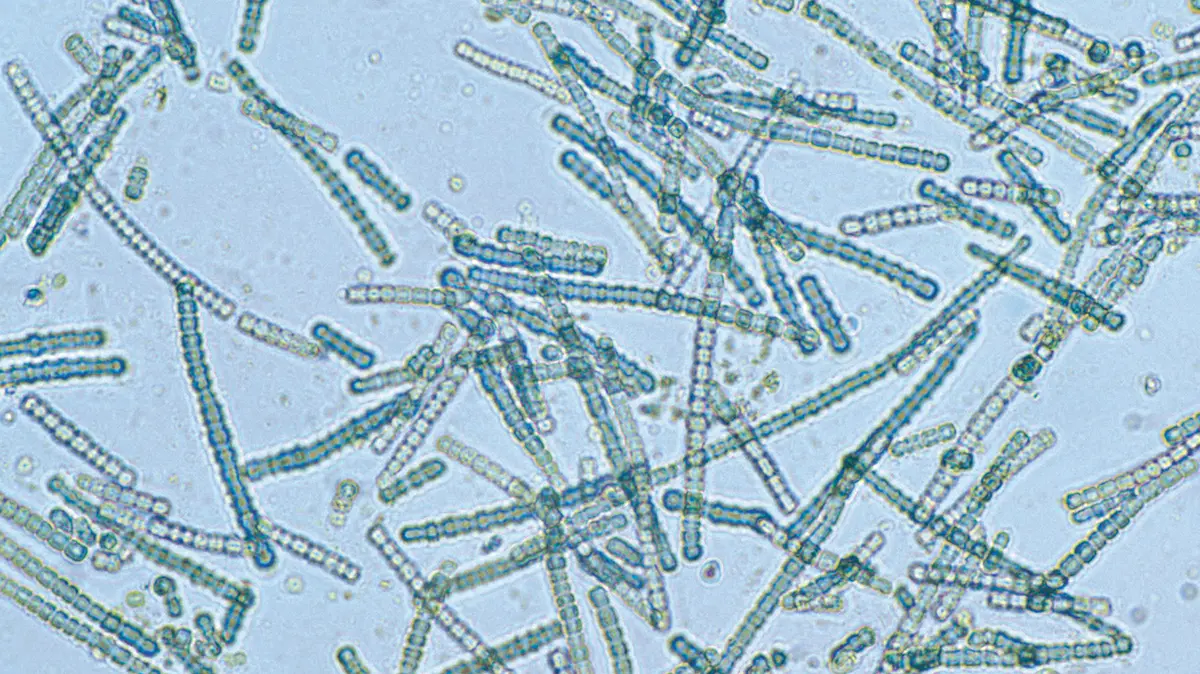
Cyanobacteria are microscopic bacteria that capture sunlight for photosynthesis, and they occur in ponds, lakes, soils, oceans and paddy fields.
They are traditionally called blue-green algae because of their colour and appearance, but they are bacteria, not true algae.
True algae have complex cells containing a nucleus, and cyanobacteria have simpler cells without a membrane-bound nucleus.
Ancient cyanobacteria began releasing oxygen on a very large scale. This helped drive Earth’s Great Oxidation Event about 2.4 billion years ago.
The event transformed oceans and the atmosphere, and it eventually supported the evolution of oxygen-dependent life.
Important features of cyanobacteria
- They perform oxygen-producing photosynthesis using water and carbon dioxide, and they contain chlorophyll-a and coloured accessory pigments.
- Some species convert atmospheric nitrogen into biologically usable compounds.
- They may live alone, in colonies or as long filaments, and many produce a sticky material outside their cells.
Warm, slow and nutrient-rich water can support rapid cyanobacterial growth, and this growth may form a visible bloom.
Some blooms release harmful toxins or reduce dissolved oxygen, but not every cyanobacterial species produces toxins.
Why is lead contamination dangerous?
Lead is a toxic heavy metal with no useful biological role. Mining, batteries, pigments and industrial discharge can release it.
Lead can damage the brain, kidneys, blood and reproductive system, and children face especially serious developmental and learning effects.
The metal does not naturally break down into a harmless substance. Water treatment must therefore separate and safely contain it.
What did the researchers use?
Many cyanobacteria release exopolysaccharides, and these are long, sugar-rich molecules located outside the bacterial cells.
The molecules form a sticky protective layer around the organism, and they also contain several chemically active binding groups.
The Guwahati team extracted this material from cyanobacteria, and they then exposed it to lead-contaminated water under controlled conditions.
How does it capture lead?
- Lead exists in water mainly as positively charged ions, and the biological material carries oxygen-rich chemical groups.
- These groups attract and bind the lead ions, and the bound metal remains attached to the material’s surface.
- Workers can then separate the loaded material from the water.
This process is mainly adsorption. Adsorption means particles collect on a surface, while absorption means entry into a material.
Important distinction: The biological material captures lead; it does not destroy the metal. Used material needs safe disposal or controlled metal recovery.
What did the study report?
- The extracted material removed 66.2 per cent of tested lead.
- Chemical analysis identified the groups responsible for metal binding.
- The biological approach worked without highly energy-intensive equipment.
- The researchers proposed a future continuous-flow treatment system.
The research appeared in the Journal of Environmental Chemical Engineering in June 2026. Debasish Das led the Indian Institute of Technology Guwahati team.
Why can this approach be useful?
- Cyanobacteria grow quickly and need simple inputs, and the raw biological material may be renewable and inexpensive.
- It could reduce dependence on costly membranes and ion-exchange materials.
- Natural binding groups may capture several toxic metals, and the process can support circular recovery of valuable metals.
What must be tested next?
Real industrial wastewater contains many metals, salts and organic chemicals, and these substances may compete for the same binding sites.
Scientists must test flow rate, repeated use and long-term stability. They must also prevent any release of unwanted biological material.
Cost comparisons need a complete treatment cycle, and that cycle includes production, separation, regeneration and final waste handling.
Present stage: The 66.2 per cent result comes from controlled research. It does not yet prove readiness for city-wide drinking-water treatment.
Conclusion
Cyanobacterial exopolysaccharides offer a promising, low-energy method for capturing lead. The study explains how surface binding makes removal possible, and safe scale-up now requires testing with complex, real wastewater.