Why in news?
Scientists involved in China’s Dark Matter Particle Explorer (DAMPE) mission announced in April 2026 that high‑precision measurements had revealed a universal feature in cosmic‑ray nuclei. The intensity of particles such as protons, helium, carbon and iron drops more sharply at a rigidity of about 15 teraelectron‑volts (TV), providing new insights into how cosmic rays are accelerated and transported through space.
About DAMPE
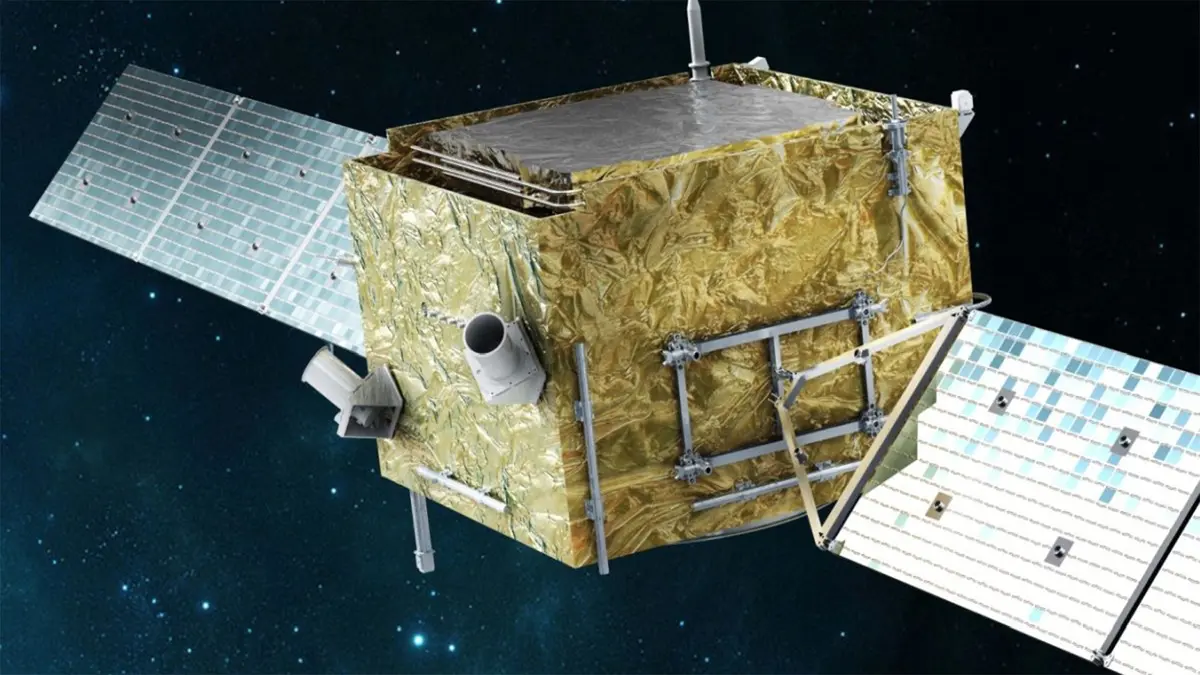
DAMPE, nicknamed “Wukong” after the Monkey King in Chinese folklore, is China’s first astronomical satellite. It was launched on 17 December 2015 and carries four instruments: a plastic scintillator detector, a silicon‑ tungsten tracker, a bismuth‑germanate (BGO) calorimeter and a neutron detector. Together these devices detect gamma rays, electrons and cosmic rays with energies up to tens of tera‑electron volts. The mission is a collaboration between Chinese and European institutions, including the University of Geneva.
New findings
- Spectral softening: Researchers observed that the flux of cosmic‑ray nuclei decreases faster beyond a rigidity of roughly 15 TV. This “spectral softening” is seen across elements from hydrogen to iron and suggests a common limit to particle acceleration.
- Model implications: The discovery supports models in which the maximum energy of cosmic rays depends on the rigidity (momentum per unit charge) rather than on energy per nucleon. Alternative models based on energy per nucleon are strongly disfavoured by the data.
- Technological contribution: The University of Geneva team developed the silicon‑tungsten tracker used to reconstruct particle trajectories with high precision. They also applied artificial intelligence techniques to analyse billions of events recorded by DAMPE.
Why it matters
Cosmic rays are the most energetic particles known. Understanding their origin and propagation helps scientists study extreme astrophysical phenomena such as supernovae, pulsars and black hole jets. DAMPE’s observation of a common spectral break brings researchers closer to identifying the mechanisms that accelerate these particles and constrains models of galactic magnetic fields and shock waves.