
Why in news?
The United States Army deployed Dark Eagle to Guam during Valiant Shield. The exercise ran from 22 June through 1 July 2026. This was the weapon’s first publicly confirmed appearance on Guam. Available reports do not establish permanent basing there.
Background
Dark Eagle is the popular name for the United States Army’s long-range hypersonic weapon.
Its formal programme name is Long-Range Hypersonic Weapon (LRHW), and the popular name became official in April 2025.
It is a ground-launched, conventionally armed system for striking distant targets.
What does hypersonic mean?
Hypersonic speed generally begins at Mach 5, meaning five times the speed of sound.
Speed alone does not make every hypersonic object a new weapon class.
Ballistic missile warheads have travelled at hypersonic speeds for decades.
Modern concern centres on sustained speed, manoeuvring and unusual flight paths.
How does a boost-glide weapon work?
- A rocket booster launches vertically or along a steep initial path.
- The booster accelerates a glide body above hypersonic speed.
- The glide body separates after the booster completes its work.
- It then glides through the upper atmosphere without an engine.
- The vehicle manoeuvres while approaching its distant target.
Its lower, changing path can complicate radar warning, although interception is not necessarily impossible.
Boost-glide weapon versus hypersonic cruise missile
| Feature | Boost-glide weapon | Hypersonic cruise missile |
|---|---|---|
| Initial acceleration | A rocket booster supplies the required speed. | A booster may first accelerate the cruise vehicle. |
| Later flight | An unpowered body glides towards the target. | An air-breathing engine powers much of the flight. |
| Dark Eagle | It belongs to this category. | It does not belong to this category. |
Main system components
| Component | Function |
|---|---|
| Two-stage booster | It accelerates the glide body to hypersonic speed. |
| Common Hypersonic Glide Body | It manoeuvres during the unpowered glide phase. |
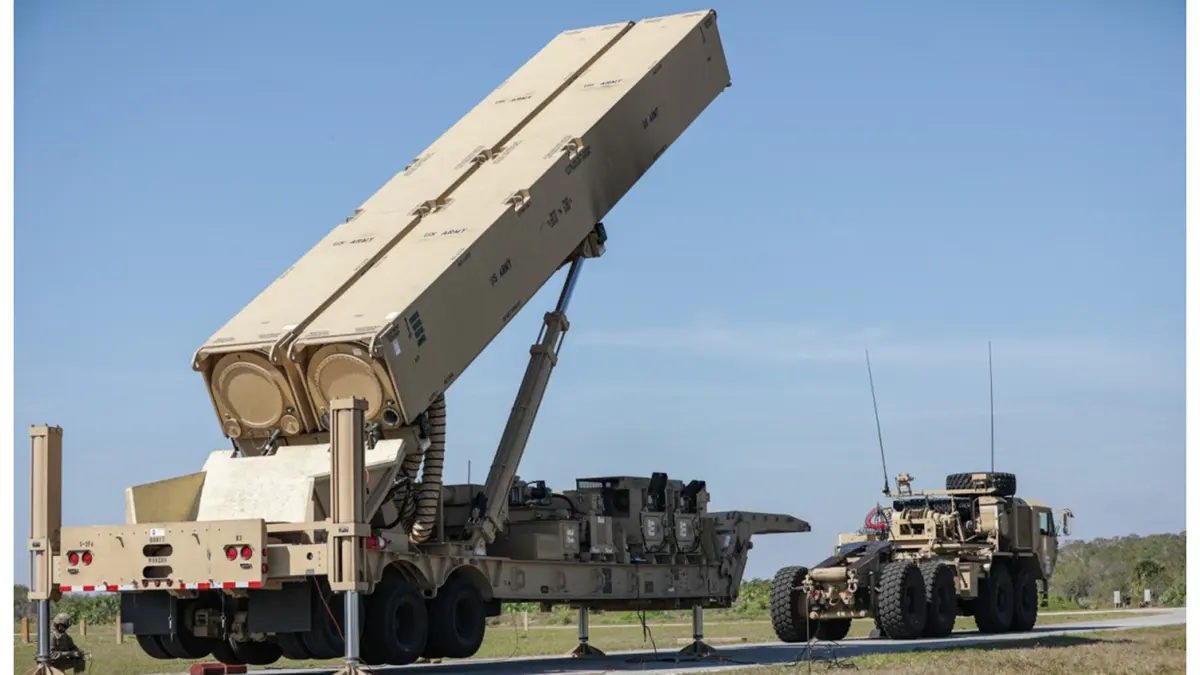
| Transporter Erector Launcher | It carries, raises and launches two packaged rounds. |
| Battery Operations Center | It provides command, planning and fire control. |
| Support vehicle | It assists battery movement and sustained operations. |
The Common Hypersonic Glide Body (C-HGB) supports both Army and Navy programmes.
The Transporter Erector Launcher (TEL) uses a modified heavy trailer.
What does one battery contain?
A planned battery has four launchers carrying two rounds each, creating eight rounds altogether.
It also includes an operations centre and support vehicle, while road mobility enables flexible positioning.
Open-source specifications
| Feature | Reliable public description |
|---|---|
| Country | The United States develops and operates the system. |
| Service | The United States Army fields the ground-launched version. |
| Weapon class | It is a conventional boost-glide strike weapon. |
| Speed | The glide body travels at Mach 5 or higher. |
| Reported range | A congressional report gives 1,725 miles, about 2,775 kilometres. |
| Payload | Public descriptions identify a conventional payload. |
Precise operational range, flight profile and accuracy remain partly classified.
Development timeline
| Year | Development |
|---|---|
| 2021 | A booster problem prevented the intended glide-body test. |
| 2022–2023 | Further failures and cancellations delayed fielding. |
| June 2024 | An end-to-end flight test succeeded over the Pacific. |
| December 2024 | A test first used the battery centre and launcher together. |
| April 2025 | The Army officially announced the name Dark Eagle. |
| July 2025 | The system made its first overseas appearance in Australia. |
| December 2025 | A designated operating battery formally activated in Washington state. |
| June 2026 | The Army deployed the system to Guam for Valiant Shield. |
Why is Guam important?
Guam is an unincorporated United States territory in the western Pacific.
It hosts major American air and naval facilities supporting operations across the wider Indo-Pacific region.
A mobile weapon there expands possible coverage, while deployment tests transport, command and operating procedures.
Was this Dark Eagle’s first overseas deployment?
Australia hosted the first overseas appearance during Exercise Talisman Sabre in July 2025.
Guam was instead the first publicly confirmed deployment to that territory.
Why is permanent deployment uncertain?
Official photographs showed an exercise deployment, but reports could not confirm whether the system remained afterward.
Temporary exercise deployment and permanent basing are therefore not equivalent.
Strategic advantages and limitations
| Possible advantage | Continuing limitation |
|---|---|
| Very high speed shortens response time. | The system and each round are expensive. |
| Manoeuvring complicates defensive tracking. | Reliable targeting still needs strong sensors. |
| Road mobility creates flexible launch options. | Large vehicles require transport and logistical support. |
| Long range supports distant conventional strikes. | Adversaries may misread a fast launch during crisis. |
Conclusion
The Guam exercise demonstrated mobility, while permanent basing remains unconfirmed.