
Why in news?
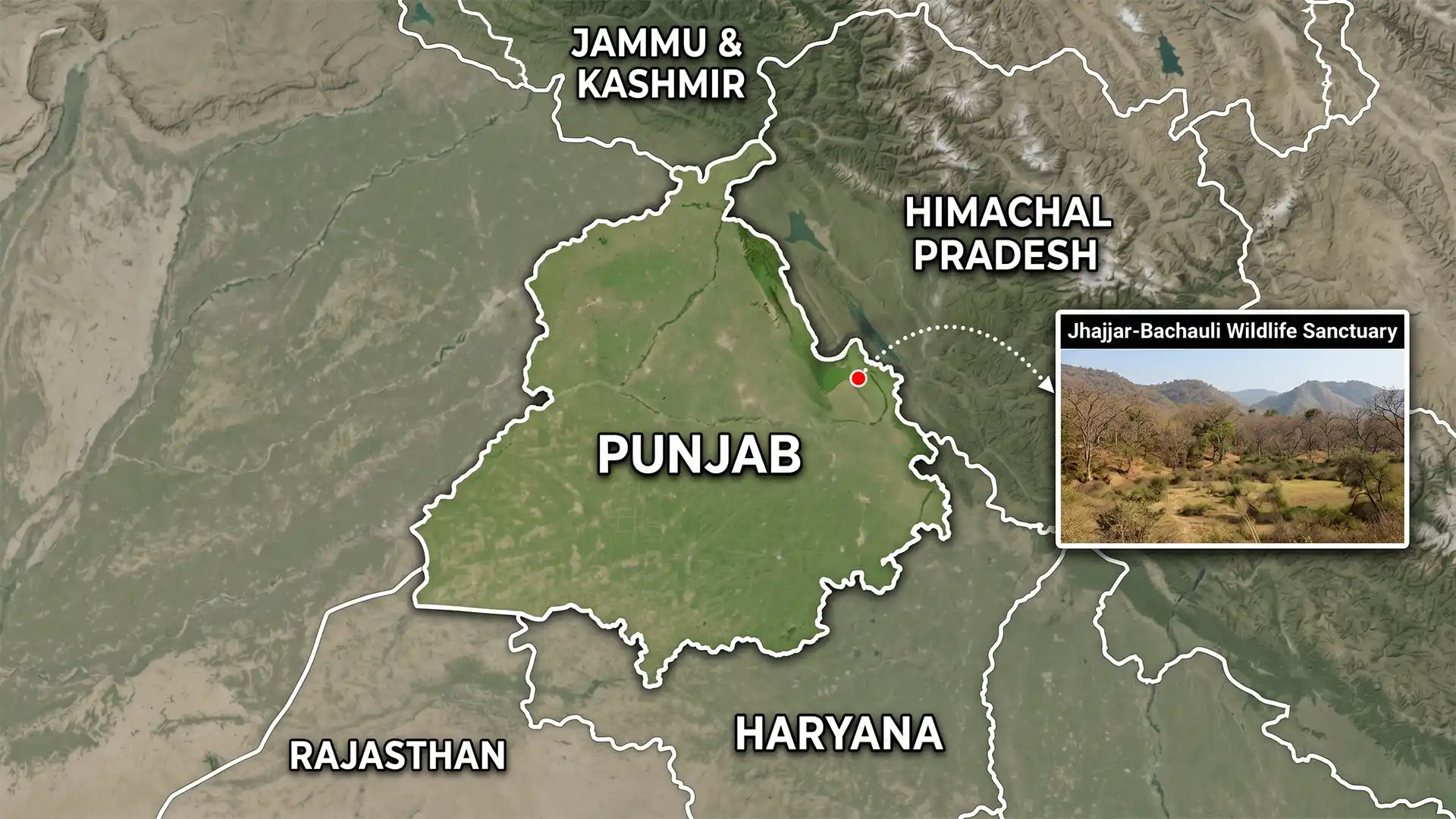
The Punjab Forest Department has prepared a ₹5.36 crore development plan for the Jhajjar–Bachauli Wildlife Sanctuary near Anandpur Sahib. In January 2026 the sanctuary was renamed the Sri Guru Tegh Bahadur Wildlife Sanctuary to honour the ninth Sikh Guru. Officials intend to create a leopard safari and nature interpretation centre to boost eco‑tourism while conserving biodiversity.
Background
Established in 1996, the sanctuary spreads across 289 acres covering the villages of Jhajjar, Bachauli and Lamlehri in Punjab’s Rupnagar district. It lies on the Shivalik foothills near the Sutlej River and consists of dry deciduous forest with scattered acacia, khair, eucalyptus, neem and shisham trees. The area was notified to protect seasonal wildlife that migrates along the river corridor. In January 2026 the Punjab State Board for Wildlife approved renaming it after Guru Tegh Bahadur.
Proposed developments
- Leopard safari: A dedicated fenced enclosure will house rescued or captive‑bred leopards, allowing visitors to observe them from vehicles without disturbing wild habitats.
- Nature interpretation centre: Plans include an educational facility explaining local ecology, Sikh heritage and conservation measures, together with watch towers and elevated observation decks.
- Eco‑friendly infrastructure: The project will construct walking trails, gazebos, solar‑powered lighting, chain‑link fencing and battery‑operated vehicles to minimise pollution. The first phase (2026‑27) has an outlay of about ₹2 crore, with the remainder to be spent over two years.
- Flora and fauna: The sanctuary hosts sambar, barking deer, hare, jackal, blue bull (nilgai), mongoose, wild boar and several reptile species. Leopards occasionally migrate from the neighbouring Himachal hills. The dry forest is dominated by deciduous trees and tall grasses.
- Community involvement: Authorities plan to employ local residents as guides and staff, generating livelihood options and ensuring that tourism benefits nearby villages.
Conclusion
The development of the Sri Guru Tegh Bahadur Wildlife Sanctuary marks a shift towards sustainable wildlife tourism in Punjab. By combining conservation with education and livelihoods, the state aims to create a model for eco‑tourism that celebrates both biodiversity and cultural heritage.