

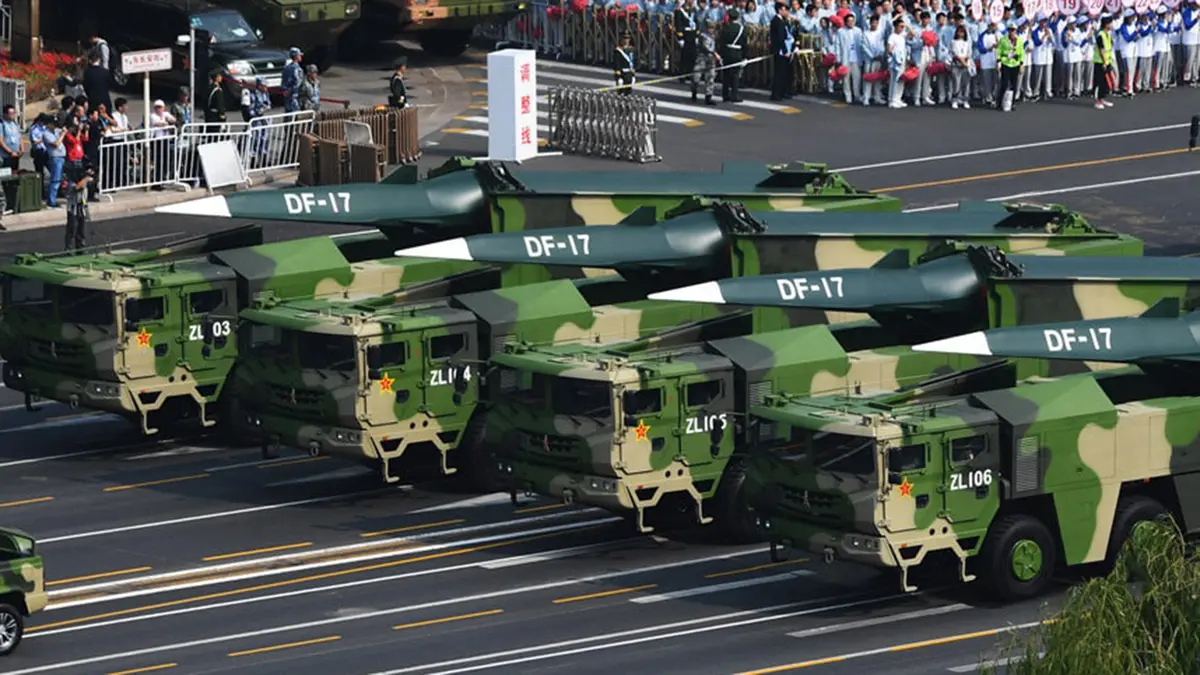
Why in news?
China’s state broadcaster CCTV recently aired footage of the launch of the Dongfeng‑17 hypersonic missile, drawing international attention to Beijing’s growing arsenal of advanced weapons. The DF‑17 is one of the few operational hypersonic glide vehicle systems in the world.
Background
Hypersonic weapons travel at speeds above Mach 5 and can manoeuvre during flight, making them hard to detect and intercept. China reportedly began testing hypersonic glide vehicles in the 2010s and officially unveiled the DF‑17 during its 2019 National Day parade. The missile is believed to carry conventional or nuclear payloads.
Specifications and operation
- Design: The DF‑17 is a road‑mobile, solid‑fuelled medium‑range ballistic missile about 11 metres long and weighing roughly 15 tonnes. Its NATO reporting name is CSS‑22.
- Range: It is estimated to reach targets 1 800 to 2 500 kilometres away, putting much of East Asia within reach.
- Hypersonic glide vehicle: After launch, the missile boosts an unpowered warhead into the upper atmosphere. There the DF‑ZF hypersonic glide vehicle separates, re‑enters the atmosphere and glides at speeds of Mach 5–10 using fins to manoeuvre. Its low, unpredictable flight path reduces radar detection and complicates interception.
Conclusion
The DF‑17 exemplifies the shift towards hypersonic weapons that can evade current missile defences. Its development has spurred major powers to accelerate research on countermeasures and underscores the strategic competition in advanced military technologies.