

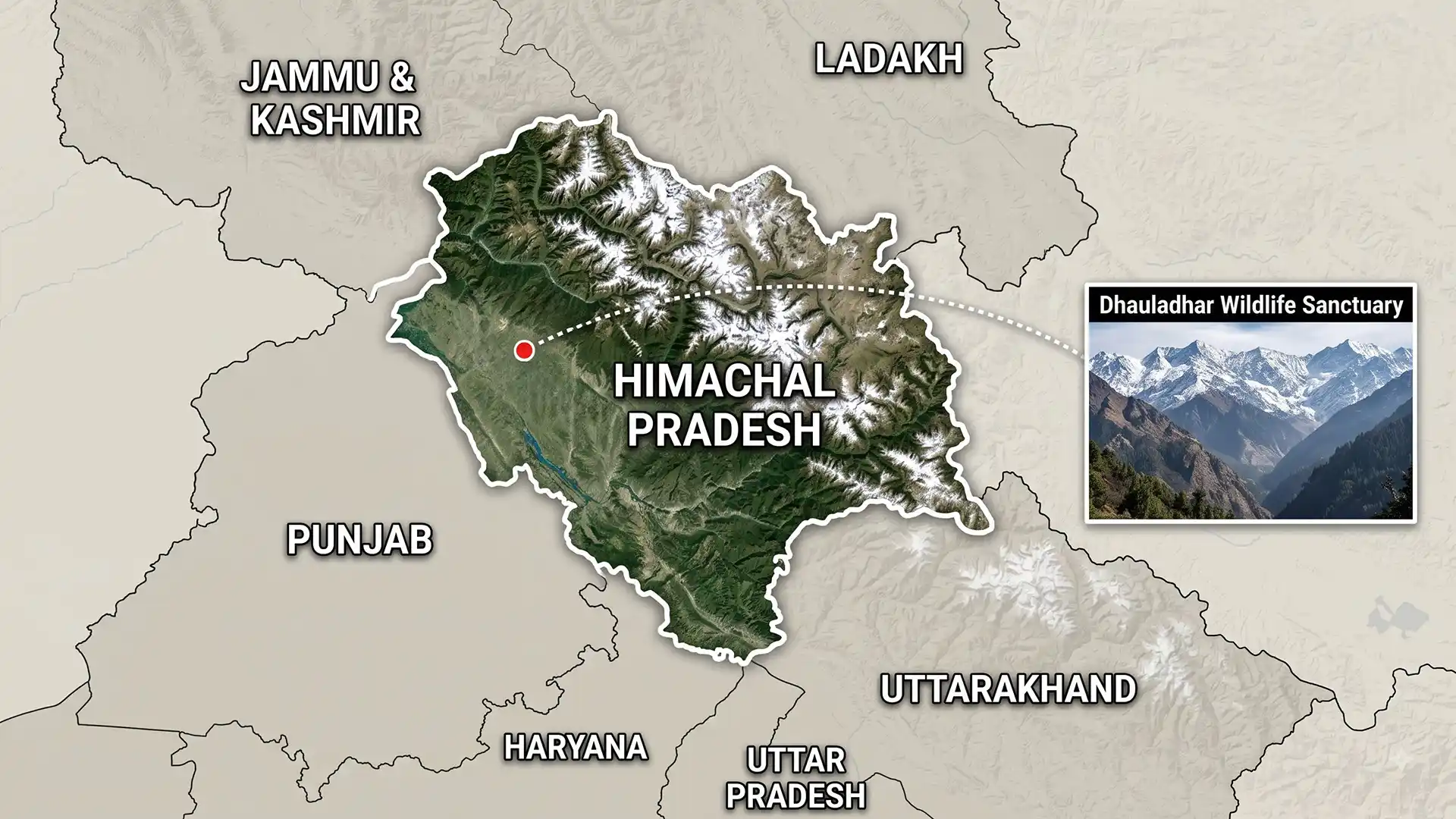
Why in news?
A camera trap photographed a snow leopard inside Dhauladhar Wildlife Sanctuary.
The image was captured on 21 December 2025 at 2,836 metres.
Officials announced the verified finding on 1 August 2026.
It is the sanctuary's first scientific photographic record of the species.
Background
Dhauladhar Wildlife Sanctuary lies in Kangra district of Himachal Pradesh. It occupies rugged slopes within the Western Himalayan biogeographic region. The sanctuary was established in 1994 and covers about 944 square kilometres.
Its elevation rises from roughly 1,600 metres to about 4,400 metres. This gradient produces several climatic zones within one protected landscape. Lower slopes contain temperate forests, while upper ridges support alpine habitats.
Chronology of the scientific survey
- The Wildlife Institute of India began a systematic mammal assessment during 2023.
- Field teams combined camera traps, direct sightings and indirect animal signs.
- Scats, pellets, pugmarks and hoof marks helped identify probable animal locations.
- Researchers placed 117 camera traps across selected habitats and movement routes.
- The survey accumulated 4,238 camera-trap days before concluding during 2026.
- It generated a baseline inventory containing 22 recorded mammal species.
- One winter camera captured the snow leopard during December 2025.
- Experts verified the image before officials released it publicly during August 2026.
Why does the photograph matter?
Camera traps create dated evidence without requiring researchers to handle elusive animals. The record confirms presence at that location and time with high confidence. It also extends the sanctuary's verified list of large mountain carnivores.
However, one photograph cannot estimate abundance, residence or breeding success. Repeated records, individual identification and genetic samples would provide stronger evidence. The photographed elevation is relatively low for a species associated with colder mountains.
Officials therefore considered movement through a connected corridor as one possibility. Young animals may disperse widely while searching for territory, prey or mates. Seasonal snow can also bring mountain species towards lower winter elevations.
Landscape and wildlife
Deodar, oak, fir, spruce and blue pine occur across different elevations. Alpine meadows and rocky slopes provide feeding areas for mountain herbivores. Recorded mammals include common leopard, Himalayan tahr and Himalayan musk deer.
The landscape also supports Asiatic black bears and Himalayan brown bears. These overlapping carnivores require adequate prey, cover and undisturbed movement routes.
Snow leopard: key facts
The snow leopard's scientific name is Panthera uncia.
It has a long tail, wide paws and dense insulating fur. These adaptations help movement and survival across steep, cold and snowy terrain. Its natural prey includes wild sheep, goats and other mountain mammals.
The International Union for Conservation of Nature classifies it as Vulnerable. India gives the species the highest protection under Schedule I.
Conservation implications
- Future cameras should test whether the photographed animal remained locally.
- Genetic sampling can distinguish individuals and reveal wider population connections.
- Prey protection is essential because carnivore survival depends upon healthy ungulate populations.
- Livestock losses require quick compensation and community-supported preventive measures; roads and tourism need planning that preserves quiet movement corridors.
- Landscape conservation must extend beyond isolated protected-area boundaries.
Conclusion
The photograph reveals Dhauladhar's ecological value beyond its better-known wildlife. Long-term monitoring must now determine whether the sanctuary supports regular snow-leopard movement.