

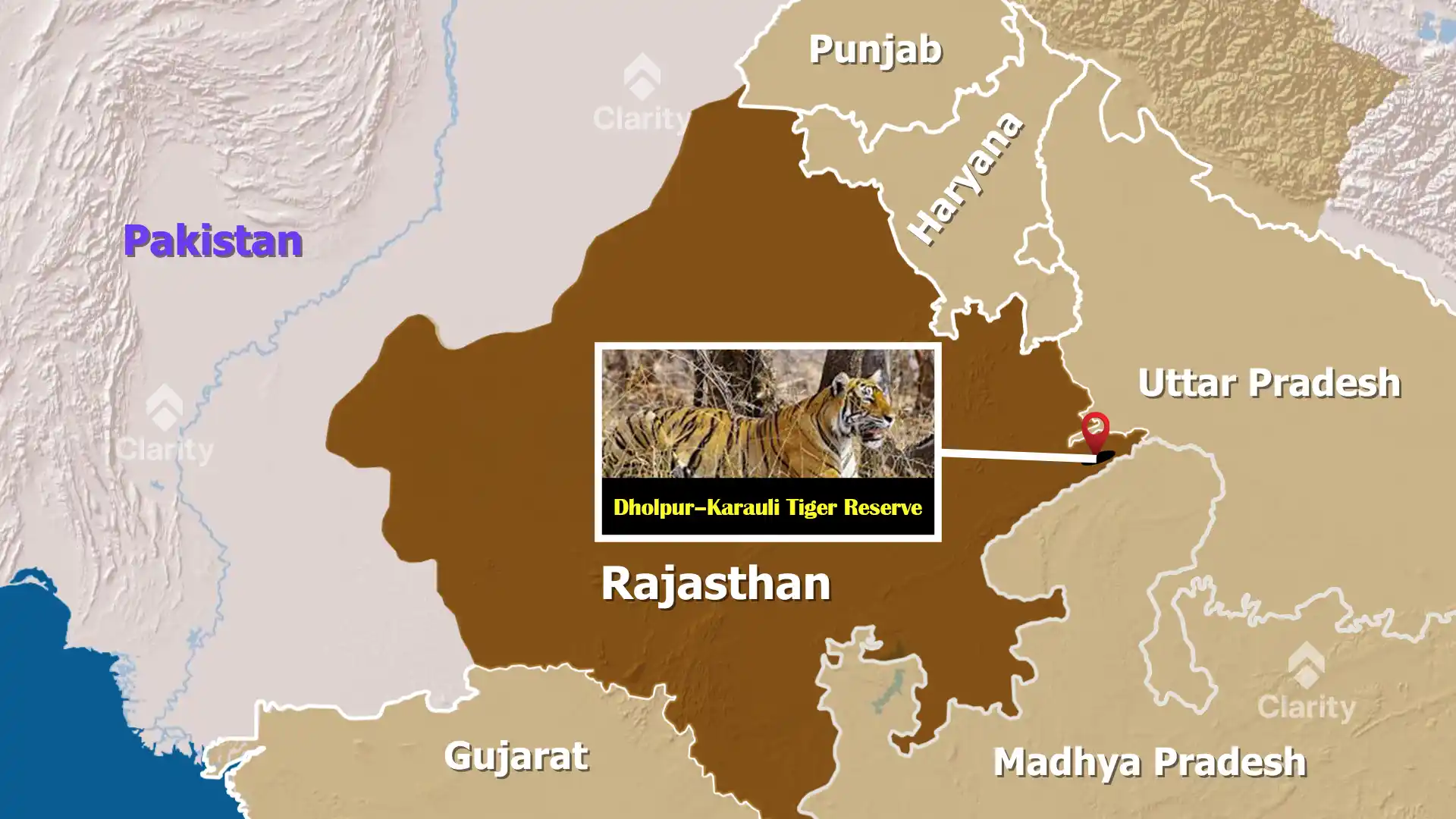
Why in news?
During discussions about human–wildlife conflict, Rajasthan’s Forest and Environment Minister announced that villagers within the new Dholpur–Karauli Tiger Reserve will not be displaced and that compensation for loss of life or livestock will be doubled from ₹5 lakh to ₹10 lakh. The statement aims to reassure local communities and promote coexistence with wildlife.
Background
The Dholpur–Karauli Tiger Reserve was approved by the National Tiger Conservation Authority (NTCA) in August 2023, making it Rajasthan’s fifth tiger reserve and India’s 54th. Located in the eastern districts of Dholpur and Karauli, the reserve forms a corridor between the Ranthambore Tiger Reserve and the ravines of the Chambal River. It covers roughly 1,100 km² of undulating plateaus, ravines and dry deciduous forests.
The core habitat is dominated by dhok (Anogeissus pendula) and khair (Acacia catechu) trees, while scrub forests and grasslands occupy the buffer zone. The Chambal River flows along the reserve’s edge, providing water and supporting riverine vegetation. Wildlife includes Bengal tigers, leopards, sloth bears, sambar, chital and wild boar.
Key features
- Purpose and status: The reserve was created to ease pressure on the overcrowded Ranthambore landscape and provide additional territory for dispersing tigers. Being a newly designated reserve, it is still developing management plans, infrastructure and eco‑development activities.
- Rugged terrain: Deep ravines carved by tributaries of the Chambal, along with rocky plateaus, offer ideal tiger habitat and serve as refuges for leopards and hyenas. Dry deciduous forests with dhok and khair support herbivores like sambar and chital.
- Community assurances: The state government has promised that no villages will be resettled without consent. Compensation for human–wildlife incidents has been doubled, and efforts will be made to involve local people in eco‑tourism and conservation activities.
- Connectivity: The reserve connects the western bank of the Chambal with the forests of Ranthambore, potentially facilitating genetic exchange among tiger populations and improving landscape‑level conservation.
Significance
- Expanding protected areas: Adding Dholpur–Karauli to India’s network of tiger reserves reflects a commitment to increase habitat for big cats and other wildlife.
- Balancing conservation and livelihoods: The government’s pledge to protect villagers’ rights and provide adequate compensation aims to reduce opposition to the reserve and encourage community participation in conservation.
- Ecological corridor: The reserve’s position along the Chambal enhances connectivity between protected areas in Rajasthan and Madhya Pradesh, facilitating wildlife movement.
Conclusion
The Dholpur–Karauli Tiger Reserve is a young yet promising addition to India’s conservation landscape. Its success will depend on effective management, community engagement and measures to mitigate human–wildlife conflict while preserving the area’s unique ravine ecosystems.
Source: The Times of India