
Why in news?
Botanists from the Jawaharlal Nehru Tropical Botanic Garden and Research Institute (JNTBGRI) announced the discovery of a new evergreen tree species named Humboldtia nairiana in the Shendurney Wildlife Sanctuary of Kerala. The species was named after the noted plant taxonomist G.M. Nair and is part of the legume family.
Background
The genus Humboldtia belongs to the pea family (Fabaceae) and includes tree species endemic to the Western Ghats. Many members of this genus exhibit myrmecophily, a symbiotic association with ants that inhabit hollow chambers in the tree and protect it from herbivores. H. nairiana was discovered during botanical surveys in the riparian forests of Shendurney Wildlife Sanctuary, which lies within the Agasthyamala Biosphere Reserve. The region’s isolation and climatic stability have allowed unique plants and animals to evolve, making it a biodiversity hotspot.
Distinctive characteristics
- Habit and size: A medium‑sized evergreen tree growing about 5–8 m tall with warty, pale‑brown bark. When the bark is cut it reveals a creamy‑white blaze.
- Branches and leaves: The branchlets are sharply angled and smooth (glabrous). The stipules – small leaf‑like structures at the base of leaves – are shorter and sparsely hairy compared with related species.
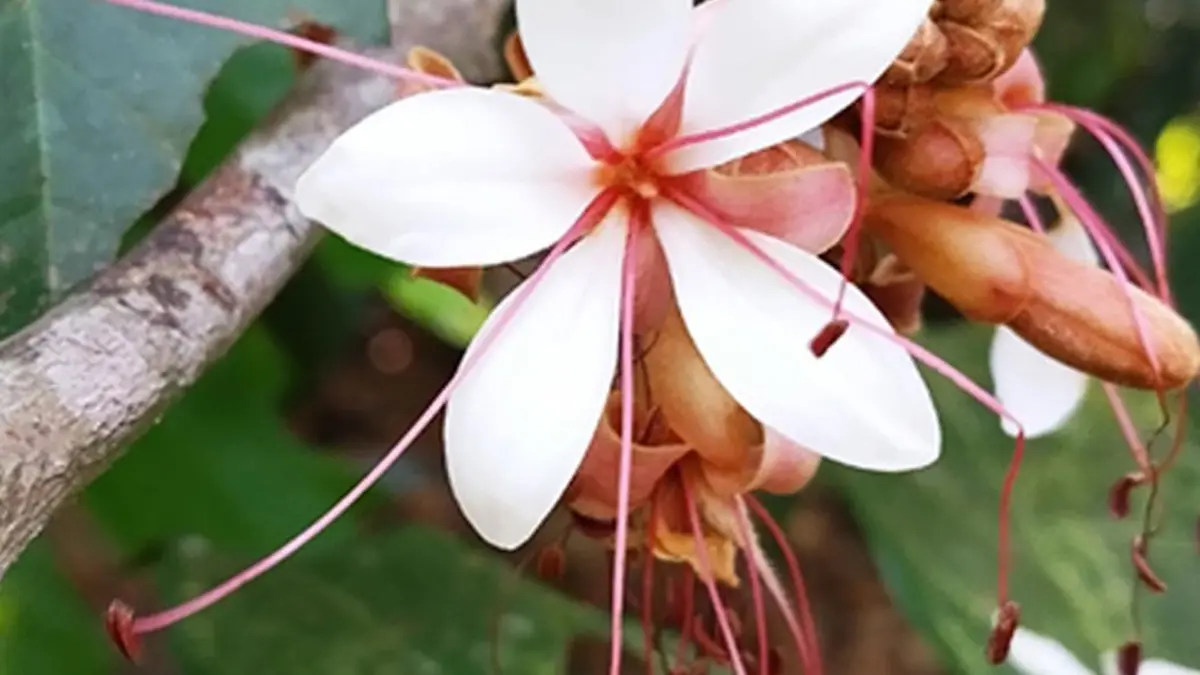
- Flowers: The flowers are larger than those of other Humboldtia species and borne on long stalks (pedicels). The petals are pinkish‑white, and the inflorescence attracts ants.
- Fruits: The pods are elliptic‑oblong with a short beak. They ripen to a leathery texture and contain two to three seeds.
Habitat and distribution
H. nairiana is strictly endemic to Kerala and has so far been documented only in the riparian forests of the Agasthyamala Biosphere Reserve around 300 m above sea level. The Shendurney Wildlife Sanctuary, part of this reserve, is located in Kollam district and features a mix of evergreen, semi‑evergreen and moist deciduous forests. Rivers such as the Shendurney, Kazhuthuruthy and Kulathupuzha converge here to form the Kallada River. The discovery highlights the importance of preserving these forested riverbanks for their unique plant diversity.
Significance
- Biodiversity value: Newly discovered species contribute to our understanding of the Western Ghats’ rich endemism. Each plant may host unique ecological interactions with insects, fungi and other organisms.
- Conservation implications: Because H. nairiana has a very limited range, habitat loss or changes in river flow could threaten its survival. Protecting riparian forests within Shendurney is therefore critical.
- Scientific curiosity: Myrmecophilous plants like Humboldtia offer a window into co‑evolutionary relationships between plants and ants, providing insights for ecology and evolutionary biology.
Conclusion
The discovery of Humboldtia nairiana underscores the biological wealth of the Western Ghats and the need for systematic surveys. Protecting riverine forests and engaging local communities in conservation will help ensure that such hidden species continue to thrive.