

Why in News?
The Ministry of Defence signed a contract with Hindustan Aeronautics Limited (HAL) on 13 February 2026 to acquire eight Dornier 228 aircraft for the Indian Coast Guard. The ₹2,312 crore order will strengthen maritime surveillance and reflects India’s push for self‑reliance in defence manufacturing.
Background
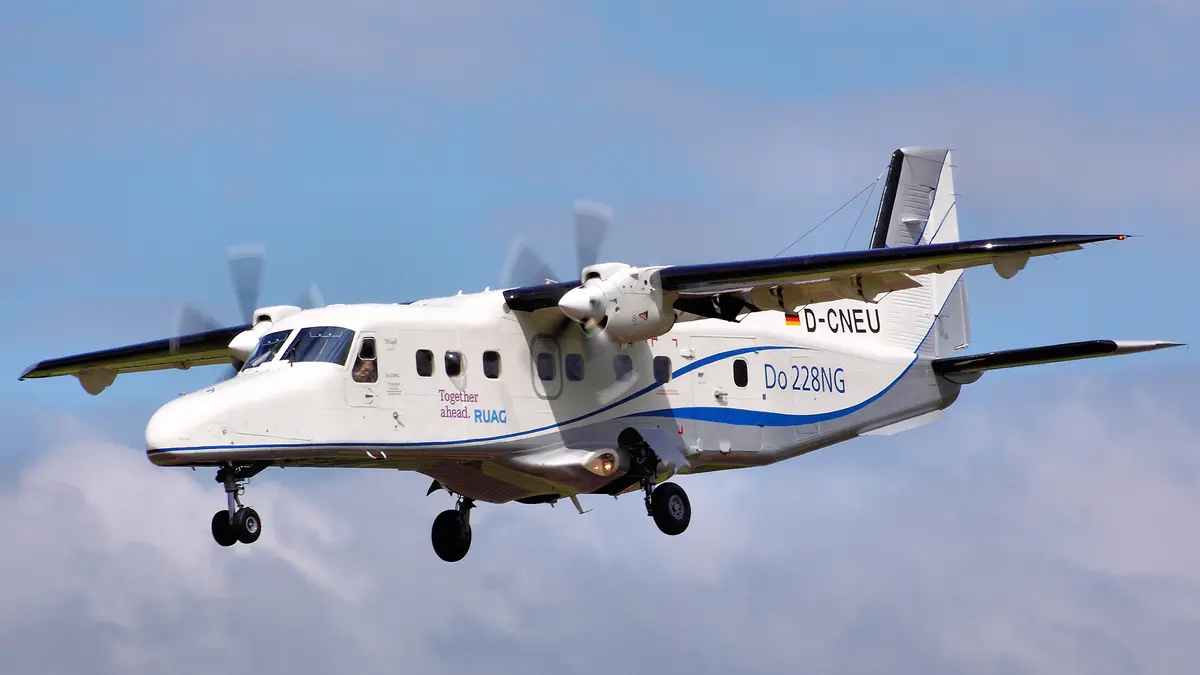
The Dornier 228 is a twin‑engine turboprop aircraft developed in Germany and produced in India by HAL since the 1980s. It is used worldwide for passenger transport, maritime patrol, search‑and‑rescue and various utility roles.
- Origin and Manufacture: Dornier developed the aircraft in the late 1970s. HAL bought a production licence in 1983 and began manufacturing at Kanpur in 1985. The aircraft now qualifies as an Indian‑made platform.
- Design: It has a high‑wing layout with a super‑critical wing and a truncated normal transition (TNT) design that produces high lift at slow speeds. The aircraft is powered by two Garrett TPE‑331 turboprop engines and can take off and land on short, unprepared airstrips.
- Capacity and Performance: The basic version seats nineteen passengers with a crew of two. Key specifications include a wingspan of about 16.97 m, length 16.56 m, maximum take‑off weight ~6.4 tonnes, cruise speed around 428 km/h and a service ceiling of 8,500 m. It offers a range of roughly 1,300 km.
- Roles: The Indian Coast Guard operates Dornier 228‑100 and 228‑200 variants for maritime surveillance, pollution control, search‑and‑rescue, medical evacuation and logistics support. Quick‑conversion cabins allow it to switch between roles.
- Significance of the Contract: The new contract will improve maritime domain awareness along India’s coast, support indigenous manufacturing and benefit numerous micro‑, small‑ and medium‑enterprise suppliers in the aerospace supply chain.