
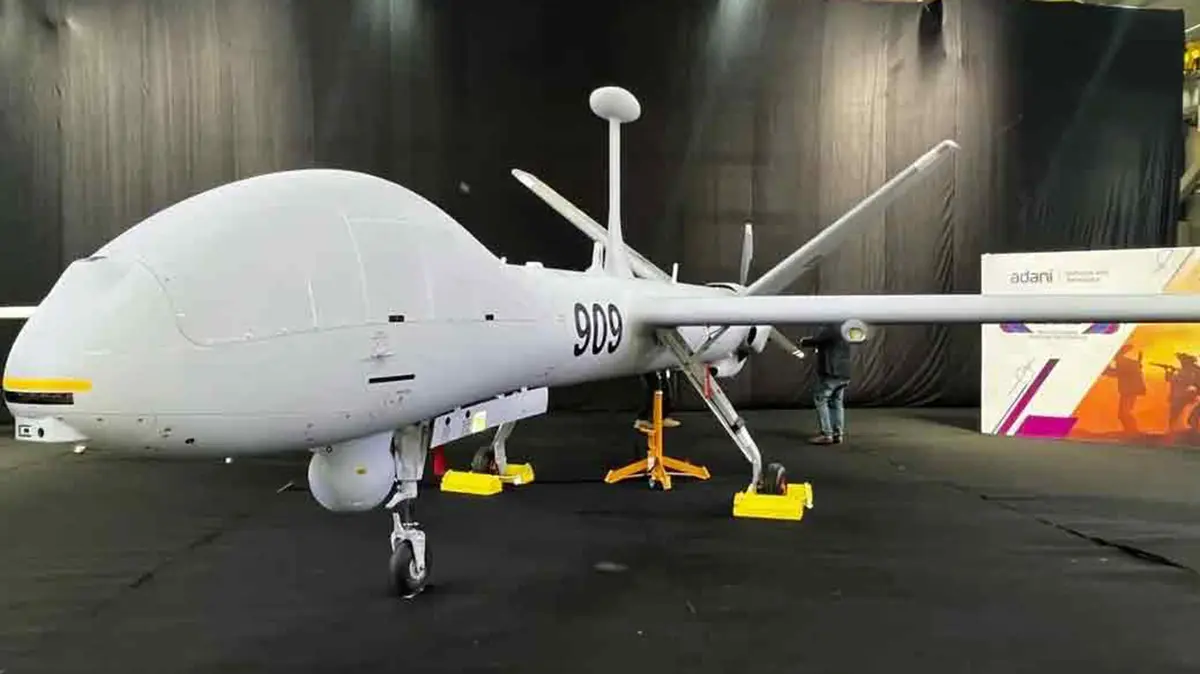
Why in news?
An Indian Navy Drishti-10 crashed near Porbandar on 8 July 2026, and it was conducting a routine training sortie. The aircraft fell in an open area without casualties or property damage. The Navy ordered an inquiry into the cause.
Background
Navies need continuous information across very large sea areas. Crewed aircraft can perform this work, but their endurance is limited.
Long-endurance uncrewed aircraft can remain airborne for many hours, and they carry sensors and send information to ground controllers.
India acquired the Drishti-10 for naval and land-border surveillance, and Adani Defence and Aerospace manufactures the Indian version in Hyderabad.
What is Drishti-10?
Drishti-10 Starliner is a Medium-Altitude Long-Endurance uncrewed aerial vehicle, and the common category abbreviation is MALE UAV.
It is based on the Hermes 900 platform of Israel’s Elbit Systems. The Indian aircraft is produced through technology transfer and local manufacturing.
Origin distinction: Drishti-10 is manufactured and integrated in India, and its base design is Israeli. Describing the complete platform as wholly indigenous would therefore be inaccurate.
What does MALE mean?
Medium altitude describes its normal operating height category; Long endurance means it can remain airborne for extended missions.
The platform can operate near 30,000 feet. Public specifications place endurance around 36 hours, depending on mission load and conditions.
Main missions
- Intelligence builds understanding from collected information; Surveillance watches an area continuously.
- Reconnaissance gathers information about a specific place or target; Maritime patrol monitors ships and activity across sea areas.
- Communication relay can connect forces beyond direct radio range.
These three information functions are often grouped as ISR, and ISR means Intelligence, Surveillance and Reconnaissance.
Sensors and payloads
The aircraft has a modular payload bay, and different missions can use different sensor combinations.
- Electro-optical cameras provide daylight imagery, and infrared sensors can detect heat during darkness.
- Maritime radar can scan wide sea areas, and communication equipment transmits information to operators.
- Electronic sensors can detect selected radio-frequency activity.
Reported payload capacity is up to about 450 kilograms, and actual carriage depends on the fitted configuration.
Line-of-sight and satellite control
A direct data link works within radio line-of-sight, and Earth’s curvature eventually blocks this connection.
Satellite communication supports beyond-line-of-sight operation, and it lets controllers receive data from far beyond the horizon.
The aircraft still requires human command and mission supervision, and automation does not make it an independent decision-maker.
Airworthiness standard
The platform is associated with NATO STANAG 4671. NATO means the North Atlantic Treaty Organization.
STANAG means Standardization Agreement. This standard supports airworthiness assessment for military uncrewed aircraft.
This standard provides airworthiness requirements for fixed-wing military UAV systems, and certification supports safer integration with other air traffic.
It does not automatically grant unrestricted access to every country’s civilian airspace. National aviation authorities retain control.
Induction timeline in India
- The Navy received its first Drishti-10 during January 2024, and the Army received a platform during June 2024.
- The Navy received another aircraft during December 2024, and naval operations are centred on Porbandar for Arabian Sea surveillance.
What happened in July 2026?
The UAV crashed near Dharampur village in Porbandar district, and it was flying a routine training mission.
No person was injured, and no property damage was reported. A formal inquiry will examine technical, operational and environmental evidence.
An inquiry is not proof of a design defect or operator error. The cause should remain open until official findings emerge.
Do not confuse categories: A UAV is the aircraft. An Uncrewed Aircraft System also includes controllers, links and ground equipment.
Conclusion
Drishti-10 expands India’s long-endurance surveillance capacity, and its Indian production supports local aerospace capability. The crash inquiry must establish facts before broader conclusions are drawn.