
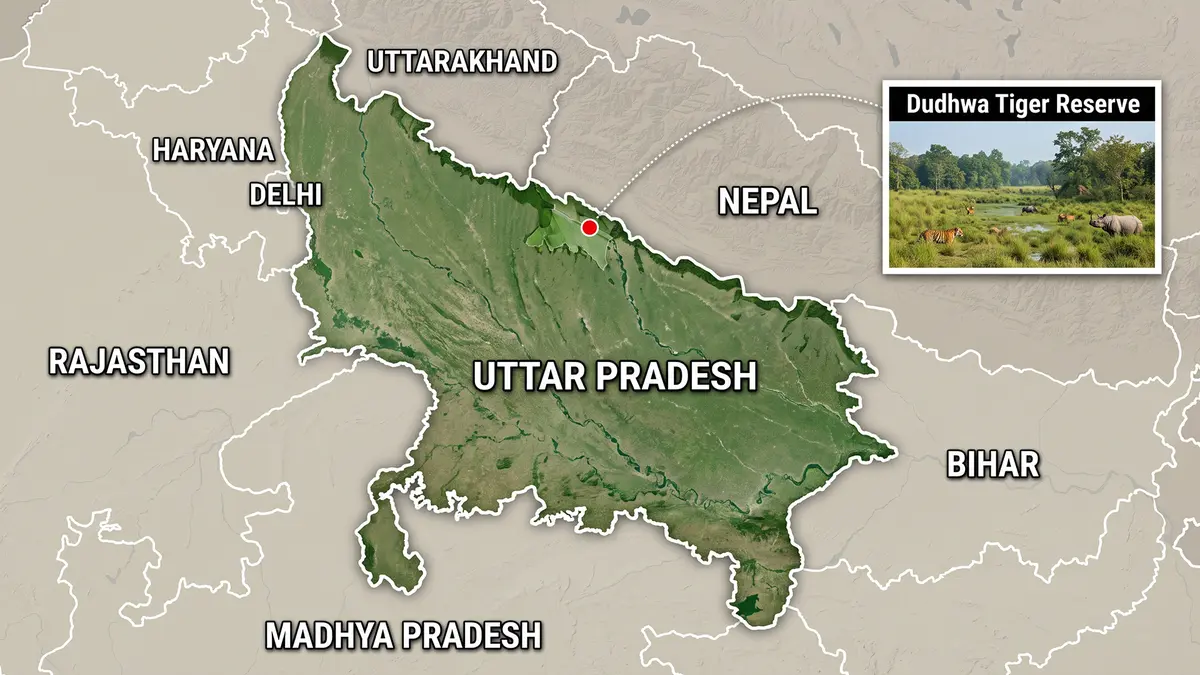
Why in news?
Dudhwa’s fourth rhinoceros census counted 53 greater one-horned rhinoceroses. Teams surveyed the reserve from 25 to 27 June 2026. The total included 17 adult males, 25 adult females and 11 calves. Uttar Pradesh is one of only three Indian states supporting wild populations of this species.
Background
Dudhwa Tiger Reserve occupies the Terai’s grassland-rich, fertile river plain in northern Uttar Pradesh, beside the international border with Nepal.
The Terai contains grasslands, marshes and moist forests, while nearby Bhabar has coarse soil where streams can disappear.
Protection began around Sonaripur in 1958, mainly for the swamp deer, and a larger Dudhwa wildlife sanctuary followed in 1968.
Dudhwa became a national park in 1977, and it entered the Project Tiger network during 1987–88.
The present tiger reserve is larger than Dudhwa National Park, and it joins several protected areas and surrounding buffer forests.
Which areas form the tiger reserve?
- Dudhwa National Park forms an important core component.
- Kishanpur Wildlife Sanctuary lies towards its southern landscape.
- Katerniaghat Wildlife Sanctuary lies farther east near Nepal.
- North Kheri, South Kheri and Shahjahanpur forests form buffer areas.
The National Tiger Conservation Authority records 1,093.79 square kilometres of core and 1,107.9848 of buffer.
The recorded total is 2,201.7748 square kilometres, although older sources may quote smaller areas covering the national park.
Core areas receive strict habitat protection. Buffers surround them and combine conservation with regulated human activity.
Do not confuse: Dudhwa National Park is one component, and Dudhwa Tiger Reserve covers a much larger connected landscape.
Where is it located?
Dudhwa National Park lies in Lakhimpur Kheri district beside the international border. Kishanpur extends into Lakhimpur Kheri and Shahjahanpur districts.
Katerniaghat lies in Bahraich district, and Nepal forms its northern boundary.
Rivers include the Suheli, Mohana, Sharda, Joraha, Nagrol, Nakua and Newra, and channels and wetlands change greatly between seasons.
The landscape connects with Nepal’s Shuklaphanta and Bardia protected areas, and these corridors allow movement by tigers, elephants and rhinoceroses.
What habitats and animals occur there?
North Indian moist deciduous forest covers large areas, and sal trees dominate many forest blocks.
Tall floodplain grasslands and seasonal marshes support specialised wildlife, and frequent flooding renews these habitats but can also displace animals.
- Tigers, leopards, elephants and sloth bears use the reserve.
- Swamp deer, hog deer, spotted deer and barking deer occur there.
- Fishing cats and smooth-coated otters use wetlands.
- Hispid hares depend upon dense tall grass.
- Gharials and Gangetic dolphins use connected river channels.
- Greater one-horned rhinoceroses graze in grasslands and marshes.
How did rhinoceroses return to Dudhwa?
The greater one-horned rhinoceros once ranged across northern South Asia, and hunting and habitat loss reduced it to scattered populations.
Dudhwa began a reintroduction programme in 1984, and seven founder rhinoceroses came from Assam and Nepal.
Managers placed the founders in South Sonaripur’s rehabilitation area, where fencing allowed close protection and breeding within suitable habitat.
The population grew from those few founders over four decades. A second rehabilitation area later provided more habitat and management space.
The first area covers about 27 square kilometres, and the second covers about 13.4 square kilometres.
How was the latest census conducted?
The fourth census ran from 25 to 27 June 2026. Twenty teams included trained forest personnel and staff from World Wide Fund for Nature–India.
Surveyors rode 20 trained camp elephants with handlers called mahouts. The elephants helped teams cross tall grass and marshes.
Teams searched both rehabilitation areas in six-hour shifts and also tracked animals already roaming freely outside the enclosures.
A direct count is still a census estimate under field conditions. Dense vegetation and moving animals require careful identification to avoid duplication.
What did the census find?
- The total population was 53 rhinoceroses.
- Adult males numbered 17.
- Adult females numbered 25.
- Calves older than one year numbered 11.
- Rehabilitation Area 1 contained six animals.
- Rehabilitation Area 2 contained 36 animals.
- Eleven animals were free-ranging.
Both sets of figures add correctly to 53, and age-sex classes and locations describe the same total in different ways.
Which rhinoceroses were released?
Managers have gradually moved selected animals from fenced areas into wider habitat, and monitoring uses radio and satellite tracking.
- Vijay Shri and Deepika were released in November 2024.
- Nakul and Riddhi were released in March 2025.
- Harsh, Deepti, Sushma and Rashi were released in March 2026.
These eight are among the eleven free-ranging rhinoceroses, and earlier free-ranging animals make up the remaining number.
Moving animals can increase mate choice and mixing between managed groups. However, relocation within Dudhwa cannot create new genetic variants.
Genetic caution: Wider mixing can reduce close breeding, but new genetic material requires unrelated animals from outside the population.
Were there recent deaths?
Three reported deaths occurred before the census, and these incidents show that a growing population still faces natural risks.
Napoleon, a dominant male, killed four-year-old Himanshu in August 2025 and an eight-month-old female calf in January 2026.
Two tigers killed an adult female called Rajeshwari in March 2026. The reported deaths involved conflict and predation, not poaching.
How much did the population increase?
The 2025 census reported 51 rhinoceroses, while the 2026 census recorded 53. The comparable headcount therefore increased by two.
The latest report called the change a “net increase of five” but did not reconcile this with the previous total.
Births, deaths and internal releases must not be mixed when calculating population growth. Releases within Dudhwa change location, not the reserve total.
Verified comparison: The reported census totals moved from 51 in 2025 to 53 in 2026. That is a rise of two animals.
Why is this population important?
Uttar Pradesh is one of only three states with wild greater one-horned rhinoceroses, alongside Assam and West Bengal.
Dudhwa provides a population outside the species’ main Assam strongholds, and geographic spread reduces dependence upon one landscape.
Rhinoceroses also shape grasslands through grazing and movement. They can prevent a few tall grasses from dominating every open patch.
Their dung moves nutrients and seeds, and for this reason, large herbivores are sometimes called ecosystem engineers.
What is the species’ conservation status?
The greater one-horned rhinoceros, scientifically named Rhinoceros unicornis, is classified as Vulnerable by the International Union for Conservation of Nature.
The Convention on International Trade in Endangered Species of Wild Fauna and Flora lists it in Appendix I. Commercial international trade in wild specimens is generally prohibited.
India’s Wildlife (Protection) Act places the species in Schedule I, and hunting is prohibited except under narrow statutory situations.
Which threats remain?
- A small founder base raises inbreeding, meaning mating among close relatives.
- Poachers target horns for illegal international markets.
- Invasive plants can replace nutritious grassland.
- Floods may separate calves or push animals near villages.
- Territorial fights can kill young or weaker animals.
- Tigers may prey upon calves and occasionally adults.
- Broken corridors can restrict movement across the Terai.
- Roads and railways can cause disturbance and collisions.
What should management prioritise?
Managers need genetic monitoring, healthy grasslands and secure water. Carefully planned exchange with suitable outside populations may improve long-term genetic health.
Free-ranging animals need continuous tracking during early adaptation, and teams must also prepare for floods, conflict and veterinary emergencies.
India and Nepal should protect cross-border corridors together. Local communities need quick support when wildlife damages crops or threatens safety.
Conclusion
Dudhwa’s 53 rhinoceroses represent four decades of patient reintroduction. Their future depends upon genetic planning, connected habitat and accurate monitoring.