
Why in news?
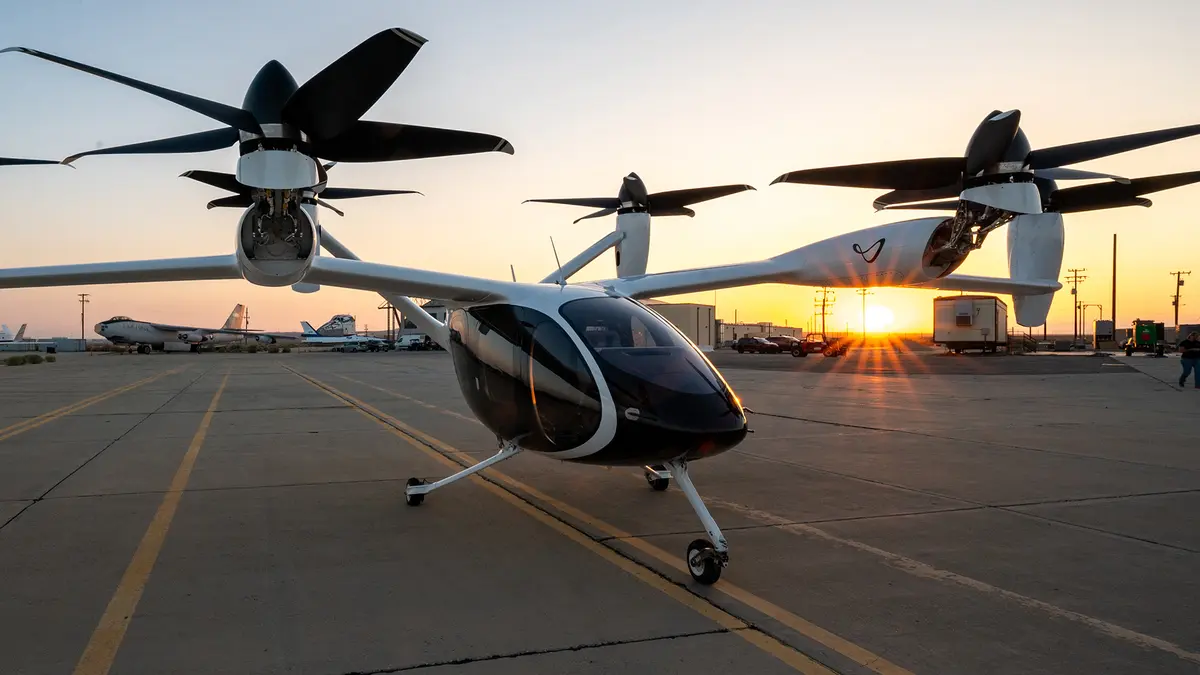
The ePlane Company unveiled India’s first full-scale electric vertical take-off and landing prototype. The aircraft is called e200X, while this prototype carries the code PT-01. It has not flown yet and must complete certification testing.
Background
An electric vertical take-off and landing aircraft uses electric power for flight.
The full term is commonly shortened to eVTOL after its first use.
It rises and lands vertically, so it does not need a runway.
After climbing, many designs use wings for more efficient forward flight.
These aircraft form part of a wider idea called advanced air mobility.
This idea uses smaller aircraft for short passenger, medical and cargo journeys.
How does an eVTOL aircraft fly?
Batteries supply several distributed motors, whose propellers create upward thrust greater than the aircraft’s weight.
The aircraft climbs vertically like a helicopter before its wings support more efficient forward flight.
Some designs tilt their propellers, while others use separate fixed systems for lifting and cruising.
What is distributed electric propulsion?
Distributed electric propulsion spreads thrust across several electric motors and propellers.
This arrangement offers flexibility and may preserve controlled thrust when one motor fails.
However, safe continuation depends upon the certified design and failure conditions.
How is it different from a helicopter?
| Feature | Typical eVTOL design | Conventional helicopter |
|---|---|---|
| Energy source | Rechargeable batteries power electric motors. | Aviation fuel usually powers turbine engines. |
| Lift system | Several smaller propellers may share the work. | One main rotor usually provides most lift. |
| Runway need | No runway is needed for vertical operations. | No runway is needed for vertical operations. |
| Noise | Designers expect lower noise, especially during some flight stages. | Large rotors and engines create substantial noise. |
| Maturity | Most passenger designs remain under testing and certification. | Helicopter operations use long-established standards and infrastructure. |
Therefore, vertical flight alone does not make eVTOL technology entirely new.
The main change is electric propulsion combined with modern control systems.
Who developed the Indian prototype?
The ePlane Company developed the e200X after incubation at the Indian Institute of Technology Madras.
The institute is commonly called IIT Madras.
ePlane unveiled PT-01 at its IIT Madras Discovery Campus production facility.
The event displayed a full-size airframe rather than a commercial aircraft launch.
Status correction: The company unveiled a prototype; it did not launch passenger service. PT-01 has not yet made its first flight.
Important features of e200X PT-01
- Its carbon-fibre airframe has a maximum take-off weight of about 2.2 tonnes.
- The aircraft measures roughly eight by eleven metres and carries one pilot with two passengers.
- A cargo configuration could carry 200 kilograms across a targeted 110-kilometre operating range.
- An 800-volt electrical system supplies separate fixed propellers for vertical and forward movement.
The compact footprint aims to use existing helipads and suitable open spaces.
Rooftop operations would still need structural, fire-safety and regulatory approvals.
Testing and certification pathway
The full-scale aircraft must first complete structural and system tests on the ground.
The company targets initial uncrewed flight trials around mid-2027.
Its smaller demonstrator aircraft have reportedly completed over 10,000 kilometres of test flying.
Those smaller tests support development but never certify the full-scale aircraft.
The Directorate General of Civil Aviation regulates civil aircraft safety in India.
This regulator is commonly called the DGCA after its full name.
The company received Design Organisation Approval from the DGCA during May 2023.
That approval recognises organisational design capability but does not certify PT-01 for commercial passenger operations.
Certification sequence: Organisation approval concerns the designer. Type certification concerns the aircraft design. Operating approvals govern actual commercial services.
Possible uses
- Air ambulances could bypass congestion, while air taxis could connect airports and business districts.
- Cargo and disaster versions could carry urgent goods where roads become unusable.
Major challenges
- Batteries must balance range and payload, while critical systems need proven failure responses.
- Cities need approved landing areas and charging, while air traffic needs safe flight-management systems.
- Weather can restrict operations, while affordable fares need high use and manageable battery costs.
- Public acceptance requires reliable evidence about noise and safety near homes and workplaces.
Conclusion
PT-01 advances Indian electric aviation, but success requires flight evidence, certification and safe daily operations.