
Why in news?
The United States Federal Communications Commission authorised Reflect Orbital’s Eärendil-1 satellite on 9 July 2026. The experimental satellite will direct reflected sunlight towards selected ground areas after sunset. The licence covers one satellite for a limited two-year period. Astronomers have raised concerns about sky brightness and observations.
Background
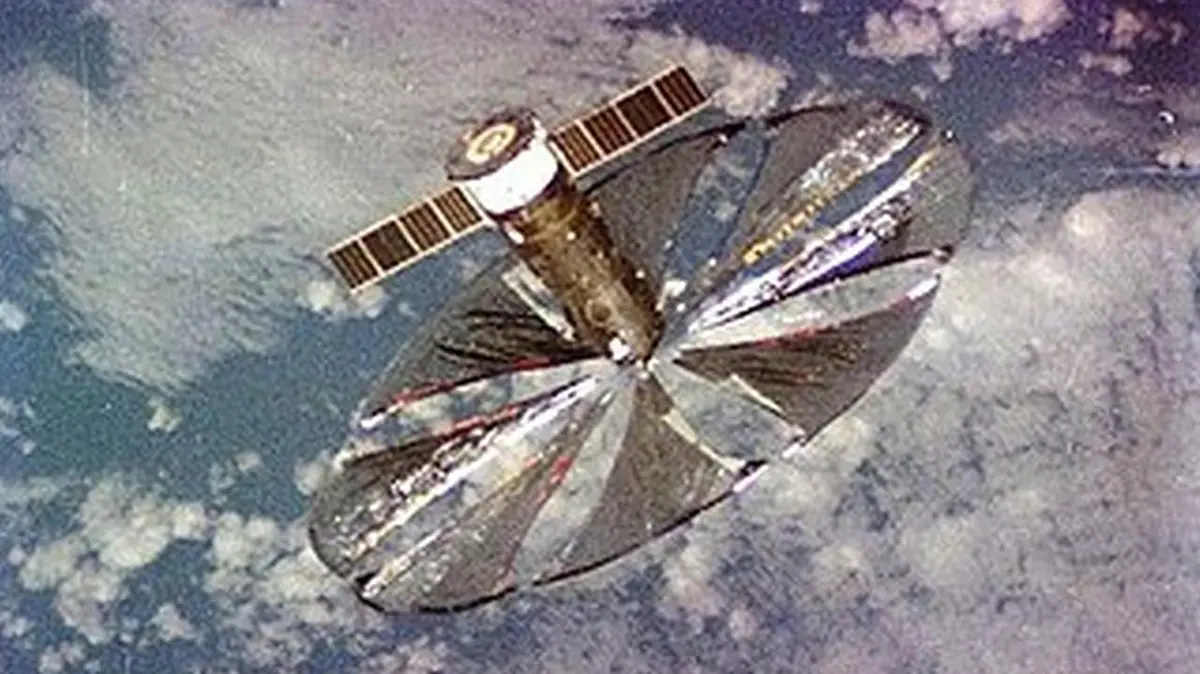
Eärendil-1 will carry a thin, highly reflective film, which motors will steer while the spacecraft moves around Earth.
The system works like a heliostat. A heliostat is a movable mirror that keeps sunlight aimed towards a chosen target.
Ordinary mirrors only change the direction of incoming light, and Eärendil-1 would change its angle continuously during each useful pass.
What did the regulator approve?
The Federal Communications Commission, or FCC, regulates satellite radio communications and related orbital operations under United States law.
Reflect Orbital filed its application on 1 July 2025. The FCC adopted and released its order on 9 July 2026.
The order carries call sign S00711 and authorises one non-geostationary satellite, and it does not approve a large future constellation.
The spacecraft must first enter an insertion orbit near 510 kilometres. This temporary path precedes its planned 625-kilometre operating orbit.
Orbital inclination measures tilt against the equator. Eärendil-1’s planned 88-degree inclination creates a near-polar path across many latitudes.
The licence lasts two years after orbital certification, and planned operations occupy about one year, followed by deorbiting activities.
Key distinction: The FCC approved communications and orbital operations for one spacecraft, and it did not approve every environmental effect.
What does non-geostationary mean?
A geostationary satellite appears fixed above one equatorial location. It completes each orbit in about 23 hours and 56 minutes.
Eärendil-1 will move through low Earth orbit instead, and observers would see it cross their sky during brief passes.
Low Earth orbit generally extends up to about 2,000 kilometres. Satellites there move much faster relative to the ground.
How could reflected sunlight be used?
- It could extend useful light for solar farms after local sunset.
- It could provide temporary lighting after disasters.
- It could illuminate remote work areas for short periods.
- It could test guidance and control for larger reflectors.
News reports describe an approximately 18-metre reflector, whose ground illumination would move as the satellite passes overhead.
This is not electricity generation inside the satellite. The mirror only redirects sunlight that would otherwise miss the selected area.
Why are astronomers concerned?
A bright moving object can enter telescope images. Reflected light can also create skyglow, meaning diffuse brightening beyond the ground target.
Optical astronomy studies very faint objects against a dark background. Even brief glare can spoil long exposures or survey measurements.
Many satellites together could create a larger cumulative effect, and this concern becomes important if future operators deploy extensive constellations.
Natural darkness supports astronomy, migrating animals and human sleep, but the FCC order did not decide those wider concerns.
How did the FCC handle these objections?
The American Astronomical Society sought rejection or delay, while more than 1,800 public letters reached the regulatory proceeding.
The FCC excluded visual brightness from its communications authority and therefore did not judge whether the projected light was acceptable.
The company promised coordination with relevant organisations. These include the National Aeronautics and Space Administration and National Science Foundation.
Coordination can help schedule observations or change mirror orientation. However, voluntary coordination differs from an enforceable brightness limit.
Do not confuse: Regulatory approval does not prove scientific usefulness or environmental safety. It confirms compliance within that regulator’s legal field.
What about space debris?
The FCC reviewed the company’s orbital debris plan, and the short licence includes time for controlled end-of-life manoeuvres.
Atmospheric drag is stronger in low Earth orbit than in higher orbits. A large, thin reflector may experience substantial drag.
Operators must still control orientation and avoid collisions, and failure could create debris or complicate tracking for other spacecraft.
Why is it called Eärendil?
Eärendil is a fictional mariner associated with a bright celestial light in J.R.R. Tolkien’s writings. The name is not an abbreviation.
Conclusion
Eärendil-1 will test whether orbital mirrors can deliver useful lighting while exposing regulatory gaps around night-sky protection.