
Why in news?
In May 2026 the eurozone’s annual inflation rate climbed to 3.2 percent, up from 3.0 percent in April, with energy and services prices pushing the increase. The month also saw preparations for Bulgaria’s entry into the euro area on 1 January 2026, bringing the total number of members to 21.
Background
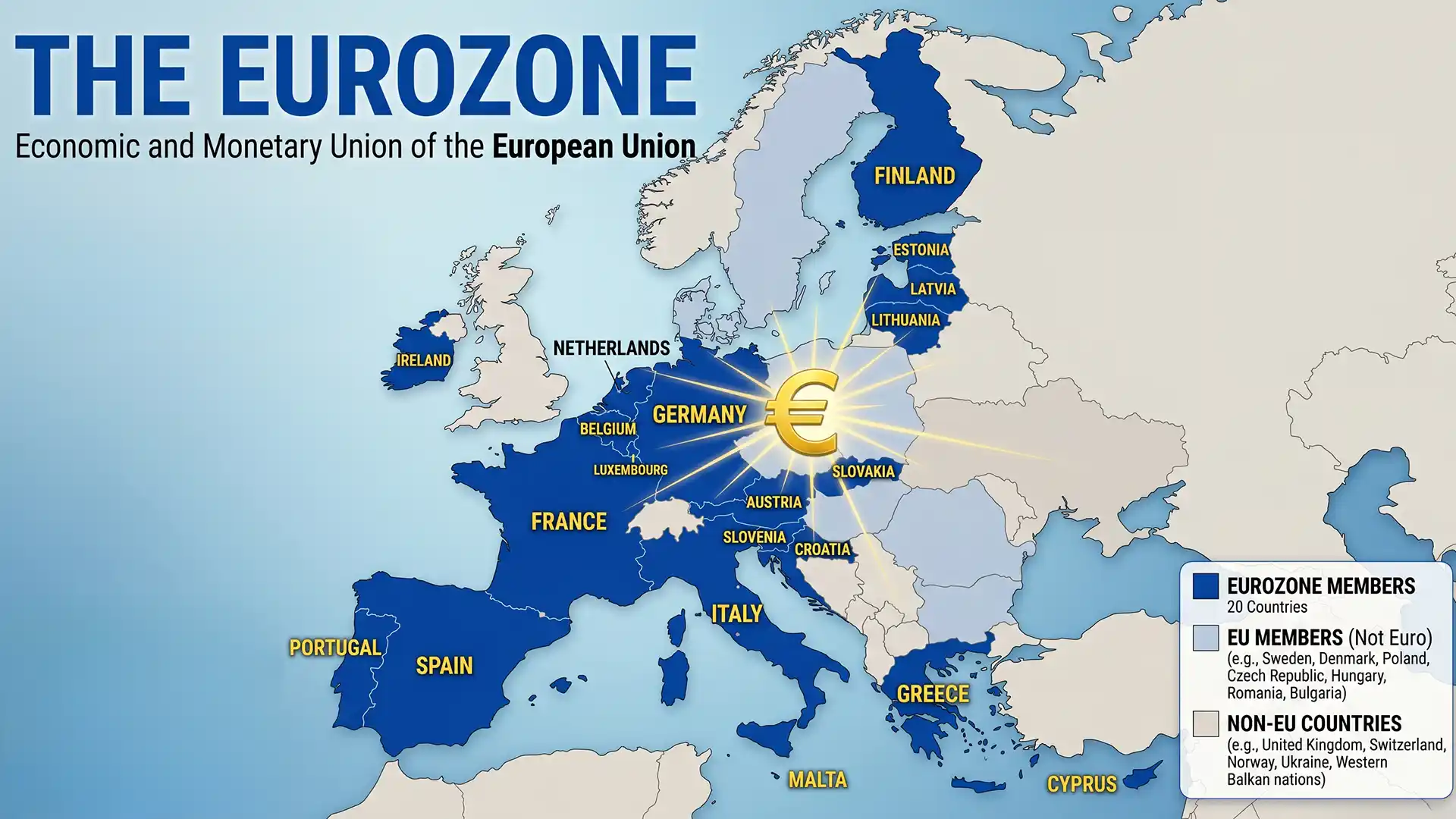
The eurozone, officially known as the euro area, consists of European Union (EU) countries that have adopted the euro (€) as their national currency. Launched in 1999 for non‑cash transactions and in 2002 as physical currency, the euro aims to facilitate trade, promote price stability and deepen economic integration. Not all EU members use the euro; countries must meet specific economic and legal criteria known as the Maastricht or convergence criteria. Once these are fulfilled, they adopt the euro and join the monetary union, ceding control over monetary policy to the European Central Bank (ECB).
Members of the eurozone
As of January 2026, the eurozone will consist of 21 EU countries:
- Austria
- Belgium
- Bulgaria (joining 1 January 2026)
- Croatia
- Cyprus
- Estonia
- Finland
- France
- Germany
- Greece
- Ireland
- Italy
- Latvia
- Lithuania
- Luxembourg
- Malta
- Netherlands
- Portugal
- Slovakia
- Slovenia
- Spain
Several EU members—Czechia, Hungary, Poland, Romania and Sweden—have not yet adopted the euro. Denmark has an opt‑out clause and retains the Danish krone.
Governance and institutions
- European Central Bank (ECB): Headquartered in Frankfurt, the ECB sets monetary policy for the eurozone. It manages interest rates, issues euro banknotes and aims to keep inflation close to, but below, 2 percent.
- Eurogroup: Finance ministers of eurozone countries meet regularly to coordinate economic policies. Decisions often require consensus among members.
- European Stability Mechanism (ESM): An emergency fund that provides financial assistance to member states in crisis. It was created after the sovereign debt crisis to stabilise markets.
Recent developments
- Inflation spike: Eurostat’s flash estimate for May 2026 showed inflation at 3.2 percent year‑on‑year. Energy prices surged by 10.9 percent due to geopolitical tensions and supply constraints, while services inflation rose to 3.5 percent. Food, alcohol and tobacco inflation eased to 2 percent.
- Bulgaria’s entry: In July 2025 the EU Council adopted legal acts approving Bulgaria’s adoption of the euro from 1 January 2026. The conversion rate is fixed at 1.95583 Bulgarian lev per euro. Bulgaria will become the 21st member of the eurozone.
- Convergence criteria: To join, countries must meet requirements on price stability, public finances (budget deficit and debt levels), exchange‑rate stability and long‑term interest rates. Denmark has negotiated an opt‑out, while other non‑euro countries are obliged to adopt the euro once they meet the criteria.
Conclusion
The eurozone remains a cornerstone of European integration, offering benefits such as easier trade and stable prices. At the same time, it must manage divergent economic conditions across member states. Rising inflation highlights the challenges facing the ECB, while Bulgaria’s upcoming entry illustrates the continued attraction of the single currency. Understanding how the eurozone functions helps explain Europe’s economic news and policies.