

Why in news?
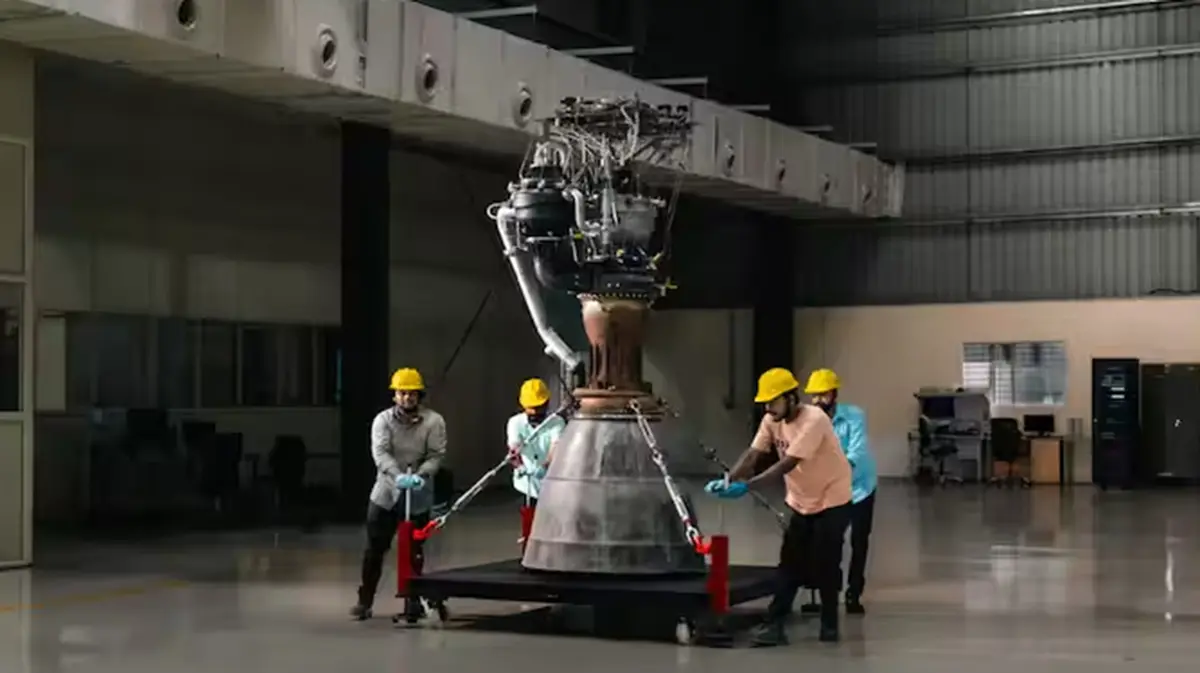
Bengaluru space start-up Astrobase reportedly unveiled integrated Everest engine hardware on 7 August 2026. The design uses liquid oxygen and methane; the company targets 800 kilonewtons of vacuum thrust. It describes a reusable engine using full-flow staged combustion.
The unveiling is an engineering milestone; it does not show a full-duration engine test or a flight.
The proposed engine and its propellants
A rocket produces thrust by accelerating high-pressure combustion gases through a nozzle. Everest is designed to burn liquid oxygen with methane. Liquid oxygen is often abbreviated as LOX and provides the oxidiser. Liquid methane provides the fuel.
Methane produces less soot than kerosene during clean combustion. Lower deposits can simplify repeated engine use.
Methane is also denser and easier to store than liquid hydrogen; however, both propellants still need cryogenic equipment.
Safe operation requires careful insulation and handling. Ground equipment must control leaks, ignition sources and rapid pressure changes. Astrobase lists a vacuum thrust target of 800 kilonewtons; it also gives a 50–110 per cent throttle range.
A three-dimensionally printed core is another listed design feature; these are company specifications and targets.
They are not yet independently demonstrated performance. Vacuum thrust also differs from sea-level thrust.
The company intends Everest for reusable launch vehicles. Restart capability, throttling and low wear would support that aim; however, reusability is a result for the entire vehicle. Landing, inspection and refurbishment all shape it.
An engine label alone proves no reusable operation. Repeated test and flight evidence is necessary.
Why full-flow staged combustion is demanding
Everest is designed around a full-flow staged-combustion, or FFSC, cycle; this differs from a conventional gas-generator engine. A gas generator burns a small propellant share to drive a turbopump; its exhaust is then discarded.
A staged-combustion engine sends turbine exhaust into the main chamber; this makes fuller use of the propellant.
The full-flow design uses separate fuel-rich and oxygen-rich preburners. They drive separate turbopumps.
Essentially all fuel and oxidiser pass through their respective turbines; both streams then enter the main combustion chamber. This arrangement can lower turbine temperature for a given power. It can also support high chamber pressure and efficient propellant use.
The cycle may suit repeated operation. Its engineering complexity is exceptionally high.
Two hot-gas paths need precise control. Oxygen-rich machinery exposes materials to severe ignition and oxidation risks.
Seals, bearings, valves and software must work within narrow margins. Start-up timing must also remain exact; a small instability can destroy hardware within fractions of a second. Integrated construction is therefore meaningful.
The harder evidence comes from instrumented firings and repeatability; hardware must survive the intended operating envelope.
What has been validated—and what has not
The Indian National Space Promotion and Authorisation Centre, or IN-SPACe, selected Astrobase in June 2026. Support comes through its Technology Adoption Fund. IN-SPACe material describes the Everest programme and intended specifications. Astrobase says the programme has entered hot-fire testing.
That wording does not establish a full-duration 800-kilonewton engine firing. Hot-fire testing can cover many different stages.
It may involve igniters, injectors, preburners or turbopumps; it may also cover sub-scale chambers or brief integrated runs.
The correct engineering evidence ladder
A credible path starts with material and component tests. Subsystem hot fires come next. Integrated starts must lead to full-duration firings, shutdowns, restarts and throttling. Stage-level tests and flight qualification follow.
Actual missions provide stronger evidence, while reusability requires repeated firings or flights. Inspection data must support every claim.
The unveiling belongs on this ladder. It is not the top rung.
Why the project matters for India
An indigenous high-thrust liquid engine would expand India’s private space capability. It would move beyond small propulsion units and satellite services; the design demands cryogenic turbomachinery and stable combustion. High-temperature alloys and precision valves are equally important.
Additive manufacturing, controls and test infrastructure complete the capability base. Successful subsystems can benefit other launch programmes.
The skills can also support industrial turbomachinery and advanced manufacturing. Benefits may therefore appear before flight.
Public support can help because engine development is capital-intensive. Failures are often part of the learning process; the corresponding responsibility is disciplined disclosure. Test conditions matter more than a rendering or target specification.
Useful data include duration, chamber pressure and restart count. Post-test hardware condition also reveals whether repeated use is plausible.
Payload claims are premature at this stage; public company and programme materials provide different figures.
Payload depends on the complete rocket, staging and mission profile; one engine cannot determine it. Private firms also need safe test ranges and predictable authorisation. Real missions are necessary for a durable launch ecosystem.
Cryogenic propulsion still creates safety and environmental duties. Methane leakage, noise and ground-system risk need regulation.
Local land use and spent-stage operations also matter. “Cleaner-burning” does not mean impact-free.
Conclusion
Everest is a technically ambitious Indian private project. Reaching integrated hardware is worth noting; its thrust, throttling and reusable operation remain design goals. They await transparent full-engine and flight demonstrations.
Lasting achievement will come from repeatable data and dependable missions; an unveiling alone cannot provide that evidence.