

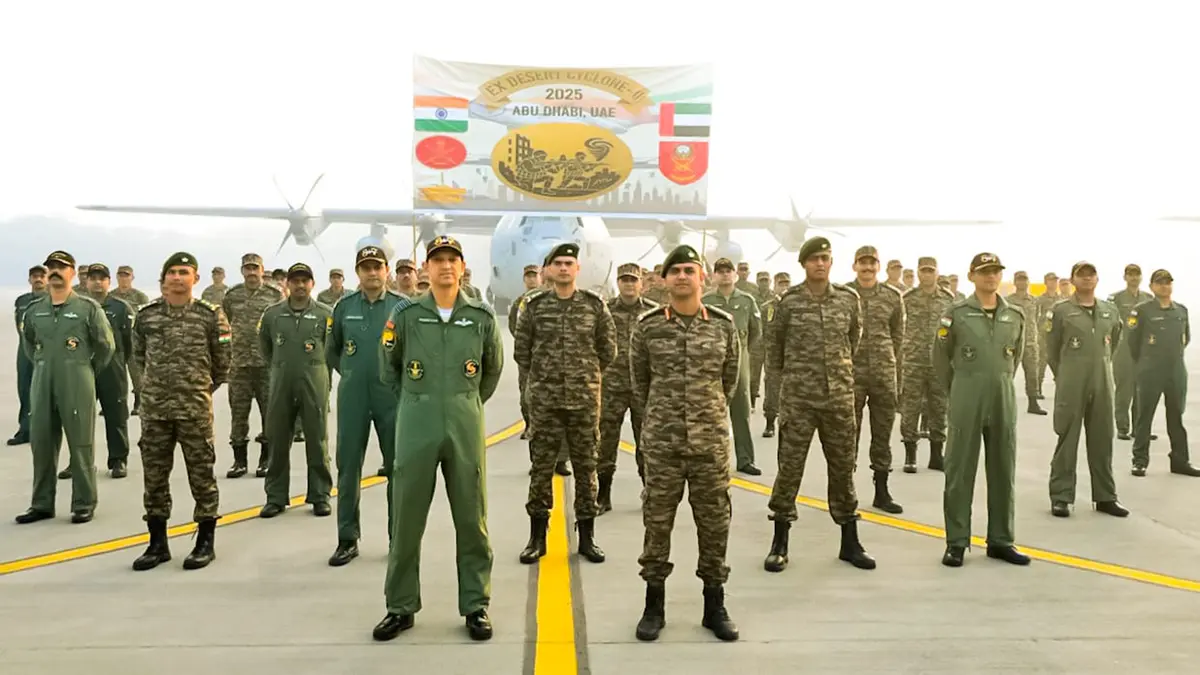
Why in news?
An Indian Army contingent of 45 soldiers from the Mechanised Infantry Regiment has travelled to the United Arab Emirates to participate in the second edition of the joint exercise Desert Cyclone II. Scheduled from 18 to 30 December 2025 at the Al Hamara training area near Abu Dhabi, the exercise will see Indian troops training alongside an equal number of personnel from the UAE Armed Forces. The aim is to improve interoperability in urban combat and counter‑terrorism scenarios.
Background
India and the UAE share close political and economic ties, and defence cooperation has grown steadily in recent years. The first edition of Exercise Desert Cyclone was held in Rajasthan, India, in January 2024. It focused on sub‑conventional operations under a United Nations mandate, including convoy protection, cordon‑and‑search drills and joint surveillance. The Indian Army’s participation in the second edition underscores the commitment to deepening military engagement and building synergy between the two armies.
Key aspects of Desert Cyclone II
- Urban operations training: Soldiers will practise movement and combat in built‑up areas, including room clearing, street fighting and securing critical infrastructure.
- Heliborne maneuvers: The exercise will integrate helicopters to insert troops, evacuate casualties and resupply units, honing coordination between ground and air assets.
- Use of unmanned systems: Unmanned aerial systems (drones) will assist in surveillance, reconnaissance and targeting, reflecting modern battlefield realities.
- Cultural exchange: Beyond drills, the exercise fosters understanding of each other’s tactics, culture and operational philosophy, strengthening trust.
Significance
- Enhanced interoperability: Joint training helps soldiers from both countries develop common procedures and communication protocols, enabling effective cooperation in peacekeeping and crisis situations.
- Strategic partnership: Defence exercises complement economic and diplomatic ties, signalling a shared commitment to regional stability in the Gulf and Indian Ocean regions.
- Experience sharing: India and the UAE can learn from each other’s experiences in counter‑insurgency, desert warfare and urban operations, contributing to professional growth.
Conclusion
Exercise Desert Cyclone II builds upon the lessons of the first edition and showcases the deepening defence partnership between India and the United Arab Emirates. By training together in realistic scenarios, the two armies enhance their readiness to conduct joint operations, support United Nations mandates and address shared security challenges.
Source: TH