

Why in news?
Exercise Pitch Black 2026 concluded in Australia on 7 August; the Indian Air Force joined the exercise from 20 July. India deployed Rafale fighters, C-17 Globemaster III transport aircraft and an IL-78 aerial refuelling aircraft.
What the exercise involved
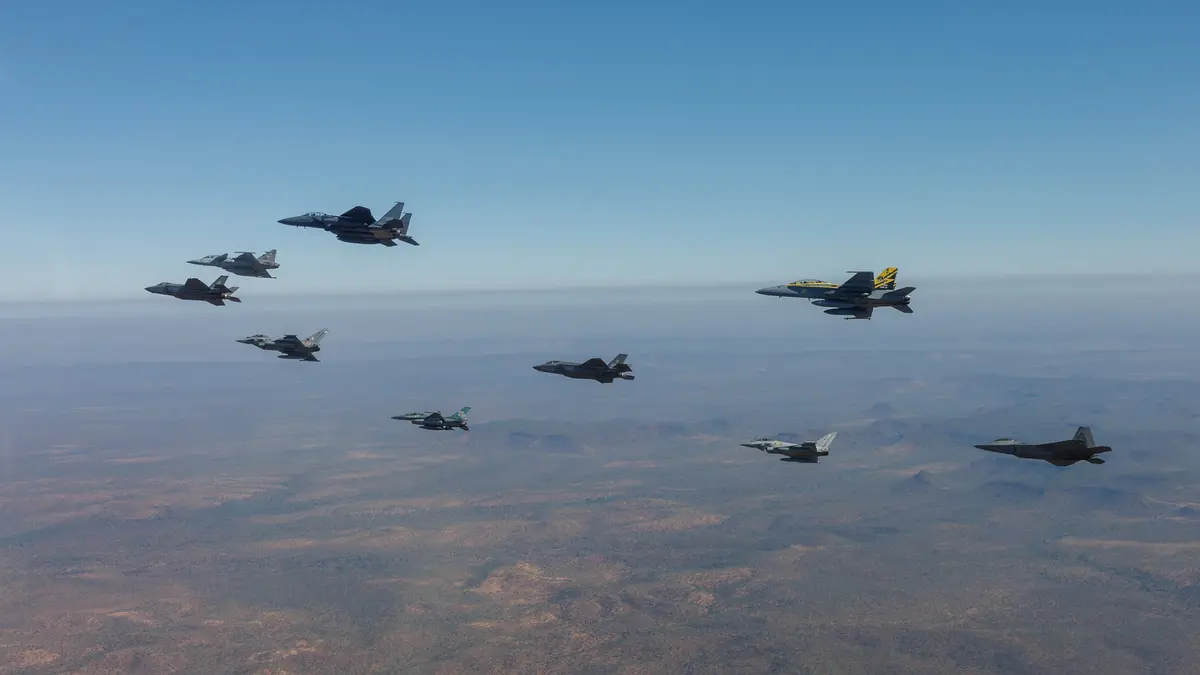
Pitch Black is the Royal Australian Air Force’s premier biennial multinational air combat exercise. Its name reflects extensive night flying over northern Australia. The 2026 edition involved about 100 aircraft and roughly 2,500 personnel. Australia hosted participants from 20 other countries.
Flying operated from Darwin and Tindal in the Northern Territory. Amberley in Queensland also supported the exercise.
Australian officials described this as one of the largest editions in the exercise’s 45-year history. Aircraft came from several Asian, European and Pacific partners.
India had earlier joined the 2018, 2022 and 2024 editions. Regular participation therefore reflects a sustained defence relationship, not a one-off deployment.
Why such exercises matter
Modern air operations rarely depend on fighters alone; they require tankers, transport aircraft, controllers, intelligence and secure communications. A large exercise tests whether these elements can work across different national procedures. It also exposes crews to unfamiliar aircraft and command arrangements.
The Indian package covered combat, strategic lift and aerial refuelling. This combination tested deployment over long distances and sustained operations away from home bases.
Night sorties add difficulty because visual references are limited. Crews must rely more heavily on instruments, planning and disciplined coordination.
Northern Australia offers large training areas and relatively uncongested airspace. These conditions permit complex formations that smaller ranges cannot safely accommodate.
Strategic significance
Interoperability does not mean that participating countries form a military alliance. It means their forces can communicate and coordinate when governments choose cooperation. That ability supports humanitarian relief, evacuation and maritime-security missions. It can also support combined combat operations under separate political decisions.
For India, the exercise connects operational learning with its wider Indo-Pacific partnerships. Australia gains experience working with a major regional air force.
Professional contact also builds familiarity below the political level; such links can reduce confusion during future contingencies.
What the exercise does not prove
An exercise demonstrates practised procedures under controlled conditions; it cannot establish wartime effectiveness by itself. Actual operations would involve political limits, hostile interference and uncertain logistics. Those pressures cannot be reproduced fully during training.
Conclusion
Pitch Black 2026 gave India a demanding setting for long-range and multinational air operations. Its value lies in tested coordination and professional learning; the exercise also illustrates a broader regional trend. Air forces increasingly train together while governments retain independent strategic choices.