
Why in news?
Argentina defeated England in a 2026 World Cup semi-final. Two Argentine players then displayed a territorial-claim banner. Its message concerned sovereignty over the disputed Falkland Islands. Football authorities began reviewing whether the display breached sporting rules.
Background
The Falkland Islands form an archipelago in the south-western Atlantic Ocean; Argentina calls the same territory the Islas Malvinas.
The United Nations uses “Falkland Islands (Malvinas)” in decolonisation work; the United Kingdom administers the islands as an Overseas Territory.
Argentina claims sovereignty over the islands and rejects continuing British administration.
Neutral usage: Different names reflect the sovereignty dispute; a careful account should recognise both.
What happened after the football match?
Argentina beat England 2–1 in the World Cup semi-final.
Lautaro Martínez and Giovani Lo Celso displayed a banner during celebrations.
It read “Las Malvinas son Argentinas.”
The Spanish sentence means “The Malvinas are Argentine.”
The International Football Association Board governs football’s playing laws; its Law 4 restricts political messages on players’ equipment.
The Fédération Internationale de Football Association governs world football; its official shortened name is FIFA.
World Cup stadium rules prohibit political banners; FIFA began reviewing the incident.
A review does not itself establish a final violation or punishment.
Argentina’s team displayed a similar banner before a 2014 friendly; FIFA later fined the Argentine association 30,000 Swiss francs.
Where are the islands?
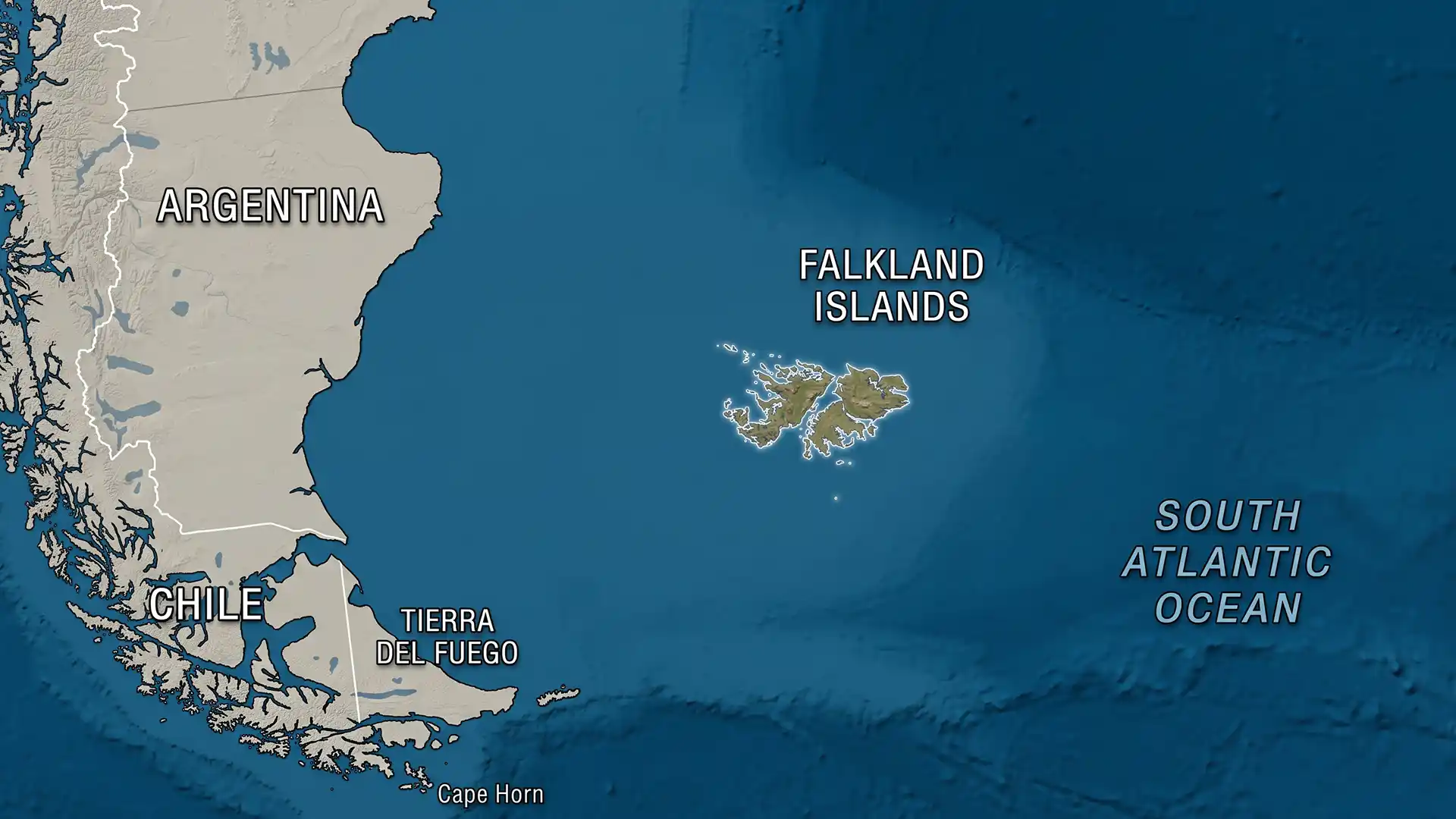
The islands lie east of southern South America in the South Atlantic; they consist of East Falkland and West Falkland.
Falkland Sound separates these two main islands; the territory also contains 778 smaller islands.
Correct island count: Official island records state two main islands and 778 smaller islands.
The total land area is about 12,173 square kilometres; Stanley, on East Falkland, is the capital.
More than three-quarters of residents live around Stanley; the terrain includes low hills, peatlands and treeless grasslands.
Strong winds and cool oceanic conditions shape the climate.
How did the sovereignty dispute develop?
- European sailors recorded the islands during the early modern period.
- France established Port Louis on East Falkland during 1764.
- Britain established Port Egmont on West Falkland soon afterwards.
- Spain acquired and renamed the original French settlement during 1767.
- Britain withdrew its settlement during 1774 but maintained its claim.
- Spanish administration ended during 1811 amid regional independence struggles.
- Buenos Aires asserted authority and supported settlement during the 1820s.
- Britain re-established its permanent administration over the islands during 1833.
- Argentina has continually disputed the legality of that action.
Britain says its earlier claim survived the 1774 withdrawal; Argentina says it inherited Spain’s rights after independence.
It regards the 1833 British action as an unlawful occupation; these competing historical narratives remain central to the modern dispute.
What has the United Nations done?
The United Nations listed the territory as non-self-governing during 1946; Britain is recorded as the administering power.
The Special Committee on Decolonization began examining the issue during 1964; General Assembly Resolution 2065 followed during 1965.
It recognised a sovereignty dispute between Argentina and the United Kingdom.
United Nations bodies have repeatedly encouraged a negotiated peaceful settlement.
The Special Committee continues requesting renewed bilateral negotiations.
Legal position: United Nations resolutions recognise a dispute; they have not awarded sovereignty to either claimant.
What happened during the 1982 war?
- Argentine forces invaded the islands on 2 April 1982.
- Britain sent a naval task force to recover the territory.
- Fighting occurred at sea, in the air and on land.
- Argentine forces surrendered at Stanley on 14 June.
- The armed conflict lasted 74 days before Argentine forces surrendered.
The war killed 649 Argentine personnel and 255 British personnel; three civilian islanders also died during the conflict.
Britain retained control, but the underlying sovereignty claim continued.
How are the islands governed today?
The islands have an elected Legislative Assembly and local government; the 2009 Constitution provides the present institutional framework.
Local authorities manage most internal public matters; the United Kingdom remains responsible for defence and foreign affairs.
A Governor represents the British monarch; the islands are not part of the United Kingdom itself.
They also remain outside Argentina’s present and effective territorial administration.
What happened in the 2013 referendum?
Islanders voted on their political status during March 2013; the question asked whether they wished to retain Overseas Territory status.
There were 1,513 votes in favour and three against; the favourable share was 99.8 per cent.
Turnout reached 92 per cent of registered voters; Britain presents this result as strong evidence of self-determination.
Argentina rejects the vote as deciding a territorial sovereignty question.
What the vote changed: It showed residents’ preference; it did not end the international sovereignty dispute.
Why do the two sides use different legal principles?
| United Kingdom’s emphasis | Argentina’s emphasis |
|---|---|
| Islanders have a right to self-determination | Argentina has inherited territorial title |
| Residents wish to retain present status | The 1833 British action was unlawful |
| Sovereignty cannot change against residents’ wishes | Territorial integrity limits a transplanted population’s claim |
Self-determination concerns a people’s freedom to choose political status; territorial integrity protects an existing state’s geographical unity.
The dispute persists because both sides prioritise different principles and histories.
What supports the islands’ economy?
- Fishing-licence revenue provides an important share of public income.
- Sheep farming produces wool and supports rural settlements.
- Tourism focuses upon wildlife, scenery and war history.
- Local government services and British defence activity support substantial employment.
Surrounding waters contain rich marine ecosystems and valuable squid fisheries; the region also supports penguins, albatrosses, seals and other seabirds.
Why does the dispute matter beyond the islands?
- It affects relations between Argentina and the United Kingdom.
- It raises difficult questions about decolonisation and self-determination.
- South Atlantic waters hold important fisheries and possible energy resources.
- The islands have strategic value near Antarctic sea routes.
- Sport can revive unresolved political memories before a global audience.
Conclusion
The football banner revived a dispute that can only be understood through geography, history and competing legal principles.