

Why in news?
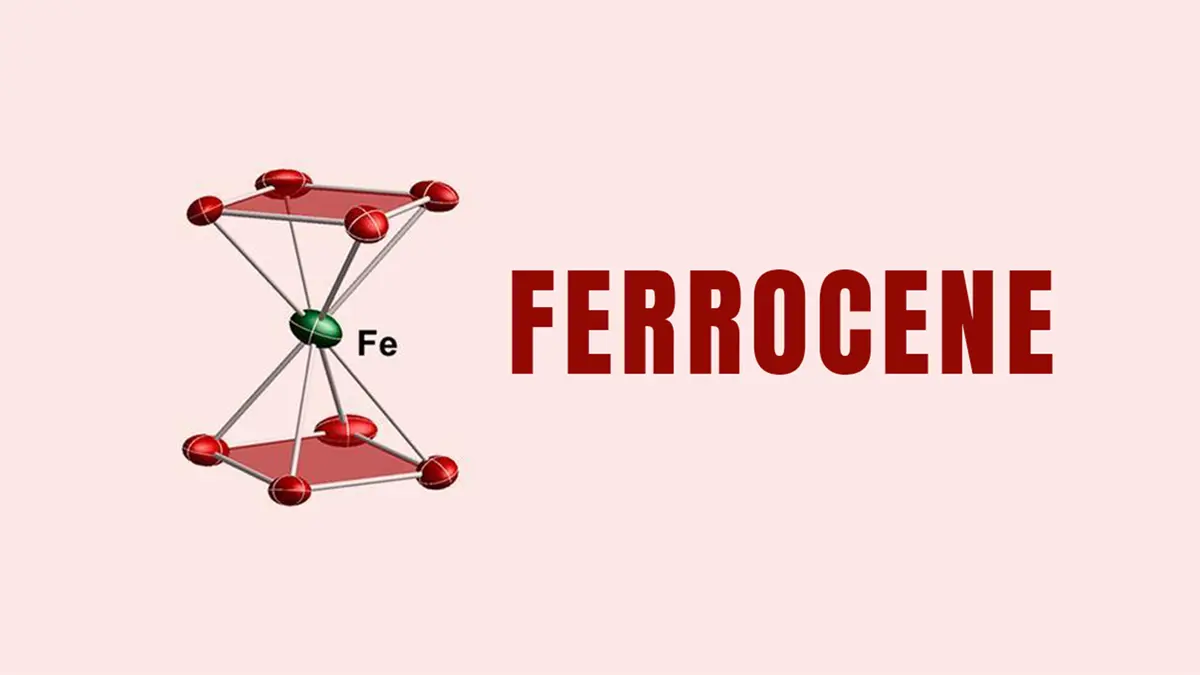
Researchers from IIT Madras and the Indian Institute of Science have synthesised a boron‑based analogue of ferrocene. Unlike classical ferrocene, which has an iron atom sandwiched between two carbon rings, the new compound replaces the carbon rings with five‑boron clusters bound to an osmium atom. The breakthrough demonstrates that stable “sandwich” compounds can exist without carbon, opening possibilities for designing novel materials.
Background
Ferrocene was discovered by accident in 1951 when chemists looking for a different product obtained an unusually stable orange powder. In 1952 Geoffrey Wilkinson and Ernst Fischer independently proposed that the iron atom is sandwiched between two flat cyclopentadienyl rings. X‑ray studies confirmed the structure, and their work led to a Nobel Prize in 1973. Ferrocene’s stability revolutionised organometallic chemistry and inspired thousands of “sandwich” complexes with metal centres and aromatic rings.
The new compound, formally written as (B5H10)Os(B5H10), replaces each carbon ring with a boron cluster (known as a pentaborane) and swaps iron for osmium. Boron cages are electron‑deficient, yet they form strong covalent bonds with metals. The experiment proved that these clusters can behave like aromatic rings when bonded to a metal, broadening the concept of sandwich complexes beyond carbon chemistry.
Key features and implications
- Carbon‑free framework: The absence of carbon distinguishes this compound from traditional metallocenes. It shows that aromaticity – the electron sharing that stabilises rings – can arise in boron cages.
- Stability: Computational studies and experiments indicate that the boron–osmium bonds are strong and the molecule remains intact under moderate conditions, with the metal-ring bonding in fact stronger than in ferrocene, the boron rings sitting closer to the osmium than the carbon rings do in ferrocene.
- Potential applications: Carbon‑free sandwich complexes could lead to new catalysts, sensors and materials with unusual electronic properties. They may also inspire research into boron‑rich clusters for hydrogen storage or superconductors.
Conclusion
The discovery of a boron–osmium sandwich compound shows that the chemistry of “metallocenes” is broader than once imagined. By transcending carbon, scientists can explore new structures and properties. This work continues the tradition begun by ferrocene’s accidental discovery more than seven decades ago and points toward a rich frontier in organometallic research.