

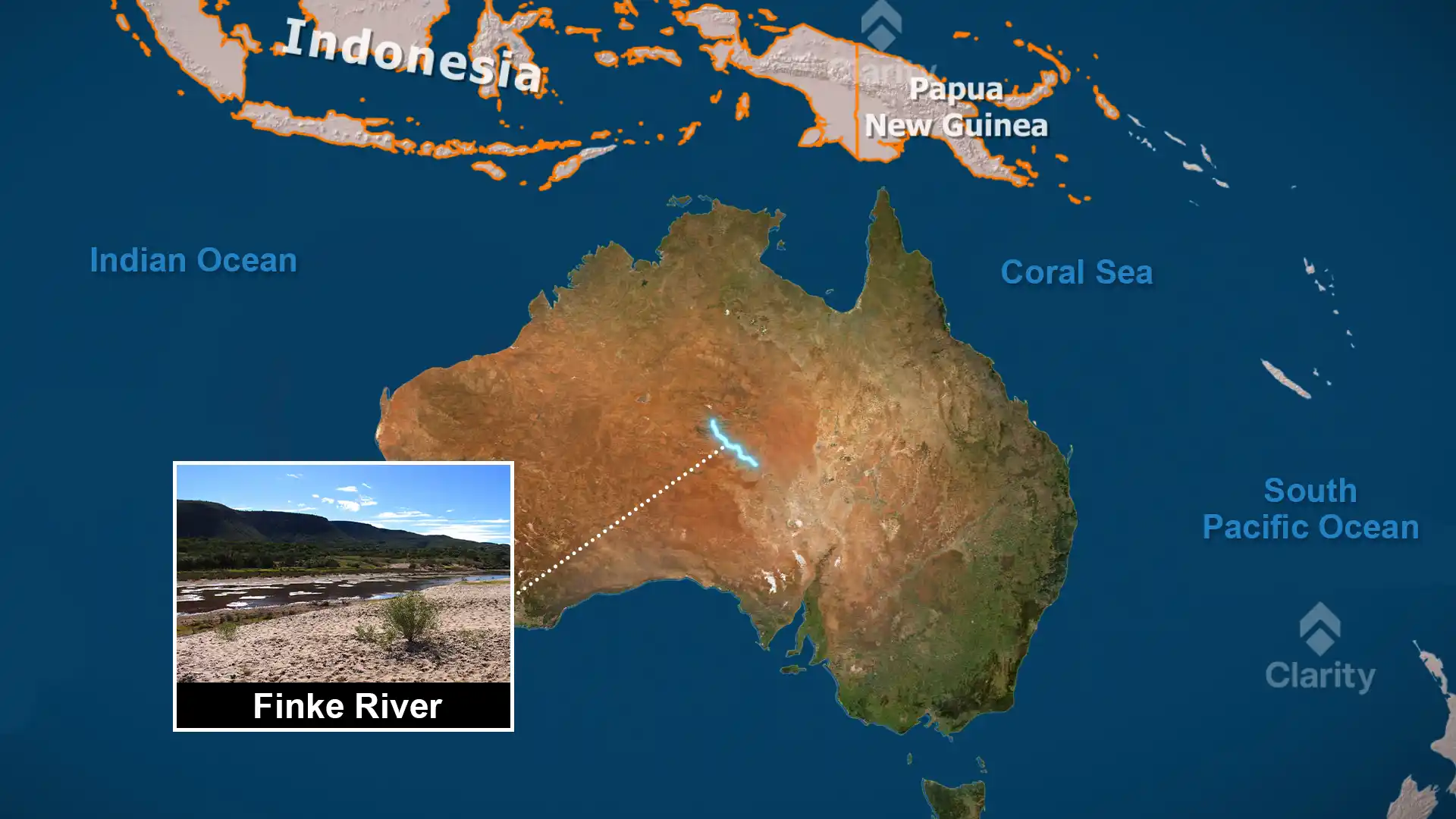
Why in news?
Scientific discussions about the age of the Finke River in Australia resurfaced recently after researchers suggested it could be up to 400 million years old. This ancient watercourse has persisted through multiple geological upheavals and is often cited as the oldest river on Earth.
Background
The Finke River flows intermittently through the arid heart of Australia. It begins in the Northern Territory’s MacDonnell Ranges and meanders for more than 640 kilometres through the Simpson Desert before draining into the Lake Eyre basin. Aboriginal Arrernte people call the river “Larapinta.” Geological evidence shows that as the MacDonnell Ranges rose around 300 million years ago, the river cut across them rather than being diverted. This rare phenomenon, known as cross‑axial drainage, indicates that the Finke predates the mountains themselves. Australia’s tectonic stability has allowed the river valley to survive largely undisturbed for hundreds of millions of years.
Key facts
- Length: The river’s main channel runs for roughly 640 kilometres, though it often breaks into waterholes and dry channels that reconnect during heavy rains.
- Age estimates: Geologists estimate the river to be between 300 million and 400 million years old, making it older than the Himalayas and contemporaneous with the formation of the first reptiles.
- National park: The Finke Gorge National Park in the Northern Territory protects part of the river and the unique Palm Valley, home to some 3,000 adult red cabbage palms (Livistona mariae), a species isolated from its relatives for millions of years.
- Intermittent flow: Because central Australia is dry, the Finke flows only after rainstorms, leaving behind permanent waterholes that sustain desert wildlife and Indigenous communities.
Why it matters
- Geological heritage: The river offers a window into Earth’s deep past. Its preserved meanders illustrate how landscapes evolve over immense time‑scales.
- Biodiversity refuge: Waterholes along the Finke provide refuge for native fish, reptiles and birds in an otherwise arid region. Protecting these habitats helps conserve unique desert species.
- Cultural significance: The Arrernte people have lived along the Larapinta for thousands of years, and the river features prominently in their Dreaming stories and ceremonial life.