

Why in news?
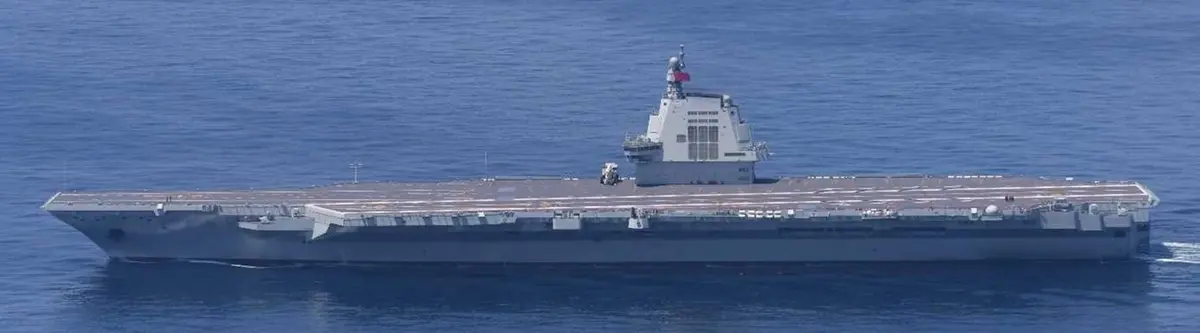
The People's Liberation Army Navy (PLAN) of China formally inducted the aircraft carrier Fujian after extensive sea trials. The carrier's entry into service marks a major milestone in China's naval modernisation and has implications for power projection in the Indo-Pacific region.
Background
- Fujian is China's third aircraft carrier and the first to be fully designed and built domestically. It follows the carriers Liaoning (a Soviet-built vessel acquired from Ukraine and rebuilt) and Shandong (China's first indigenous carrier).
- The carrier is named after the southeastern province of Fujian, which faces Taiwan, reflecting China's strategic messaging.
Key features
- Catapult launch system: Fujian is the first Chinese carrier equipped with an electromagnetic catapult launch system. This allows it to launch heavier and fully fuelled aircraft, including airborne early-warning planes, rather than relying on a ski-jump ramp. Only the US Navy's Gerald R. Ford-class carriers have similar technology.
- Displacement and range: The ship has a full-load displacement of about 80,000 tonnes and an estimated operational range of 8,000-10,000 nautical miles. Unlike US carriers, it is not nuclear-powered, which limits its endurance.
- Aircraft capacity: China has not officially disclosed how many aircraft the carrier will operate, but experts estimate 40-60 aircraft, compared with 60-70 on US carriers. It has two aircraft elevators and three electromagnetic catapults, allowing quicker launch cycles.
- Flat deck: The carrier has a flat flight deck rather than the ski-jump ramps used on China's earlier carriers. This configuration, combined with catapults, enables a wider variety of aircraft operations.
Significance
- The induction of Fujian gives China the second-largest fleet of aircraft carriers after the United States, although its capability still lags US super-carriers.
- It enhances China's ability to project power far from its shores, support naval aviation training and potentially operate in the Taiwan Strait and wider Indo-Pacific.
- The use of electromagnetic catapults signals China's progress in military technology and underscores its ambition to build a blue-water navy.
Sources: The Indian Express