

Why in news?
Researchers described a new freshwater crab from Karnataka. They named it Ghatiana karnataka after the state where it was found.
The discovery
Beat forester Ajmeer K first encountered the crab in the Mavinakaru range. The range lies within Mookambika Wildlife Sanctuary in Udupi district.
He worked with Santanu Mitra of the Zoological Survey of India. Their peer-reviewed description appeared in the journal Species in 2026.
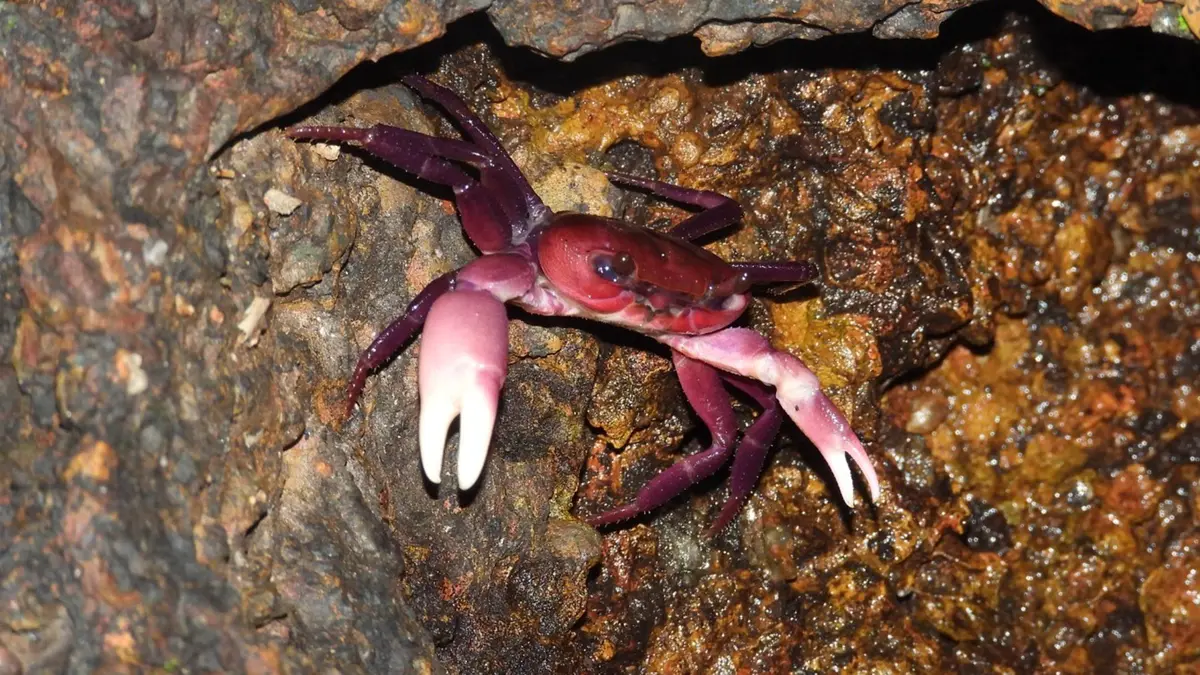
The crab has a dark purple body and lighter pink claws. Colour alone, however, does not establish a species.
Taxonomists rely on stable anatomical characters and comparisons with related specimens. The formal description allows other researchers to test the diagnosis.
Habitat and geographic setting
Mookambika Wildlife Sanctuary occupies the central Western Ghats near Karnataka’s coast. Udupi lies between these mountains and the Arabian Sea.
The landscape contains evergreen and semi-evergreen forests, laterite formations and perennial streams. The crab was observed close to moist stream habitats.
During the monsoon, individuals used laterite rock openings. In drier periods, they were also found in damp tree cavities.
What the name establishes
This is a newly described species, not a newly created organism. Publication gives a scientific name to a distinct population already living there.
Why the record matters
All known members of Ghatiana are endemic to the Western Ghats. The new description raises the genus to fifteen recognised species.
Such restricted distributions can make freshwater crabs vulnerable to local habitat change. Stream pollution or altered water flow may affect an entire population.
Forest protection alone may not secure aquatic microhabitats. Conservation must also maintain water quality, riparian cover and natural seasonal flows.
Further surveys should determine the crab’s actual range and abundance. A discovery site does not define its complete distribution.
Local field staff can make important scientific contributions. Their repeated observations often reveal seasonal behaviour missed during short research visits.
Voucher specimens should remain accessible in a recognised scientific collection. Future taxonomists can then re-examine the defining characters.
Stream-level mapping would guide sanctuary management more precisely. It could identify breeding sites and seasonal refuges before new disturbance occurs.
Research should also examine diet, reproduction and movement. Those data would connect the formal description with practical conservation decisions.
A small species with a large message
The discovery shows how much Western Ghats freshwater diversity remains undocumented. It also links taxonomy directly with habitat management.
Conclusion
Ghatiana karnataka strengthens Karnataka’s biodiversity record. Its protection now requires sound surveys and healthy headwater habitats.